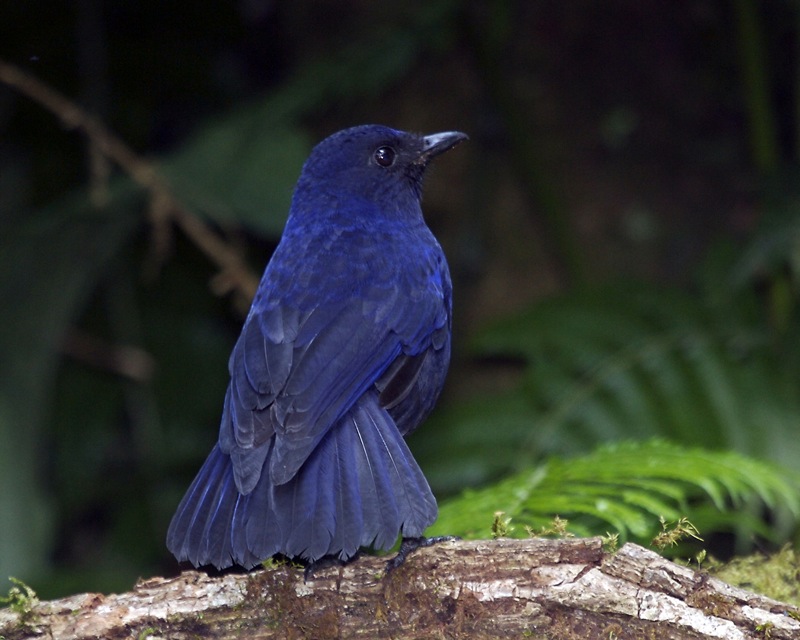
Javan Whistling-Thrush
Myophonus glaucinus
Order: Passeriformes / Family: Muscicapidae
Wikimedia Commons
About the Javan Whistling-Thrush
The Javan Whistling-Thrush, scientifically known as Myophonus glaucinus, is a captivating songbird found predominantly on the island of Java in Indonesia. This thrush belongs to the family Muscicapidae, a group known for its diverse and melodious members. Its significance lies in its role as both an indicator of forest health and a contributor to the rich soundscape of its native habitats. Typically inhabiting subtropical or tropical moist lowland forests, as well as mountain forests, the Javan Whistling-Thrush has adapted to a variety of ecological niches within these regions. The lush, dense forests of Java provide an ideal habitat for this species, offering ample food resources and suitable nesting sites. This bird's presence often indicates a healthy, biodiverse ecosystem, as it thrives in undisturbed forest environments. The Javan Whistling-Thrush plays a vital ecological role by controlling insect populations through its diet and by contributing to the pollination and seed dispersal of various plant species. Seasonally, these birds are known to move altitudinally within their range, seeking different elevations based on food availability and climatic conditions. In the wet season, they may descend to lower elevations where insects are more abundant, while in the dry season, they might be found at higher altitudes, taking advantage of the cooler, more humid conditions. The Javan Whistling-Thrush's adaptability to different habitats across Java highlights its ecological importance and the need for its conservation. Unfortunately, the species faces threats from habitat destruction due to deforestation and land conversion for agriculture. Despite these challenges, the Javan Whistling-Thrush remains a beloved figure among bird enthusiasts and nature lovers, celebrated for its stunning appearance and enchanting song.
The Javan Whistling-Thrush belongs to the family Muscicapidae, within the order Passeriformes. These birds typically live typically around 5-7 years, with some reaching up to 10 years in the wild..
How to Identify a Javan Whistling-Thrush
The Javan Whistling-Thrush is easily recognizable by its vibrant blue plumage, which covers most of its body. The adult birds exhibit a deep, iridescent blue on the head, back, and wings, while their underparts are slightly paler. This coloration is particularly striking in sunlight, when the feathers shimmer with an almost metallic quality. In contrast, juveniles display a duller, more muted blue with a slight brownish tinge, particularly on the wings and back, which helps them blend into their forest surroundings. Males and females are similar in appearance, making it difficult to distinguish between the sexes in the field. However, subtle differences can be noted, with males often having slightly brighter plumage and a more pronounced iridescence. When observing the Javan Whistling-Thrush, birders should note its size and shape, as it is a medium-sized thrush with a robust body and strong legs, adapted for foraging on the forest floor. In flight, the bird shows a strong, direct flight pattern with broad wings and a slightly rounded tail. Its perching posture is typically upright, with the bird often seen on low branches or rocks as it surveys the forest for food. One might confuse the Javan Whistling-Thrush with other species in the Myophonus genus, such as the Blue Whistling-Thrush, but the Javan species can be distinguished by its more uniform blue coloring and its preference for specific Javan habitats.
Having trouble telling birds apart? Upload a photo to our bird identification tool for an instant species match.
Javan Whistling-Thrush Habitat and Range
Preferred Habitat
The Javan Whistling-Thrush primarily inhabits the tropical and subtropical moist forests of Java, thriving in both lowland and montane regions. These forests are characterized by dense canopy cover, a rich understory, and abundant insect life, which provides ample food for the species. Typically found at elevations ranging from sea level up to 2,500 meters, the Javan Whistling-Thrush adapts to various forest types, including primary and secondary growth areas. While primarily a forest-dwelling bird, it can occasionally be spotted in more open areas near forest edges, especially during foraging excursions. Unlike some bird species that have adapted to urban environments, the Javan Whistling-Thrush tends to avoid heavily urbanized areas, preferring the seclusion and resources offered by its forest habitats. During the dry season, these birds may move to higher elevations where moisture is more readily available, while in the wet season, they may descend to lower areas to exploit the increased abundance of insects. This altitudinal migration allows them to optimize their food intake throughout the year.
Geographic Range
The Javan Whistling-Thrush is endemic to the Indonesian island of Java, meaning it is found nowhere else in the world. Its range covers both the western and eastern parts of Java, although it is more common in central and western regions where forests remain relatively intact. The bird's distribution is closely tied to the availability of suitable forest habitats. During the breeding season, the Javan Whistling-Thrush is found in higher densities within the mountainous regions of Java, where the cooler temperatures and abundant food resources provide optimal conditions for raising young. There is no evidence of long-distance migration in this species, as it primarily exhibits altitudinal movements in response to seasonal changes. The population density of the Javan Whistling-Thrush is highest in protected areas such as national parks and conservation reserves, where forest ecosystems are preserved. However, outside these areas, habitat loss due to deforestation and development poses a significant threat to the species, leading to fragmented populations and reduced range.
Want to know which birds visit your area? Browse our backyard birds by location guides for region-specific species lists.
What Does the Javan Whistling-Thrush Eat?
The diet of the Javan Whistling-Thrush consists primarily of insects, making it an efficient insectivore. Its foraging behavior involves meticulously searching the forest floor and low vegetation for a variety of invertebrates, including beetles, caterpillars, ants, and spiders. The thrush employs a methodical approach to foraging, using its keen eyesight to detect movement and its strong bill to overturn leaves and debris to uncover hidden prey. During the wet season, when insect populations surge, the Javan Whistling-Thrush takes advantage of the abundance, increasing its feeding activity to store energy for the drier months. While insects form the bulk of its diet, the Javan Whistling-Thrush occasionally supplements its nutrition with small fruits and berries found within its forest habitat. This opportunistic feeding strategy allows it to exploit a range of food sources, ensuring survival even when insects are less plentiful. The bird's feeding schedule generally peaks during the early morning and late afternoon, times when insect activity is high and temperatures are more favorable.
Javan Whistling-Thrush Behavior and Social Structure
The Javan Whistling-Thrush exhibits a variety of behaviors that reflect its adaptability and social nature. It is generally a solitary or paired bird, although small family groups may be observed during the breeding season. Territoriality is a significant aspect of its behavior, with males often engaging in vocal displays and physical posturing to defend their territory from intruders. These displays are particularly prominent during courtship, as males use their rich, melodious songs to attract mates and establish dominance over their area. Flocking behavior is rare in this species, as it tends to maintain clear territories and prefers the company of its mate or immediate family. In response to predators, the Javan Whistling-Thrush employs a series of alarm calls to alert nearby birds of potential danger. Its keen sense of awareness and agility allow it to evade many predators, as it can quickly disappear into the dense foliage of its forest home. Daily activity patterns are largely diurnal, with peak activity occurring in the early morning and late afternoon. During these times, the bird is most active in foraging and vocalizing, while it typically seeks shelter during the hottest part of the day.
Javan Whistling-Thrush Nesting and Reproduction
Nesting habits of the Javan Whistling-Thrush involve the construction of cup-shaped nests, typically located on ledges, in crevices, or on branches of trees within dense forest. The female primarily builds the nest using a combination of moss, leaves, and twigs, creating a secure and camouflaged environment for the eggs. A typical clutch consists of two to three eggs, which the female incubates for approximately 14-16 days. During this period, the male plays a crucial role in providing food and protection. After hatching, both parents participate in feeding the chicks, ensuring they receive a steady supply of insects and other invertebrates. The fledging period lasts around 14-18 days, during which the chicks develop rapidly, gaining strength and agility to leave the nest. The Javan Whistling-Thrush typically produces one to two broods per year, depending on environmental conditions and food availability. Parental care continues even after fledging, with young birds often staying close to their parents as they learn to forage independently.
Javan Whistling-Thrush Sounds and Vocalizations
The primary song of the Javan Whistling-Thrush is a rich, melodious sequence of notes that varies in rhythm and pitch. It is characterized by a series of clear, flute-like whistles that resonate through the forest, often echoing for considerable distances. This song serves multiple purposes, including attracting mates and establishing territorial boundaries. In addition to its song, the Javan Whistling-Thrush produces a variety of call notes and alarm calls, which are typically sharper and more abrupt in tone. These calls are used to communicate with mates and alert other birds to potential threats. During the dawn chorus, the Javan Whistling-Thrush is particularly vocal, contributing to the vibrant soundscape of the forest with its distinctive song. Its vocalizations can be compared to those of other thrushes, although the Javan Whistling-Thrush's song is notably more complex and varied, reflecting the bird's social and territorial behaviors.
Interesting Facts About the Javan Whistling-Thrush
- 1The Javan Whistling-Thrush is one of the few bird species endemic to Java, highlighting its unique ecological niche.
- 2Despite its striking blue plumage, the Javan Whistling-Thrush is often difficult to spot in its dense forest habitat.
- 3The melodious song of the Javan Whistling-Thrush can be heard up to half a mile away in the right conditions.
- 4Javan Whistling-Thrushes are known to be highly territorial, with males often engaging in vocal duels.
- 5During the breeding season, the Javan Whistling-Thrush's song becomes more frequent and varied to attract mates.
- 6The bird's diet primarily consists of insects, but it occasionally consumes small fruits to supplement its nutrition.
- 7Conservation areas on Java play a crucial role in protecting the Javan Whistling-Thrush's habitat from deforestation.
Javan Whistling-Thrush Conservation Status
The Javan Whistling-Thrush is currently listed as Near Threatened on the IUCN Red List, with its population trend showing a decline. The primary threats to this species include habitat loss due to deforestation, agricultural expansion, and urban development on the island of Java. As forests are cleared for human activities, the Javan Whistling-Thrush faces fragmentation of its habitat, leading to isolated populations and decreased genetic diversity. Conservation efforts are underway to protect the remaining forest areas on Java, with several national parks and reserves established to safeguard key habitats. These protected areas are crucial for the survival of the Javan Whistling-Thrush, providing refuge from the pressures of habitat destruction. Historical population changes have been influenced by the island's development and land use changes, emphasizing the need for continued conservation focus. Raising awareness about the ecological importance of the Javan Whistling-Thrush and its role in maintaining healthy forest ecosystems is vital for garnering support for its protection.