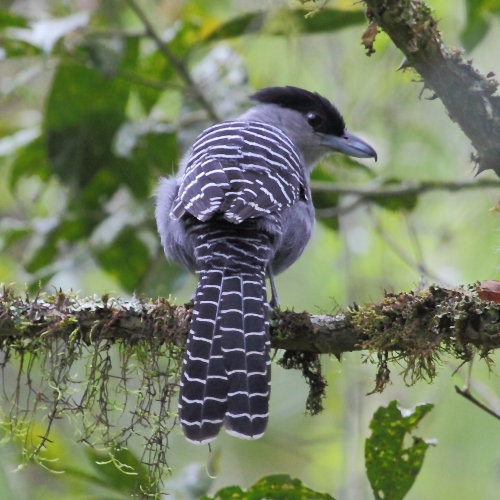
Jet Antbird
Cercomacra nigricans
Order: Passeriformes / Family: Thamnophilidae

Wikimedia Commons
About the Jet Antbird
The Jet Antbird, scientifically known as Cercomacra nigricans, is a striking member of the Thamnophilidae family, noted for its deep black plumage and contrasting white wing markings. This distinctive bird inhabits the dense undergrowth of tropical forests and is most commonly found in lowland and foothill regions across northern South America. Its presence is often indicated by its rich and clear vocalizations, which echo through the forest understory.
Beyond its appearance, the Jet Antbird plays a vital role in its ecosystem. By preying on various insects, it helps control insect populations and maintains the ecological balance. It is frequently observed following swarms of army ants, capturing prey that flees from the advancing ants. This behavior underscores its importance as both a predator and a participant in the complex food web of tropical forests.
The Jet Antbird's ecological significance extends to its role as an indicator species. Changes in its population can signal shifts in forest health, making it a valuable species for conservationists monitoring the impacts of deforestation and habitat degradation. As a species largely confined to pristine forest environments, the Jet Antbird highlights the importance of preserving these habitats to maintain biodiversity.
The Jet Antbird belongs to the family Thamnophilidae, within the order Passeriformes. These birds typically live average 5 years with a max recorded of 8 years.
How to Identify a Jet Antbird
The Jet Antbird is a medium-sized bird, measuring about 14-16 cm in length. Its plumage is predominantly black, with males exhibiting a glossy sheen that sets them apart from other similarly sized antbirds. Both sexes display prominent white wing bars, which are visible when the bird is in flight or perched with wings slightly open. These wing bars serve as a key identification feature, especially in dimly lit forest understories.
Females of the species are slightly duller in coloration, with a more subdued sheen compared to males. Juveniles resemble females but often exhibit a brownish tinge to their otherwise black feathers. The Jet Antbird's stout bill and strong legs are adapted for foraging within dense vegetation, allowing it to maneuver skillfully through its habitat.
In terms of similar species, the Jet Antbird can be confused with the Black Antbird (Cercomacra serva) but can be differentiated by its more pronounced white wing bars and slightly larger size. Its perching posture is typically upright, with a slightly cocked tail, which aids birdwatchers in distinguishing it from other antbirds.
Having trouble telling birds apart? Upload a photo to our bird identification tool for an instant species match.
Jet Antbird Habitat and Range
Preferred Habitat
The Jet Antbird thrives in dense tropical and subtropical forests, particularly in lowland and foothill areas. It is frequently associated with mature secondary forests where the understory is rich and varied. This bird is typically found at elevations ranging from sea level to about 1,500 meters, though it generally favors lower elevations.
The species exhibits some degree of habitat flexibility, occasionally venturing into degraded forests and forest edges, but it remains predominantly tied to pristine jungle environments. Unlike some antbird species, the Jet Antbird is not commonly found in urban areas, as it requires thick vegetation to thrive.
Seasonally, the Jet Antbird does not migrate but may shift its territory slightly within a forest to exploit seasonal changes in prey availability. Its presence in various forest types underscores its adaptability to different tropical forest habitats, although it remains largely reliant on areas with substantial understory growth.
Geographic Range
The Jet Antbird's range is predominantly restricted to tropical regions in South America. It is commonly found in countries such as Brazil, Venezuela, Colombia, and Guyana. Within these regions, the bird favors the Amazon Basin and the adjacent lowland areas, where its preferred forest habitat is abundant.
While the Jet Antbird does not undertake long-distance migrations, it may engage in local movements to track areas of higher prey density. Its range does not extend into temperate zones, remaining confined to the humid and warm climates of the tropics.
Population densities tend to be higher in continuous stretches of forest, such as those found in the Amazon Basin. However, deforestation poses a significant threat, and the loss of suitable habitat could lead to population declines in fragmented forest areas. Conservation efforts are crucial in maintaining the habitats that support the Jet Antbird's distribution.
Want to know which birds visit your area? Browse our backyard birds by location guides for region-specific species lists.
What Does the Jet Antbird Eat?
The Jet Antbird primarily feeds on insects and other small arthropods, which it captures in the dense foliage of the forest understory. Its diet includes ants, beetles, spiders, and occasionally small lizards. This bird is particularly adept at exploiting army ant swarms, capturing insects that attempt to escape the ants.
Seasonal variations in insect populations lead to slight shifts in the Jet Antbird's diet. During wetter months, when insect activity peaks, the bird may expand its foraging range and increase its dietary intake. In drier periods, it relies more heavily on the abundant ants and beetles available within its territory.
Foraging typically occurs throughout the day, with peak activity during the early morning and late afternoon. The Jet Antbird employs a gleaning technique, meticulously picking prey from leaves and branches, often pausing briefly before darting to another spot in search of its next meal.
Jet Antbird Behavior and Social Structure
The Jet Antbird is predominantly solitary or found in monogamous pairs, engaging in cooperative behaviors when foraging. It is highly territorial, with pairs defending their patch of forest vigorously against intruders. Territorial disputes often involve vocalizations and visual displays, with the bird puffing its plumage to appear larger and more intimidating.
During the breeding season, which aligns with the wet season, males engage in courtship displays that include singing from prominent perches and performing short flights to showcase their glossy plumage. Once paired, the Jet Antbird remains with its mate for the duration of the breeding season.
The species demonstrates a keen awareness of its environment, responding swiftly to potential threats. It employs a series of sharp alarm calls to alert its mate or any nearby conspecifics to the presence of predators such as snakes or raptors. Daily activity peaks at dawn and dusk, with the bird spending much of the midday period resting or preening within the dense foliage.
Jet Antbird Nesting and Reproduction
Jet Antbirds construct cup-shaped nests from twigs, leaves, and other plant materials, typically placing them low in the understory vegetation. These nests are often well-concealed within thickets or dense foliage, providing protection from predators.
The typical clutch size for the Jet Antbird is two eggs, which are incubated primarily by the female. The incubation period lasts approximately 14 days, during which time the male may assist by bringing food to the nest. Both parents participate in feeding the chicks after hatching.
Fledging occurs about 12 to 15 days after hatching, with young birds remaining under parental care for a few weeks post-fledging. The Jet Antbird typically raises one brood per year, though in areas with particularly favorable conditions, a second brood may occasionally be attempted.
Jet Antbird Sounds and Vocalizations
The Jet Antbird's primary song is a series of clear, melodic whistles that rise and fall in pitch, often lasting several seconds. These songs serve to establish territory and attract mates during the breeding season. In addition to its song, the bird emits a variety of call notes that include sharp, staccato chips used in social interactions and as alarm calls.
During the dawn chorus, the Jet Antbird's song stands out due to its clarity and rhythmic quality, echoing through the forest understory. Its vocalizations are distinct from those of other antbirds, aiding in identification by sound alone.
Interesting Facts About the Jet Antbird
- 1The Jet Antbird's name reflects its sleek, black plumage, reminiscent of polished jet stone.
- 2Despite its striking appearance, the Jet Antbird's vocalizations are often the first clue to its presence in dense foliage.
- 3This bird's reliance on ant swarms for foraging highlights a fascinating ecological relationship within tropical forests.
- 4Unlike many birds, the Jet Antbird remains largely sedentary, with no need to migrate due to the stable climate of its habitat.
- 5The Jet Antbird's glossy plumage helps it blend into the shadows of the forest understory, providing an effective camouflage.
- 6Females of the species are known to aggressively defend their nests against potential threats, showcasing strong parental investment.
- 7The species' preference for dense vegetation makes it a challenging subject for photographers and birdwatchers alike.
Jet Antbird Conservation Status
The Jet Antbird is currently listed as Least Concern by the IUCN due to its relatively stable population across its range. However, habitat destruction poses a significant threat, with deforestation leading to the fragmentation of its forest habitat. Conservation efforts focus on preserving large tracts of tropical forest to ensure the continued survival of this species. Protected areas and national parks in the Amazon Basin play a key role in safeguarding the habitats necessary for the Jet Antbird's existence.