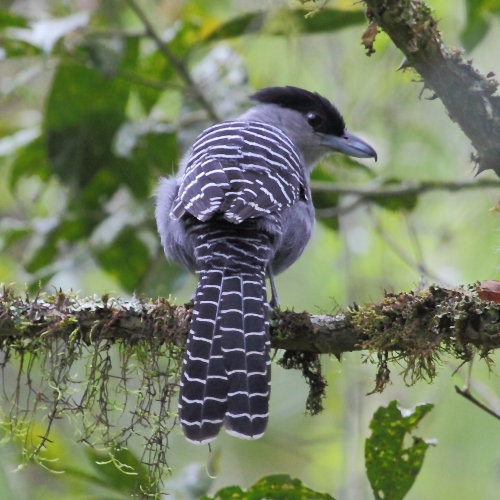
Klages's Antwren
Myrmotherula klagesi
Order: Passeriformes / Family: Thamnophilidae

Wikimedia Commons
About the Klages's Antwren
Klages's Antwren (Myrmotherula klagesi) is a diminutive yet remarkable bird native to the lush forests of the Amazon Basin. It belongs to the family Thamnophilidae, a group renowned for their specialization in dense forest environments. This species inhabits the understory of tropical lowland rainforests, particularly favoring areas with abundant vine tangles and thick foliage. Its presence is most prominent in regions such as northeastern Brazil, extending into Venezuela and Colombia, where intact forest ecosystems still prevail. The ecological role of Klages's Antwren is significant, as it participates in the intricate web of life within the Amazon. This bird primarily preys on insects, thus contributing to the control of insect populations and promoting forest health. During the breeding season, which typically coincides with the wet season, Klages's Antwren engages in territorial displays and vocalizations to ensure access to resources and mating opportunities. Its movements are largely sedentary, although minor altitudinal shifts may occur in response to environmental changes. As a species inhabiting one of the world's most biodiverse regions, Klages's Antwren exemplifies the intricate relationships and delicate balance inherent to tropical ecosystems. Conservation of its habitat, therefore, is crucial not only for the preservation of this species but also for the myriad of organisms that coexist within this complex habitat.
The Klages's Antwren belongs to the family Thamnophilidae, within the order Passeriformes. These birds typically live average 4-5 years, with a maximum recorded of 6 years..
How to Identify a Klages's Antwren
Klages's Antwren is a small songbird, measuring approximately 9-10 cm in length, with a wingspan of about 14-16 cm. The adult male is characterized by its predominantly black and gray plumage, featuring striking white wing bars that are conspicuous during flight. Female Klages's Antwrens differ slightly in appearance, exhibiting more subdued gray tones and less distinct wing markings. Juveniles generally resemble females but display a lighter and more mottled pattern, lacking the defined plumage of adults. Field identification can be challenging due to their preference for dense, shadowy undergrowth. Their subtle, methodical movements and relatively quiet demeanor demand patience from observers. When perched, they maintain a horizontal posture, often flicking their wings and tail. While visually similar to other Myrmotherula species, Klages's Antwren can be distinguished by its unique vocalizations and localized range. Its flight is typically short and direct, seldom rising above the forest canopy, which further aids in differentiation from other sympatric antwrens.
Having trouble telling birds apart? Upload a photo to our bird identification tool for an instant species match.
Klages's Antwren Habitat and Range
Preferred Habitat
Klages's Antwren thrives in the humid lowland rainforests of the Amazon, preferring dense, vine-laden understories where it can forage efficiently. These habitats often lie at elevations below 500 meters, where the climate and vegetation offer optimal conditions for its survival. The bird's presence is notably absent in urban and heavily disturbed areas, underscoring its reliance on pristine forest environments. Seasonal habitat shifts are minimal, although during periods of excessive rainfall, Klages's Antwren may temporarily relocate to slightly drier microhabitats within the forest. Its distribution is tightly bound to regions where large tracts of undisturbed rainforest remain, such as Brazil's Amapá and Pará states, where conservation efforts are critical to maintaining suitable habitats.
Geographic Range
The range of Klages's Antwren is confined to the northern part of the Amazon Basin, specifically within Brazil, Venezuela, and Colombia. Its breeding territories are particularly concentrated around the Rio Negro and its tributaries, where dense forest cover supports its ecological needs. Unlike many other passerines, Klages's Antwren is non-migratory, instead remaining within its established range year-round. Population density is highest in regions with minimal anthropogenic disturbance, although precise population figures remain elusive due to the bird's secretive nature and the challenging terrain of its habitat. Efforts to map its distribution continue, with particular focus on identifying key areas of ecological importance that can support sustainable populations.
Want to know which birds visit your area? Browse our backyard birds by location guides for region-specific species lists.
What Does the Klages's Antwren Eat?
Klages's Antwren primarily feeds on insects and other small arthropods, employing a methodical foraging technique that involves gleaning prey from leaves and branches. The bird uses its slender bill to probe crevices and undersides of foliage, capturing caterpillars, spiders, and beetles. During the wet season, when prey abundance peaks, Klages's Antwren may expand its diet to include small fruits and seeds, although insects remain its staple. Foraging occurs throughout the day, with activity peaking during the cooler morning and late afternoon hours. The bird's foraging strategy involves a series of short, deliberate hops interspersed with brief pauses to inspect potential prey sites. This behavior allows it to efficiently exploit the rich food resources available within its habitat.
Klages's Antwren Behavior and Social Structure
Klages's Antwren exhibits a highly territorial and solitary behavior, with pairs maintaining and defending territories throughout the year. During the breeding season, males engage in vocal displays to assert territorial boundaries and attract mates. These displays involve a series of rapid, high-pitched calls that resonate through the understory. The bird's social structure is typically monogamous, with pairs forming long-term bonds. In response to predators, Klages's Antwren relies on its cryptic plumage and the dense vegetation for concealment, often freezing or retreating deeper into cover when threatened. Daily activity patterns are largely diurnal, with peaks in foraging and vocalization occurring during early morning and late afternoon. Unlike some other antbirds, Klages's Antwren does not typically form mixed-species foraging flocks, instead preferring to forage alone or in pairs.
Klages's Antwren Nesting and Reproduction
The nesting habits of Klages's Antwren are adapted to their dense forest habitat. Nests are typically constructed low in the understory, often within dense tangles or shrubs. The structure is a shallow cup made from plant fibers, leaves, and spider silk, providing a secure yet inconspicuous site for raising young. Clutch size usually consists of two eggs, which both parents incubate for approximately 14-16 days. After hatching, chicks remain in the nest for about 10-12 days before fledging. Parental care is shared, with both parents actively feeding and protecting the young. The species is believed to have one to two broods per year, depending on environmental conditions and food availability. Successful nesting requires a habitat with minimal disturbance, reinforcing the importance of forest conservation for this species.
Klages's Antwren Sounds and Vocalizations
The vocalizations of Klages's Antwren are an integral aspect of its behavior, particularly during the breeding season. Its primary song consists of a series of high-pitched, rapid notes that can be described as a soft trill. This song serves both to establish territory and to communicate with potential mates. Additionally, the bird emits short, sharp call notes used for contact between pairs or as alarm signals when predators are near. These calls, though subtle, play a crucial role in maintaining pair bonds and ensuring the safety of the nest. The dawn chorus features the antwren's prominent contributions, adding to the symphony of sounds that characterize the Amazonian forest at daybreak.
Interesting Facts About the Klages's Antwren
- 1Klages's Antwren was named in honor of the German ornithologist, Paul Klages, who made significant contributions to the study of Neotropical birds.
- 2The antwren's specialized bill enables it to extract insects from crevices that are inaccessible to less adapted bird species.
- 3Its cryptic plumage provides excellent camouflage, making it difficult for both predators and birdwatchers to spot in the dense understory.
- 4Despite its small size, Klages's Antwren plays a crucial role in insect population control, highlighting its ecological importance.
- 5The bird's vocalizations, while subtle, are a key component of its territorial displays, particularly during the breeding season.
- 6Females of the species are often more elusive than males, due to their more subdued plumage and preference for remaining hidden.
- 7Klages's Antwren is part of a diverse family of antbirds, encompassing over 230 species, each with unique adaptations to their environments.
Klages's Antwren Conservation Status
Klages's Antwren currently holds a status of Least Concern on the IUCN Red List, but its population trends warrant careful monitoring. Habitat loss due to deforestation and land conversion poses the most significant threat to its survival. Efforts to protect large tracts of intact forest, such as those encompassed by national parks and reserves, are vital for its continued existence. Historical population changes remain poorly documented, largely due to the bird's elusive nature and the challenges associated with conducting comprehensive surveys in its remote habitat. Conservation organizations emphasize the importance of sustainable forestry practices and community engagement to mitigate habitat destruction and preserve the biodiversity of the Amazon Basin.