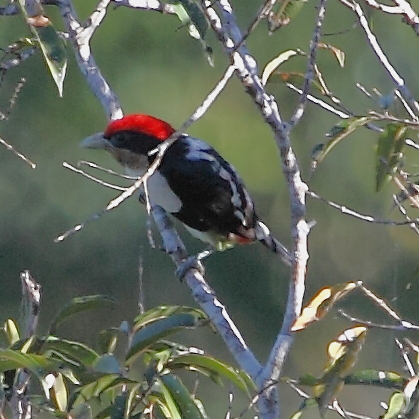
Lemon-throated Barbet
Eubucco richardsoni
Order: Piciformes / Family: Capitonidae

Wikimedia Commons
About the Lemon-throated Barbet
The Lemon-throated Barbet (Eubucco richardsoni) is a captivating bird native to the lush tropical rainforests of South America. This species belongs to the family Capitonidae, known for their stout bodies and brilliant plumage. Measuring approximately 17 cm in length, the Lemon-throated Barbet is small yet striking, with a primarily green body and a vivid yellow throat that gives the bird its common name. The species inhabits lowland forests, often seen in the Amazon Basin across countries such as Brazil, Peru, and Ecuador. This bird plays a significant ecological role as a frugivore, helping to disperse seeds across the forest floor and contributing to the biodiversity of its environment.
The Lemon-throated Barbet's presence in these biodiverse ecosystems highlights its importance as a pollinator and seed disperser, especially in areas like the Manu National Park in Peru, where biodiversity is among the richest on the planet. It thrives in the dense canopy and sub-canopy layers of primary and secondary forests, where it forages for fruit and occasionally insects. This species is non-migratory, maintaining a year-round presence in its preferred habitats. It is particularly active during the early morning and late afternoon, when it can often be heard vocalizing with its distinctive calls, contributing to the auditory tapestry of the rainforest.
The ecological significance of the Lemon-throated Barbet extends beyond its role as a pollinator. By consuming a wide variety of fruits, this bird aids in maintaining the genetic diversity of plant species, which is crucial for the health and sustainability of tropical rainforests. As a member of the Piciformes order, the Lemon-throated Barbet shares its habitat with other barbet species and toucans, creating a dynamic community of frugivores that influence the forest structure. The bird's interactions with its environment underscore the delicate balance of tropical ecosystems, where each species plays a pivotal role in the ecological web.
Seasonal behaviors of the Lemon-throated Barbet include shifts in foraging patterns based on fruit availability, which can fluctuate throughout the year. During the wet season, when fruit is more abundant, the barbet's diet becomes more varied, whereas in the dry season, it may rely more heavily on insects and other alternative food sources. This adaptability ensures the species' survival in changing environmental conditions, demonstrating its resilience in the face of ecological challenges.
The Lemon-throated Barbet belongs to the family Capitonidae, within the order Piciformes. These birds typically live typically 5-8 years, with a maximum recorded of 11 years..
How to Identify a Lemon-throated Barbet
Identifying the Lemon-throated Barbet involves noting its distinct and vibrant coloration. The adult plumage features a predominantly green body, with the striking lemon-yellow throat and forehead being the most conspicuous traits. The red crown and nape contrast sharply with the yellow, while the face displays a mix of blue and black, giving it a colorful and unique appearance. The underparts are a paler green, and the wings and tail are a darker shade of green. Juveniles resemble adults but have a duller coloration overall, lacking the bright yellow throat and red crown.
Male and female Lemon-throated Barbets look similar, with only slight differences in brightness and intensity of their plumage. However, males generally have more pronounced colors, particularly around the head and throat, making them slightly easier to identify in the field. This sexual dimorphism is subtle, requiring a keen eye and experience to discern in some instances.
In flight, the Lemon-throated Barbet displays a rapid wingbeat typical of barbets, with a compact silhouette that allows for agile maneuvers through dense foliage. When perched, it exhibits a characteristic posture, often sitting upright on branches while scanning its surroundings for food. This bird can sometimes be confused with other barbet species, such as the Scarlet-crowned Barbet, but its distinct lemon-yellow throat helps to differentiate it from similar species. Observers should also note its unique vocalizations, which aid in its identification even when the bird is not visible.
Having trouble telling birds apart? Upload a photo to our bird identification tool for an instant species match.
Lemon-throated Barbet Habitat and Range
Preferred Habitat
The Lemon-throated Barbet primarily inhabits the lowland tropical rainforests of the Amazon Basin, thriving in the humid and biodiverse environment of South America. It is commonly found in primary forests, characterized by dense canopy cover and a rich variety of plant species, which provide abundant food resources. This bird also occupies secondary forests, which are areas of regrowth following disturbance. The barbet prefers the canopy and sub-canopy layers, where it can forage for fruits and insects.
In terms of elevation, the Lemon-throated Barbet is usually found at altitudes ranging from sea level to about 1000 meters, although it is more frequently observed in lower regions where forest density is greatest. Seasonal habitat shifts are minimal due to the stable climate of its tropical range, allowing the bird to remain a year-round resident of its preferred environments.
The species is less frequently seen in urban areas, as it relies heavily on the forest ecosystem for its food and nesting sites. While not commonly found in rural or agricultural landscapes, it may occasionally venture into nearby wooded areas if fruiting trees are available. The Lemon-throated Barbet's reliance on intact forest ecosystems makes habitat conservation crucial for its continued survival.
Geographic Range
The Lemon-throated Barbet's range is confined to the tropical regions of South America, specifically within the Amazon Basin. It is found predominantly in Brazil, Peru, and Ecuador, with smaller populations extending into Colombia and Bolivia. This species does not undertake long migrations, instead residing year-round in its preferred habitats of lowland rainforests.
During the breeding season, the Lemon-throated Barbet is most commonly observed in regions with abundant fruiting trees, which provide the necessary resources for nesting and rearing young. The bird's range overlaps with protected areas such as the Tambopata National Reserve in Peru, where diverse avian communities can be studied.
Population density hotspots are typically found in areas with high forest cover and minimal human disturbance. The Amazon rainforest, with its vast expanse and limited accessibility, provides an ideal environment for the Lemon-throated Barbet. However, deforestation and habitat degradation pose significant threats to this species, leading to localized declines in population. Conservation efforts focused on preserving these vital habitats are essential to maintaining the barbet's presence in its natural range.
Want to know which birds visit your area? Browse our backyard birds by location guides for region-specific species lists.
What Does the Lemon-throated Barbet Eat?
The Lemon-throated Barbet primarily consumes a diet rich in fruits, making it an essential frugivore within its ecosystem. Its primary food sources include figs, berries, and small fruits from various rainforest trees and shrubs. The barbet's strong, curved bill is well adapted to plucking and manipulating fruit, allowing it to access a wide range of dietary options.
During periods of fruit scarcity, the Lemon-throated Barbet supplements its diet with insects, providing an important protein source. This diet flexibility is particularly apparent during the dry season when fruit availability decreases. Insects such as beetles and caterpillars become more significant in their diet, showcasing the bird's adaptability.
Foraging techniques involve carefully navigating through the canopy and sub-canopy layers, often in pairs or small family groups. The Lemon-throated Barbet typically feeds during the cooler parts of the day, such as early morning and late afternoon, when it is most active. Its role as a seed disperser underscores its ecological importance, as it helps to maintain plant diversity within its habitat.
Lemon-throated Barbet Behavior and Social Structure
The social behavior of the Lemon-throated Barbet is characterized by its tendency to form small family groups, often consisting of a mated pair and their offspring. These groups are generally non-territorial, allowing them to move freely within their range in search of food and suitable nesting sites. The species exhibits a cooperative breeding system, where older offspring may assist with the care of younger siblings, enhancing the survival rate of the brood.
Courtship displays are subtle and involve mutual preening and food sharing between potential mates. These behaviors strengthen pair bonds and facilitate successful breeding. During the breeding season, the Lemon-throated Barbet becomes more vocal, with pairs frequently exchanging calls to maintain contact and reinforce their bond.
The species displays a distinctive response to predators, often mobbing intruders with a series of sharp calls and quick, coordinated movements designed to drive off threats. When not breeding, the Lemon-throated Barbet joins mixed-species flocks, enhancing foraging efficiency and reducing the risk of predation.
Daily activity patterns indicate the bird is most active during the early morning and late afternoon. During these times, it engages in foraging, social interactions, and territorial displays. Such patterns reflect the bird's adaptation to its tropical environment, where midday temperatures can become uncomfortably high.
Lemon-throated Barbet Nesting and Reproduction
The Lemon-throated Barbet nests in tree cavities, which provide protection from predators and harsh weather conditions. These cavities are often excavated by the birds themselves using their strong bills, though they may also occupy abandoned nests of other species, such as woodpeckers. The preferred nesting sites are located in trees with softer wood, facilitating easier excavation.
A typical clutch consists of two to four eggs, which are white and have a smooth texture. Both parents participate in incubation, which lasts approximately 14 to 16 days. The division of parental roles extends to feeding and caring for the hatchlings, with both male and female sharing these responsibilities equally.
Fledging occurs about 30 days after hatching, during which time the young birds develop the necessary skills for independent survival. While the Lemon-throated Barbet is generally monogamous, pairs may attempt two broods per year if conditions are favorable, particularly in areas with abundant food resources. The cooperative nature of this species enhances the success rate of each breeding attempt, ensuring the continuation of the species.
Lemon-throated Barbet Sounds and Vocalizations
The Lemon-throated Barbet's vocalizations are a distinctive aspect of its presence in the rainforest. Its primary song consists of a series of repetitive, melodious notes, delivered with a clear and rhythmic cadence. The pitch is moderate, and the quality of the sound is rich and flute-like, allowing it to carry across the dense forest canopy.
Call notes are simpler and often serve as communication between mates or group members. These calls can be described as short, sharp chirps or whistles, used to maintain contact or alert others to potential threats. The alarm call is a louder, more urgent series of notes, designed to warn of approaching predators.
During the dawn chorus, the Lemon-throated Barbet's song can be heard mingling with the calls of other rainforest birds, creating a vibrant soundscape. Its vocalizations, though not as complex as some songbirds, are an integral part of its communication strategy and serve multiple functions within its social structure.
Interesting Facts About the Lemon-throated Barbet
- 1The Lemon-throated Barbet can excavate its own nest cavities, a task that usually takes several days due to the dense rainforest woods.
- 2This species is known to participate in mixed-species flocks, which include other fruit-eating birds like toucans and tanagers.
- 3A Lemon-throated Barbet's call can travel up to 200 meters through dense jungle, making it an effective means of communication.
- 4The species plays a key role in the Amazon rainforest by dispersing seeds from a variety of fruit-bearing trees, aiding in forest regeneration.
- 5Despite their small size, Lemon-throated Barbets can defend territory against larger birds using cooperative defense tactics.
Lemon-throated Barbet Conservation Status
The IUCN currently lists the Lemon-throated Barbet as a species of Least Concern, indicating that it is not immediately threatened. However, its population trend is decreasing, primarily due to habitat loss and fragmentation. Deforestation for agriculture, logging, and infrastructure development poses significant threats to the barbet's rainforest habitat. Conservation efforts focus on preserving large tracts of intact forest, which are crucial for the survival of the species and the biodiversity of the region. Protected areas such as national parks and reserves provide vital refuges for the Lemon-throated Barbet and other forest-dependent species. Historically, the population of the Lemon-throated Barbet has been stable, but ongoing environmental pressures could lead to future declines. Continued monitoring and habitat conservation are essential to ensure the long-term viability of this species and the ecosystems it supports.