
Lined Antshrike
Thamnophilus tenuepunctatus
Order: Passeriformes / Family: Thamnophilidae

Wikimedia Commons
About the Lined Antshrike
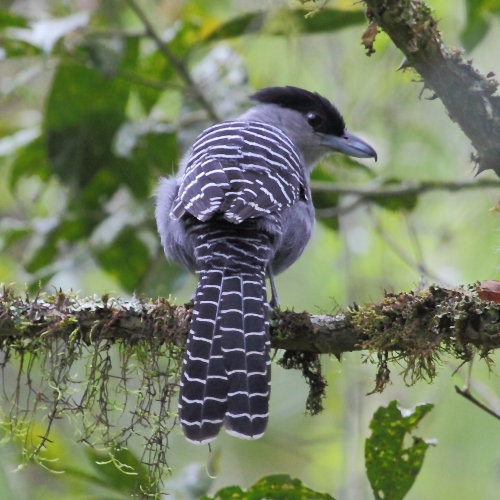
The Lined Antshrike, Thamnophilus tenuepunctatus, is a captivating bird of the Thamnophilidae family, notable for its intricately barred plumage that provides excellent camouflage in its natural habitat. This small passerine bird inhabits the subtropical and tropical forests of South America, specifically thriving in Colombia, Ecuador, and Peru. Its presence in these biodiverse regions underscores its role in the ecosystem as both a predator and prey.
Primarily found in the understory and mid-levels of forests, the Lined Antshrike plays a significant ecological role as an insectivore. It helps control insect populations, thus maintaining a balanced ecosystem. During the breeding season, which typically spans from March to June in these regions, the Lined Antshrike becomes more active and vocal, with males often performing elaborate displays to attract females. These behaviors are crucial for the continuation of its species, as they ensure successful mating and reproduction.
The Lined Antshrike's preference for dense, humid forests makes it a vital indicator species for the health of its habitat. Its presence often signals a thriving ecosystem with abundant insect life and adequate vegetation cover. However, the degradation of forest habitats due to logging and agricultural expansion poses a threat to this species. Conservation efforts focusing on habitat preservation are essential to ensure the Lined Antshrike continues to fulfill its ecological niche. By understanding the needs and behaviors of the Lined Antshrike, conservationists can develop strategies to protect not just this species, but the intricate web of life it supports.
The Lined Antshrike belongs to the family Thamnophilidae, within the order Passeriformes. These birds typically live average 5-7 years, with a maximum recorded of 10 years..
How to Identify a Lined Antshrike
The Lined Antshrike is a small bird, measuring about 14 to 16 centimeters in length. Adult males and females exhibit sexually dimorphic plumage. Males are primarily gray with distinct black barring across their chest and flanks, which gives them their 'lined' appearance. Their head is capped with a contrasting black, which makes their bright yellow eyes stand out. Females, on the other hand, have a more rufous or brownish hue, with subtler barring that provides excellent camouflage against the forest floor.
Juvenile Lined Antshrikes resemble females but lack the intensity of the adults' coloration. As they mature, their plumage gradually takes on more defined barring and color differentiation. When in flight, the Lined Antshrike displays a short and rounded wing silhouette, with a slightly longer tail that aids in maneuvering through dense foliage.
This species may be confused with other antshrikes, such as the Barred Antshrike, but careful observation reveals the Lined Antshrike's unique patterning and size. Its posture is typically upright when perching, with a tendency to flick its wings and tail, a behavior that can aid in identification amongst similar species.
Having trouble telling birds apart? Upload a photo to our bird identification tool for an instant species match.
Lined Antshrike Habitat and Range
Preferred Habitat
The Lined Antshrike predominantly inhabits subtropical and tropical moist lowland forests. It is commonly found at elevations ranging from 500 to 1500 meters, although it occasionally ventures higher depending on forest density. This species prefers dense understory vegetation, where it can move stealthily while foraging or evading predators.
In regions like the eastern Andes of Ecuador and northern Peru, these birds make use of secondary growth forests and forest edges, especially where primary forests have been disturbed. While primarily a forest-dwelling species, the Lined Antshrike occasionally appears in semi-open areas with sufficient shrub cover.
Seasonal habitat shifts are not prominently observed in this species, as it tends to remain within its home range year-round. Unlike some other birds, the Lined Antshrike does not adapt well to urban environments, thus it remains largely absent from cities and towns, relying heavily on natural and semi-natural habitats for survival.
Geographic Range
The Lined Antshrike is endemic to the northwestern part of South America. Its range primarily encompasses the lowland and foothill forests of Colombia, Ecuador, and northern Peru. Within Colombia, it is found along the eastern slopes of the Andes, extending into the lowlands of the Amazon basin.
In Ecuador, the Lined Antshrike inhabits the eastern Andes and the adjacent Amazonian lowlands. It is most commonly observed in protected areas such as the Yasuni National Park and the Sumaco Napo-Galeras National Park. Northern Peru represents the southern extent of its range, where it is found in similar forest habitats, primarily in the regions of Loreto and San Martín.
The Lined Antshrike is a resident species, meaning it does not migrate but remains within its established range throughout the year. Population densities are highest in undisturbed forests, with sightings becoming less frequent in areas where habitat destruction has occurred. Conservation areas provide crucial refuges for this species, allowing it to maintain stable populations in the face of environmental changes.
Want to know which birds visit your area? Browse our backyard birds by location guides for region-specific species lists.
What Does the Lined Antshrike Eat?
As an insectivore, the Lined Antshrike's diet consists mainly of insects and other arthropods. It primarily feeds on ants, beetles, caterpillars, and spiders, making it an important part of the forest ecosystem by controlling insect populations. The bird employs a foraging technique known as 'gleaning,' where it picks insects off leaves and branches while moving through the dense underbrush.
During the wet season, when insect populations are at their peak, the Lined Antshrike may also consume small fruits and seeds, supplementing its diet with available resources. This dietary flexibility helps the bird to cope with variations in food availability across different seasons.
The Lined Antshrike is most active in its foraging during the cooler parts of the day, such as early morning and late afternoon. It typically hunts alone or in pairs, although it may join mixed-species flocks that move through the forest, benefiting from the collective vigilance and increased foraging opportunities.
Lined Antshrike Behavior and Social Structure
The Lined Antshrike exhibits a largely solitary or pair-based social structure. While it may join mixed-species flocks for foraging, it tends to maintain a degree of independence. Territorial behavior is prominent, especially during the breeding season, when males vigorously defend their territory through vocal displays and physical chases.
Courtship involves the male performing intricate displays, including wing and tail flicking, to attract a mate. Once paired, Lined Antshrikes engage in cooperative breeding, with both partners participating in nest-building, incubation, and feeding of the young.
Their response to predators includes remaining motionless or moving stealthily through the underbrush to avoid detection. The Lined Antshrike's daily activity peaks during the early morning and late afternoon, aligning with periods of optimal foraging conditions. It tends to be less active during the hottest parts of the day, seeking shelter in the dense forest canopy.
Lined Antshrike Nesting and Reproduction
Lined Antshrikes construct cup-shaped nests using twigs, roots, and leaves, typically placing them in the fork of a small tree or bush within dense underbrush. These nests are well-concealed, offering protection from predators and the elements.
The typical clutch size ranges from two to three eggs, which are white with reddish-brown speckles. Both parents share the responsibility of incubation, which lasts about 12 to 14 days. After hatching, the chicks remain in the nest for approximately 10 to 12 days before fledging.
Parental roles are shared equally, with both the male and female providing food and protection for their young. The Lined Antshrike usually raises one brood per year, although favorable conditions may lead to a second brood. This reproductive strategy ensures that they maximize their breeding success within the constraints of their environment.
Lined Antshrike Sounds and Vocalizations
The Lined Antshrike's song is a series of sharp, metallic notes, often described as 'tink-tink-tink,' with a rhythmic and repetitive quality. These vocalizations are most prominent during the breeding season when males use them to establish territory and attract mates.
Call notes include a variety of harsh, chattering sounds that serve as contact calls between mates or alarm signals in response to potential threats. The Lined Antshrike also participates in the dawn chorus, joining other forest birds in a symphony of vocalizations that mark the beginning of the day.
Comparatively, its song is less musical than some of its relatives in the Thamnophilidae family, but it is distinct enough to aid in field identification. The ability to recognize these vocalizations is crucial for birders seeking to spot this elusive species.
Interesting Facts About the Lined Antshrike
- 1The Lined Antshrike's intricate barred plumage provides camouflage, blending seamlessly with the dappled forest light.
- 2Despite its small size, the Lined Antshrike can deliver a surprisingly loud and piercing song that carries through dense foliage.
- 3The Lined Antshrike has an interesting symbiotic relationship with army ants, following their swarms to catch fleeing insects.
- 4This bird's foraging behavior includes 'leaf gleaning,' where it picks insects from the undersides of leaves.
- 5During courtship, male Lined Antshrikes perform elaborate displays, showcasing their plumage and agility.
- 6The Lined Antshrike's diet adapts seasonally, incorporating more fruit when insect availability decreases.
- 7Its presence in forests acts as an indicator of ecosystem health, reflecting the richness of insect life.
Lined Antshrike Conservation Status
The Lined Antshrike is currently classified as 'Least Concern' by the IUCN, with stable population trends across its range. However, habitat destruction due to deforestation and agricultural expansion poses a significant threat to its long-term survival. Conservation efforts focus on preserving large tracts of primary and secondary forests, which are essential for the Lined Antshrike's habitat needs. Protected areas in Colombia, Ecuador, and Peru play a critical role in safeguarding this species. Historically, the Lined Antshrike's population has remained stable, but ongoing environmental changes necessitate continued monitoring and habitat protection efforts to ensure its future. By maintaining healthy forest ecosystems, conservationists can help preserve the intricate balance that supports the Lined Antshrike and other forest-dependent species.
Other Thamnophilidae Species



Birds Similar to the Lined Antshrike
These species are often confused with the Lined Antshrike due to similar appearance or overlapping range.

