Long-winged Antwren
Myrmotherula longipennis
Order: Passeriformes / Family: Thamnophilidae

Wikimedia Commons
About the Long-winged Antwren
The Long-winged Antwren, scientifically known as Myrmotherula longipennis, is a small bird belonging to the family Thamnophilidae. Found primarily in the Amazon Basin, this bird thrives in the understory of humid lowland forests, particularly in regions like Brazil, Peru, and eastern Ecuador. Its presence spans across various countries, although it is most commonly observed in dense jungles where it plays a significant role in the ecosystem. This species is an integral component of its habitat, frequently participating in mixed-species flocks. By doing so, it helps maintain the balance within its ecological niche, particularly through its feeding habits which involve the consumption of numerous insect species, thereby controlling potential pest populations. The Long-winged Antwren contributes to the intricate web of interactions that characterize tropical ecosystems. Its adaptability to different forest environments, from primary to secondary growth areas, highlights its ecological significance. Although it is not considered migratory, some populations may exhibit local movements in response to changes in environmental conditions, such as variations in food availability or habitat disturbances. This adaptability underscores its resilience in the face of changing environments but also emphasizes the importance of conservation efforts to preserve its natural habitat, which faces threats from deforestation and habitat fragmentation. Throughout the year, the Long-winged Antwren partakes in various seasonal behaviors, including breeding activities that typically align with the rainy season to ensure the availability of abundant food resources. This timing is crucial for the successful rearing of chicks, as the abundance of prey items supports the nutritional needs of both adults and their offspring. The bird's role in the ecosystem extends beyond insect control; it also serves as prey for larger predators, thus contributing to the food web's complexity. Overall, the Long-winged Antwren exemplifies the intricate balance of life within the rainforest and highlights the interconnectedness of tropical ecosystems.
The Long-winged Antwren belongs to the family Thamnophilidae, within the order Passeriformes. These birds typically live average 4-5 years, with a maximum recorded of 7 years..
How to Identify a Long-winged Antwren
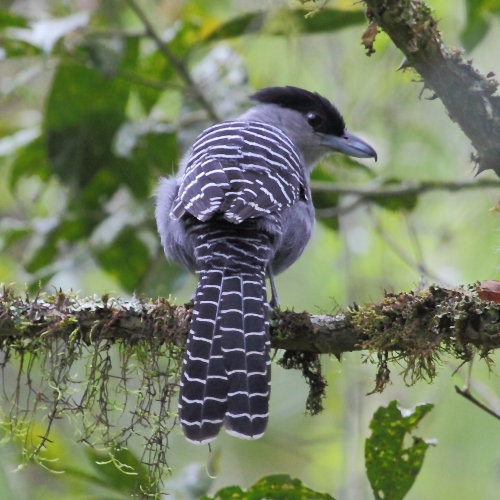
The Long-winged Antwren is a small bird, measuring about 9-10 cm in length, with a wingspan that subtly emphasizes its name. Its plumage predominantly consists of black and brown with males exhibiting a more pronounced black coloration on the head and throat. Females, on the other hand, display a browner hue with a lighter throat, providing a clear sexual dimorphism in the species. Juvenile birds resemble adult females but have a more muted brown overall. The elongated wings of the Long-winged Antwren are a distinctive feature, setting it apart from similar species like the White-flanked Antwren, which lacks such pronounced wing length. In flight, the Long-winged Antwren demonstrates a quick, agile pattern, often darting between branches in short bursts. Its perching posture is typically upright, maintaining a vigilant stance as it scans its surroundings for insects. While not overly colorful, the nuanced differences in plumage between sexes and age classes require careful observation, especially when identifying this species in dimly lit undergrowth where it frequently resides. The bird's small size, combined with its specific wing morphology, assists birders in distinguishing it from other understory inhabitants.
Having trouble telling birds apart? Upload a photo to our bird identification tool for an instant species match.
Long-winged Antwren Habitat and Range
Preferred Habitat
The Long-winged Antwren is predominantly found in the dense, humid lowland forests of the Amazon Basin. It thrives particularly in the understory of primary and secondary forests, showing a preference for areas with thick vegetation that provides ample cover and feeding opportunities. The species is typically observed at elevations ranging from sea level up to 1,000 meters, though it is most common at lower altitudes where its preferred habitat is most prevalent. Unlike some other forest birds, the Long-winged Antwren does not typically venture into urban areas, remaining closely tied to its forest environment. Seasonal habitat shifts are minimal, as the species is largely non-migratory and maintains a consistent presence within its range year-round. However, local movements may occur in response to changes in resource availability or environmental conditions such as forest clearing. Despite its adaptability to different forest types, the Long-winged Antwren relies heavily on the preservation of its natural habitat to sustain its populations.
Geographic Range
The Long-winged Antwren's range is concentrated within the Amazon Basin, covering parts of northern Brazil, eastern Ecuador, Peru, and Colombia. It can also be found in the lowland rainforests of Venezuela and Bolivia. This species does not undertake long-distance migrations, instead exhibiting a largely sedentary lifestyle with potential local movements triggered by variations in habitat conditions. Within its range, population density is highest in regions with extensive primary forest cover, such as the central Amazon in Brazil and the lowland areas of eastern Peru. These forests provide the ideal conditions for feeding and breeding. Despite some overlap with other antwren species, the Long-winged Antwren maintains a distinct presence due to its unique habitat preferences and behaviors. Conservation of large forest tracts within its range is crucial for the continued survival of this species.
Want to know which birds visit your area? Browse our backyard birds by location guides for region-specific species lists.
What Does the Long-winged Antwren Eat?
The Long-winged Antwren primarily feeds on a diet of insects and other small arthropods. It employs a foraging technique known as 'gleaning,' meticulously picking insects from leaves and branches within the dense forest understory. This bird targets a variety of prey, including ants, beetles, and spiders, with prey size generally ranging from small to medium-sized insects. The antwren's diet may vary seasonally, with increased reliance on certain prey types during breeding seasons to meet the higher nutritional demands of raising young. As an active forager, the Long-winged Antwren participates in mixed-species flocks, a behavior that enhances its feeding efficiency and reduces the risk of predation. Its feeding schedule is largely diurnal, with peaks in activity during the early morning and late afternoon when insect activity is highest. The bird's role as an insectivore helps control insect populations within its ecosystem, contributing to the overall health of the forest environment.
Long-winged Antwren Behavior and Social Structure
The Long-winged Antwren exhibits a social structure that often involves participation in mixed-species flocks. Such flocking behavior provides advantages in terms of increased foraging success and reduced predation risk. The species is territorial, with pairs or small family groups defending their chosen territories with vocalizations and displays. Courtship displays primarily involve males showcasing their elongated wings and producing soft vocalizations to attract females. Once paired, Long-winged Antwrens exhibit a monogamous breeding system, often maintaining bonds throughout the breeding season. In response to predators, these birds rely on their agility and the cover provided by dense foliage to evade capture. Their daily activity patterns are typically diurnal, with foraging and social interactions peaking during the cooler hours of the day. The Long-winged Antwren's behavior reflects its adaptation to the complex and competitive environment of the rainforest understory.
Long-winged Antwren Nesting and Reproduction
The Long-winged Antwren constructs a small, cup-shaped nest, usually situated in the fork of a low shrub or small tree within dense undergrowth. The nest is primarily made of fine plant materials such as grass and leaves, bound together with spider silk for added stability. It is typically well-concealed to protect against predators. The clutch size generally consists of two eggs, which are incubated by both parents for a period of approximately 15 days. After hatching, the chicks are altricial and reliant on parental care. Both male and female Long-winged Antwrens participate in feeding and caring for the young, which fledge about two weeks after hatching. The species may produce one or two broods per year, depending on environmental conditions and food availability. The coordinated parental effort ensures high survival rates for the offspring, reflecting the species' adaptation to its challenging habitat.
Long-winged Antwren Sounds and Vocalizations
The primary song of the Long-winged Antwren is a series of soft, high-pitched notes delivered in a rapid sequence, creating a delicate and rhythmic melody that resonates through the forest understory. Its call notes are short and sharp, often used for communication between mates or to signal the presence of intruders. Alarm calls are more abrupt and harsher, serving to alert conspecifics to potential threats. During the dawn chorus, the Long-winged Antwren's song contributes to the rich soundscape of the rainforest, blending with the calls of other birds. The quality of its vocalizations is subtle, requiring attentive listening to distinguish it from similar species. The bird's vocal repertoire plays a crucial role in maintaining social bonds and defending its territory.
Interesting Facts About the Long-winged Antwren
- 1The Long-winged Antwren has elongated wing feathers that help distinguish it from other antwrens, aiding in its quick, agile flight.
- 2Despite its small size, the Long-winged Antwren plays a significant role in controlling insect populations in its forest habitat.
- 3Participating in mixed-species flocks allows the Long-winged Antwren to enhance its foraging efficiency and reduce predation risks.
- 4The bird's preference for dense understory means it is rarely seen in open habitats, making it a true specialist of the rainforest.
- 5Long-winged Antwrens can be quite elusive, often heard rather than seen due to their preference for thick vegetation.
Long-winged Antwren Conservation Status
Currently, the IUCN lists the Long-winged Antwren as Least Concern, reflecting a relatively stable population trend. However, habitat destruction due to deforestation and land conversion poses significant threats to its long-term survival. Conservation efforts focus on preserving large tracts of primary and secondary forests, which are vital for maintaining healthy populations. Historical data suggest that while the species has adapted to various forest types, ongoing habitat loss could lead to localized declines. Initiatives aimed at sustainable land use and forest protection are essential to safeguard the future of the Long-winged Antwren and the biodiversity of the Amazon Basin.