Manicore Warbling-Antbird
Hypocnemis rondoni
Order: Passeriformes / Family: Thamnophilidae

Wikimedia Commons
About the Manicore Warbling-Antbird
The Manicore Warbling-Antbird (Hypocnemis rondoni) is a fascinating species belonging to the Thamnophilidae family, known for their vibrant vocal presence in the neotropical forests of South America. This bird, endemic to Brazil, occupies a specific niche within the ecosystem of the Amazon Basin, particularly in the region surrounding the Madeira River and its tributaries. Its presence is a testament to the rich biodiversity of the Amazon, playing a crucial role in insect population control and serving as a bioindicator for forest health. The Manicore Warbling-Antbird frequents dense, humid undergrowth in terra firme forests, which remain unflooded throughout the year. These habitats are crucial for its survival, providing abundant food resources and the cover needed for nesting and protection from predators. Unlike some of its relatives, the Manicore Warbling-Antbird does not migrate, maintaining a stable presence year-round. Its ecological role extends beyond mere insect predation. As an insectivore, it contributes to the balance within its environment, its feeding habits influencing the insect population dynamics, which in turn affects plant pollination and seed dispersal by reducing herbivory. This interconnectedness highlights the bird's importance within its habitat. Seasonally, the Manicore Warbling-Antbird maintains a consistent behavior, with its breeding season typically peaking during the rainy months when food availability spikes. During this time, its melodious warbling becomes more pronounced, playing a significant role in mate attraction and territory defense. The distinct song of the Manicore Warbling-Antbird, consisting of a series of sharp whistles, not only delineates its territory but also asserts its presence within the dense forest. This vocal prowess, combined with its ecological role, underscores the importance of conserving its habitat, as deforestation poses a significant threat to its continued existence.
The Manicore Warbling-Antbird belongs to the family Thamnophilidae, within the order Passeriformes. These birds typically live average 4-5 years with a max recorded of 7 years..
How to Identify a Manicore Warbling-Antbird
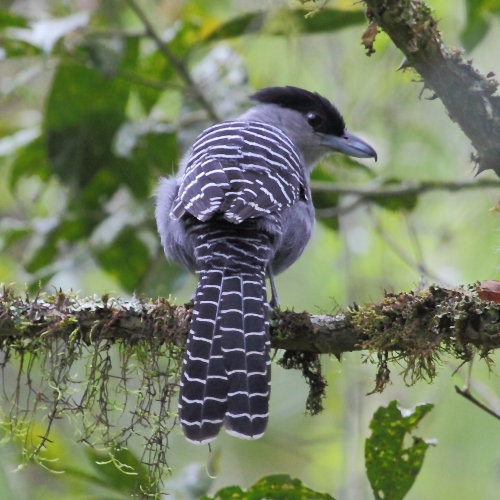
The Manicore Warbling-Antbird can be identified by its striking black and white plumage, which provides camouflage in the shadowy understory of its forest habitat. Adult males exhibit a black crown and face, with a white throat and chest, transitioning to gray on the belly. In contrast, females display a more subdued coloration with brownish tones replacing the black, particularly on the crown and back. Juveniles resemble females but often have a more mottled appearance. One might confuse the Manicore Warbling-Antbird with other members of the Hypocnemis genus, such as the Imeri Warbling-Antbird, but the Manicore's song and subtle plumage differences, such as its more pronounced white wing bars, aid in accurate identification. In flight, this bird's silhouette appears relatively short-tailed and rounded, typical of antbirds, which aids in maneuvering through dense foliage. When perching, the Manicore Warbling-Antbird often adopts a horizontal posture, remaining still for long periods as it surveys the forest floor for prey.
Having trouble telling birds apart? Upload a photo to our bird identification tool for an instant species match.
Manicore Warbling-Antbird Habitat and Range
Preferred Habitat
The Manicore Warbling-Antbird thrives in the lowland terra firme forests of the Brazilian Amazon, particularly near the Madeira River. These forests are characterized by their stability and lack of seasonal flooding, providing an ideal environment for the bird's ground-foraging lifestyle. Typically found at elevations below 500 meters, this bird shows a strong preference for humid, densely vegetated areas where it can hunt for insects and arthropods. Seasonal habitat shifts are minimal, as the Manicore Warbling-Antbird is non-migratory, maintaining its presence within these forests year-round. While some birds might adapt to urban fringes, this species remains strictly tied to its natural forest habitats, highlighting the importance of preserving these environments against deforestation and habitat fragmentation.
Geographic Range
The Manicore Warbling-Antbird is exclusively found within Brazil, inhabiting the Amazon Basin's lowland forests. Its range is relatively restricted, centering on the Madeira River region, which flows through the states of Rondônia and Amazonas. Unlike many other bird species, it does not engage in long-distance migrations, instead maintaining a stable, year-round residence within this geographically confined area. As a result, the bird's distribution is patchy, with population density hotspots closely linked to undisturbed terra firme forests. The absence of migration corridors or significant range shifts emphasizes the species' reliance on the specific ecological conditions found in these Amazonian habitats, making conservation efforts in these areas particularly vital.
Want to know which birds visit your area? Browse our backyard birds by location guides for region-specific species lists.
What Does the Manicore Warbling-Antbird Eat?
Primarily insectivorous, the Manicore Warbling-Antbird feeds on a variety of insects and arthropods, including ants, beetles, and spiders. Its foraging technique is deliberate and methodical, often seen hopping along the forest floor or low branches, carefully inspecting leaf litter and undergrowth. During the rainy season, when insect activity peaks, the bird's diet expands to include caterpillars and other soft-bodied insects. The prey size typically ranges from 5 to 15 millimeters, allowing the bird to efficiently manage its energy intake. Feeding mainly occurs during the early morning and late afternoon when insects are most active, aligning the bird's feeding schedule with the availability of prey. Despite its small size, the Manicore Warbling-Antbird plays a significant role in controlling insect populations, thereby contributing to the ecological balance within its habitat.
Manicore Warbling-Antbird Behavior and Social Structure
The Manicore Warbling-Antbird exhibits a complex social structure, often forming monogamous pairs that maintain and defend territories vigorously. Territorial disputes can be intense, with birds engaging in vocal duels and physical displays to assert dominance. During courtship, males perform elaborate displays, puffing out their bodies and singing persistently to attract females. These rituals strengthen pair bonds and ensure successful breeding. Unlike some bird species, the Manicore Warbling-Antbird does not form large flocks, preferring the company of its mate or small family groups. Its response to predators is cautious, utilizing the dense vegetation for cover while emitting alarm calls to alert its mate. Daily activity patterns are heavily influenced by light levels and temperature, with foraging occurring primarily in the cooler hours of morning and late afternoon. This behavior allows the bird to avoid the midday heat, ensuring optimal energy expenditure for feeding and territory maintenance.
Manicore Warbling-Antbird Nesting and Reproduction
The nesting habits of the Manicore Warbling-Antbird reflect its adaptation to the dense forest undergrowth where it resides. The nest is a compact cup structure, meticulously woven from plant fibers, leaves, and spider silk, providing both stability and camouflage. Typically, the nest is situated low in the underbrush, often less than two meters above ground level, to remain hidden from predators. Clutch sizes range from two to three eggs, with both parents sharing incubation duties over a period of approximately 14 days. Once hatched, the chicks remain in the nest for another 10 to 12 days before fledging. After fledging, the young continue to rely on their parents for food and protection for several additional weeks. The Manicore Warbling-Antbird typically raises one brood per year, though in favorable conditions, a second attempt may occur.
Manicore Warbling-Antbird Sounds and Vocalizations
The primary song of the Manicore Warbling-Antbird is a series of high-pitched, melodious whistles that rise and fall in a rhythmic pattern. This song is often described as both piercing and enchanting, carrying through the dense forest understory to reach potential mates or rivals. In addition to the primary song, the bird emits various call notes, including sharp, staccato chips used in alarm situations or to maintain contact with its mate. Alarm calls are more abrupt and less melodic, serving as an effective warning system against potential threats. During the dawn chorus, the Manicore Warbling-Antbird's song is particularly prominent, marking its territory and reinforcing pair bonds in the early morning light.
Interesting Facts About the Manicore Warbling-Antbird
- 1The Manicore Warbling-Antbird was only described as a distinct species in 2013, highlighting the ongoing discoveries within the Amazon.
- 2Despite their small size, Manicore Warbling-Antbirds exhibit aggressive territorial behavior, often engaging in vocal battles.
- 3These birds rarely venture above 500 meters in elevation, preferring the dense lowland Amazonian forests.
- 4The species' name, Hypocnemis rondoni, honors the Brazilian explorer Cândido Rondon.
- 5Manicore Warbling-Antbirds are adept at using their songs to communicate over short distances in dense vegetation.
- 6The bird's preference for terra firme forests means it avoids the seasonally flooded varzea habitats.
- 7Their nests are often so well hidden that they are difficult for even experienced birders to locate.
Manicore Warbling-Antbird Conservation Status
Currently, the IUCN lists the Manicore Warbling-Antbird as a species of Least Concern, but its status is precarious due to habitat destruction. Deforestation in the Amazon Basin for agriculture and logging presents the most significant threat to its continued survival. Although the population trend appears relatively stable at present, ongoing habitat loss could lead to future declines. Conservation efforts are critical, focusing on preserving large tracts of intact forest and promoting sustainable land use practices. Historical population data is limited, but anecdotal evidence suggests that the bird's numbers have decreased in areas where deforestation is most severe.