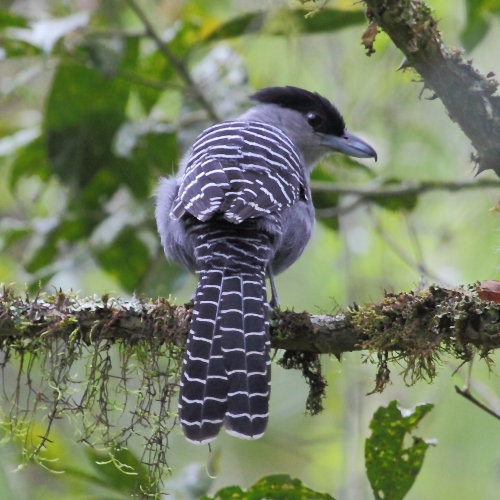
Mouse-colored Antshrike
Thamnophilus murinus
Order: Passeriformes / Family: Thamnophilidae

Wikimedia Commons
About the Mouse-colored Antshrike
The Mouse-colored Antshrike, scientifically known as Thamnophilus murinus, is a small perching bird native to the dense tropical rainforests of South America. This species is particularly prevalent in the Amazon Basin, where it frequents the understory and mid-levels of the forest. The bird's subtle yet notable presence in these lush habitats underscores its ecological role as both a predator of insects and a prey item for larger forest dwellers. Its presence is an indicator of a healthy, biodiverse ecosystem.
The Mouse-colored Antshrike is predominantly found throughout countries such as Brazil, Colombia, Peru, and Ecuador, thriving in lowland and foothill forests. This bird's preference for undisturbed or minimally disturbed forests highlights its sensitivity to habitat alteration, making it an important species for conservation monitoring.
Ecologically, the Mouse-colored Antshrike contributes significantly to insect population control, preying on a variety of arthropods. It often joins mixed-species foraging flocks, participating in a complex network of interactions that enhance its foraging efficiency. Seasonal behaviors of the Mouse-colored Antshrike are not highly pronounced, as it resides year-round in its tropical environment, though slight shifts in territory use may occur due to climatic variations or food availability.
The bird's vocal behavior is particularly notable during the breeding season. Males sing to establish territories and attract mates, with their calls resonating through the dense foliage. This vocal activity underscores the importance of acoustic communication in the dense jungle, where visibility is often limited.
The Mouse-colored Antshrike belongs to the family Thamnophilidae, within the order Passeriformes. These birds typically live 3-5 years with a maximum recorded of 7 years.
How to Identify a Mouse-colored Antshrike
The Mouse-colored Antshrike is a small bird, averaging around 14 cm in length. Its plumage is predominantly gray, which provides excellent camouflage against the shadowy forest understory. Adult males and females display similar coloration, though females may have a slightly browner tint, particularly on the wings and back. The bird's beady eyes and short, stout bill are distinctive features that aid in identifying it in the field.
Juvenile Mouse-colored Antshrikes resemble adults but tend to have a more disheveled appearance, with fluffier plumage. They may also exhibit a slightly buffy wash on the underparts, which fades as they mature. In terms of behavior, this species often perches quietly, blending seamlessly into its surroundings, making it challenging to spot without keen observation.
When comparing the Mouse-colored Antshrike to similar species, one might confuse it with other small antshrikes in the same range. However, its uniform gray coloration sets it apart from species with more pronounced patterns or color contrasts. Its silhouette in flight is relatively compact, characterized by quick, direct movements between perches.
Having trouble telling birds apart? Upload a photo to our bird identification tool for an instant species match.
Mouse-colored Antshrike Habitat and Range
Preferred Habitat
The Mouse-colored Antshrike inhabits tropical lowland rainforests and subtropical forests primarily below 1,200 meters in elevation. It shows a strong preference for dense, humid environments with a rich understory. These habitats offer an abundance of insect prey and suitable perching spots. The bird can occasionally be found in secondary growth forests, provided there is sufficient cover and food availability.
While the species is predominantly associated with pristine forest environments, it can adapt to edge habitats adjacent to human activity, although this is less common. Its presence in urban areas is minimal, as it tends to avoid open spaces and heavily disturbed landscapes. Seasonal shifts in habitat use are not well-documented for this species, given its year-round residency in tropical climates.
Geographic Range
The breeding and resident range of the Mouse-colored Antshrike spans much of the Amazon Basin, extending through countries such as Brazil, Colombia, Peru, Ecuador, and parts of Venezuela and Bolivia. It thrives in continuous forested regions, where population densities are generally highest.
This species does not undertake significant migratory movements, remaining within its established territories throughout the year. However, it may exhibit minor local movements in response to resource availability or climatic changes. Despite its wide distribution across the Amazon, the Mouse-colored Antshrike is not uniformly abundant, with densities varying based on habitat quality and forest integrity.
Want to know which birds visit your area? Browse our backyard birds by location guides for region-specific species lists.
What Does the Mouse-colored Antshrike Eat?
The diet of the Mouse-colored Antshrike primarily consists of insects and other small arthropods. It employs a 'sit-and-wait' foraging strategy, perching quietly before darting out to capture prey with its strong bill. This method is highly effective in the dense understory, where visibility is limited and quick reflexes are essential.
While insects form the bulk of its diet, the bird may occasionally consume small fruits or seeds, especially during periods when insect prey is less abundant. Seasonal variations in diet composition are influenced by prey availability, though the bird's insectivorous tendencies remain dominant. The Mouse-colored Antshrike typically forages alone or in pairs, but it frequently joins mixed-species flocks, benefiting from the collective vigilance and increased prey disturbance.
Mouse-colored Antshrike Behavior and Social Structure
The Mouse-colored Antshrike exhibits a predominantly solitary lifestyle, though it is often seen in pairs during the breeding season. Territorial behavior is pronounced, with males singing to establish and defend their territories from rivals. These vocalizations are a key component of their courtship displays, which involve subtle posturing and vocal duets between mates.
Flocking behavior is observed more frequently outside of the breeding season, when the bird joins mixed-species foraging groups. This strategy enhances foraging success and provides added protection from predators. The species is diurnal, with peak activity occurring during the early morning and late afternoon. In response to predators, the Mouse-colored Antshrike relies on its camouflage and evasive flight to avoid detection.
The bird's daily routine includes frequent foraging bouts interspersed with periods of rest and preening. Its interactions with other antbird species are typically harmonious, though occasional disputes over territory or food resources can occur.
Mouse-colored Antshrike Nesting and Reproduction
The nesting habits of the Mouse-colored Antshrike involve constructing a small, cup-shaped nest, typically located low in the understory vegetation. Nests are made from twigs, leaves, and other plant materials, providing a secure environment for the developing young.
A typical clutch consists of two eggs, which the female incubates for approximately 14-16 days. Both parents participate in feeding the chicks, which fledge roughly two weeks after hatching. Parental care continues for several weeks post-fledging, ensuring the juveniles learn essential survival skills.
The species generally produces one to two broods per year, with breeding activity peaking during the wet season, when food resources are most abundant. The Mouse-colored Antshrike's nesting success is closely tied to habitat quality, as disturbances can lead to increased predation rates or nest abandonment.
Mouse-colored Antshrike Sounds and Vocalizations
The primary song of the Mouse-colored Antshrike is a series of clear, melodious whistles that descend in pitch. This song serves both as a territorial announcement and a mate attraction call. Its rhythm is steady, with a smooth, liquid quality that carries well through the forest undergrowth.
Call notes are sharper and more abrupt, used in communication between pairs or to signal alarm. The bird's alarm calls are more rapid and staccato, often triggered by the presence of predators or intruders.
During the dawn chorus, the Mouse-colored Antshrike's song is a prominent feature, blending seamlessly with the myriad of other avian voices. Experienced birders recognize its distinctive tone, which is reminiscent of a gentle flute, adding to the rich tapestry of rainforest sounds.
Interesting Facts About the Mouse-colored Antshrike
- 1The Mouse-colored Antshrike's call can be heard from distances of up to 200 meters in dense forest, demonstrating its strong vocal capabilities.
- 2Despite its name, the Mouse-colored Antshrike is not related to mice. The name refers to its subtle gray coloration.
- 3This species often participates in 'ant-following,' where it takes advantage of insects flushed out by army ant swarms.
- 4The Mouse-colored Antshrike's diet includes over 50 different insect species, showcasing its adaptability as a forager.
- 5Observations indicate that the Mouse-colored Antshrike can recognize the alarm calls of other bird species, aiding in predator avoidance.
- 6The Mouse-colored Antshrike has been known to mimic the calls of other birds, adding complexity to its vocal repertoire.
- 7In indigenous folklore, the Mouse-colored Antshrike is often seen as a symbol of stealth and hidden knowledge due to its elusive nature.
Mouse-colored Antshrike Conservation Status
The Mouse-colored Antshrike is currently listed as Least Concern by the IUCN, with population trends considered stable. However, ongoing deforestation and habitat fragmentation pose significant threats to its long-term survival. As a species dependent on intact forest ecosystems, it is vulnerable to changes in land use. Conservation efforts focus on preserving large tracts of rainforest and promoting sustainable land management practices. Protected areas and national parks within its range play a crucial role in safeguarding suitable habitats. Historical population data suggest that while the bird has maintained stable numbers, local declines have occurred in areas heavily impacted by logging and agricultural expansion.