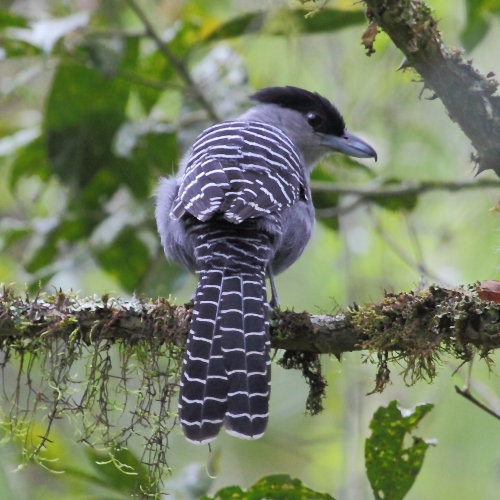
Moustached Antwren
Myrmotherula ignota
Order: Passeriformes / Family: Thamnophilidae

Wikimedia Commons
About the Moustached Antwren
The Moustached Antwren (Myrmotherula ignota) is a small, yet significant member of the Thamnophilidae family, primarily inhabiting the dense, humid lowland forests of Central and South America. Its ecological role is vital as it participates actively in the complex food webs of these ecosystems. This bird is typically found in regions such as Panama, Colombia, and Ecuador, where it prefers the understory of mature forests. The Moustached Antwren is not just a passive inhabitant of these forests; it plays an active role in seed dispersal and pest control, aiding in the maintenance of forest health. Its presence is often a sign of a well-preserved ecosystem, as it tends to avoid areas that have been heavily logged or disturbed. Seasonally, the Moustached Antwren exhibits slight changes in behavior, particularly during the breeding season when its activity levels increase. During this period, males become more vocal and territorial to attract mates and defend nesting areas. The bird's adaptability to various microhabitats within the forest allows it to exploit a range of ecological niches, although it remains closely tied to the lush, primary forests that offer ample food and shelter. This specialization makes the Moustached Antwren an indicator species for conservationists monitoring the health of tropical forests. By studying the population trends and distribution of the Moustached Antwren, researchers gain insights into the broader health of these vital ecosystems.
The Moustached Antwren belongs to the family Thamnophilidae, within the order Passeriformes. These birds typically live average 5 years with a maximum recorded of 8 years..
How to Identify a Moustached Antwren
The Moustached Antwren is a small songbird generally measuring about 10-11 cm in length. Adult males are easily distinguished by their distinctive facial markings, which include a bold white 'moustache' stripe on each side of the face. This feature is set against a contrasting dark head, which ranges from slate gray to black. The underparts are typically a paler gray, offering a sharp contrast to the darker upperparts. Females, on the other hand, show a more subdued coloration with buff or brownish tones replacing the stark black and white of the males. Juvenile Moustached Antwrens resemble the females but may display less distinct markings. In the field, the bird's perching posture is often horizontal, with a slight flick of the tail. Confusion may arise with other antwrens or small forest birds, such as the Dusky Antbird, but the facial markings of the Moustached Antwren are unique. When in flight, the bird appears to have short, rounded wings, and its flight is typically quick and direct, though it often prefers to hop between branches rather than fly over open spaces.
Having trouble telling birds apart? Upload a photo to our bird identification tool for an instant species match.
Moustached Antwren Habitat and Range
Preferred Habitat
The Moustached Antwren is primarily associated with the dense, humid lowland forests of Central and South America. It thrives in mature, primary forests with a rich understory that provides shelter and abundant food sources. Typically found at elevations up to 1,200 meters, the Moustached Antwren tends to avoid heavily disturbed areas, preferring the stability and complexity of undisturbed forest ecosystems. Seasonal habitat shifts are minimal, although breeding activities may lead them to favor particular microhabitats that provide optimal nesting conditions. Unlike some bird species, the Moustached Antwren is not commonly observed in urban or suburban areas, as it relies heavily on the dense canopy and rich biodiversity of tropical forests.
Geographic Range
The Moustached Antwren can be found throughout parts of Central and South America, with its range spanning countries such as Panama, Colombia, and Ecuador. While primarily a resident species, it exhibits limited local movements within its range, often dictated by food availability and breeding needs. Its population densities are highest in undisturbed primary forests, where it takes advantage of the rich insect life found in these ecosystems. Although not considered migratory, the Moustached Antwren may display some altitudinal movement in response to seasonal climatic changes or food resource distribution. Local population hotspots are often indicators of healthy forest ecosystems, making this species a focal point for conservation efforts in the region.
Want to know which birds visit your area? Browse our backyard birds by location guides for region-specific species lists.
What Does the Moustached Antwren Eat?
The diet of the Moustached Antwren consists mainly of insects and other small invertebrates, which it expertly gleans from leaves and branches in the dense understory of tropical forests. This bird employs a methodical foraging technique, often working in pairs or small family groups, meticulously inspecting foliage for prey. During the wet season, when insect abundance is at its peak, the Moustached Antwren focuses on a diverse array of arthropods, including spiders, caterpillars, and beetles. In drier months, when insect availability may decrease, it may supplement its diet with small fruits and seeds. Its feeding schedule is largely diurnal, with heightened activity during the early morning and late afternoon, aligning with the times of increased insect activity.
Moustached Antwren Behavior and Social Structure
The Moustached Antwren exhibits a variety of interesting behaviors that underscore its adaptability to the complex ecosystems of tropical forests. Socially, it often forms monogamous pairs, demonstrating strong territoriality especially during the breeding season. Males engage in vocal displays and physical demonstrations to ward off intruders and attract mates. Courtship behavior includes a series of calls and subtle posturing, often reinforced by the male's vibrant plumage. While generally seen in pairs or small family groups, the Moustached Antwren may occasionally participate in mixed-species foraging flocks, taking advantage of the increased protection and foraging efficiency such groups offer. In response to predators, this antwren relies on its cryptic plumage and the dense forest cover, often freezing in place to avoid detection. Daily activity patterns typically include active foraging during cooler parts of the day, with periods of rest during the midday heat.
Moustached Antwren Nesting and Reproduction
The Moustached Antwren constructs a small, cup-shaped nest, expertly camouflaged among the dense foliage of its forest habitat. Nest materials primarily consist of fine twigs, leaves, and plant fibers, bound together with spider silk. The preferred nesting sites are typically within the understory, at heights ranging from 1 to 3 meters above ground. Clutch size generally consists of 2 eggs, with both parents sharing the responsibility of incubation. The incubation period lasts approximately 14 to 16 days, after which the chicks hatch and remain in the nest for another two weeks before fledging. Both parents partake in feeding and caring for the young, ensuring their survival in the competitive forest environment. The Moustached Antwren typically raises one brood per year, although favorable conditions may occasionally lead to a second.
Moustached Antwren Sounds and Vocalizations
The primary song of the Moustached Antwren is a series of high-pitched, rapid notes that can be described as a 'tseet-tseet-tseet' pattern, often accelerating towards the end. These vocalizations serve as both mate attraction and territorial defense mechanisms, particularly prominent during the breeding season. In addition to its song, the bird emits a range of call notes, including sharp 'chip' sounds used for communication between mates and within family groups. Alarm calls are distinctly sharper and more insistent, designed to alert others to the presence of predators. During the dawn chorus, the Moustached Antwren's song intermingles with those of other bird species, contributing to the rich tapestry of sounds characteristic of tropical forests.
Interesting Facts About the Moustached Antwren
- 1The Moustached Antwren's distinctive 'moustache' stripe is not just for show; it plays a role in mate selection.
- 2Despite its small size, the Moustached Antwren holds its own in mixed-species flocks, often leading the charge in foraging expeditions.
- 3The Moustached Antwren, weighing only about 8 to 10 grams, can consume nearly its body weight in insects daily.
- 4Its song, though simple, varies slightly between individuals, potentially aiding in individual recognition among mates.
- 5The bird's preference for dense understory makes it a challenge to spot, even for seasoned birders, rendering it a prized sighting.
- 6Moustached Antwrens are monogamous, forming long-term pair bonds that contribute to their stable population dynamics.
- 7Their nests, though small, are architectural marvels, using spider silk for added strength and flexibility.
Moustached Antwren Conservation Status
The IUCN currently lists the Moustached Antwren as Least Concern, indicating a stable population trend. However, habitat loss due to deforestation poses a significant long-term threat to its survival, as this species relies heavily on primary forest environments. Conservation efforts focus on preserving large tracts of undisturbed forest, which are crucial for maintaining healthy populations. In some regions, protected areas and national parks provide refuge from the pressures of logging and agricultural expansion. Historical population changes have shown resilience, but continuous monitoring is essential to ensure that this species remains abundant in its natural habitat.