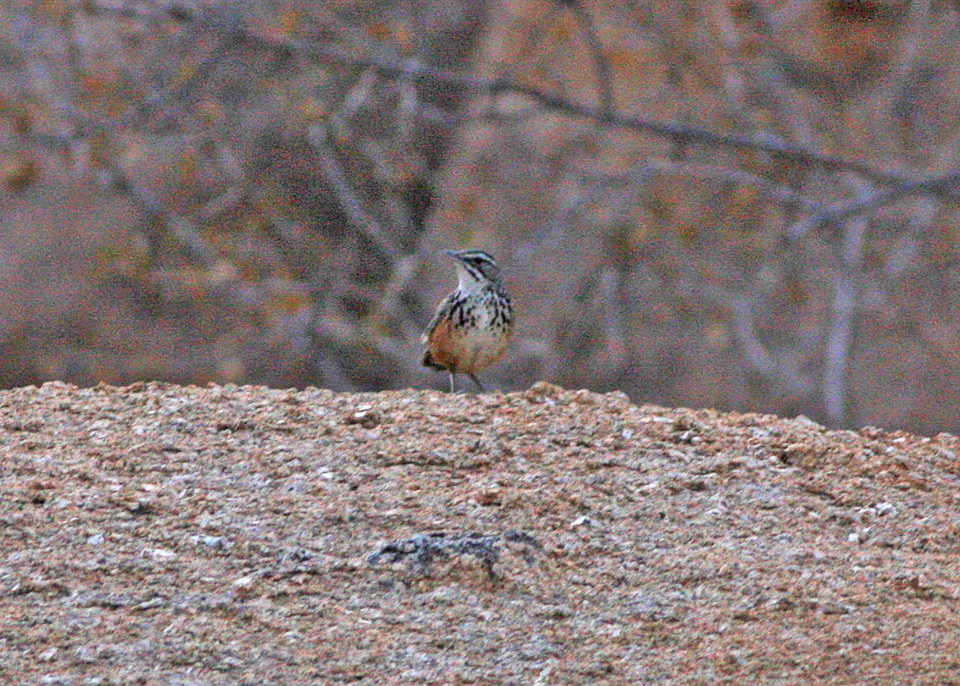
Moustached Grass-Warbler
Melocichla mentalis
Order: Passeriformes / Family: Macrosphenidae

Wikimedia Commons
About the Moustached Grass-Warbler
The Moustached Grass-Warbler (Melocichla mentalis) is a fascinating songbird that inhabits the grasslands and marshes of sub-Saharan Africa. It plays a crucial role in the ecosystem as both a predator of insects and a prey species for larger birds. This warbler is primarily found in regions like Uganda, Kenya, Tanzania, and the Democratic Republic of the Congo, thriving in areas with dense vegetation and water bodies. Its adaptability to various grassland habitats makes it a significant part of these ecosystems. During the breeding season, typically from September to April, males become highly territorial and vocal. This period coincides with the rainy season in many parts of its range, ensuring an abundance of food for the young. The Moustached Grass-Warbler's song is a familiar sound in its habitats, announcing its presence and staking its territory. Outside the breeding season, these birds may become slightly more secretive, but they remain active, continuing to forage and maintain their territories. Their ecological role extends beyond mere insect control; they also contribute to seed dispersal, albeit to a lesser extent. The Moustached Grass-Warbler's presence in various protected areas highlights its resilience and adaptability, although habitat loss remains a threat in unprotected regions. Despite these challenges, its population remains stable, thanks to its widespread distribution and adaptability.
The Moustached Grass-Warbler belongs to the family Macrosphenidae, within the order Passeriformes. These birds typically live average 6 years, with a maximum recorded of 9 years..
How to Identify a Moustached Grass-Warbler
The Moustached Grass-Warbler is a medium-sized songbird, measuring about 16 cm in length. It is easily identified by its distinctive facial pattern: a broad white supercilium, or eyebrow stripe, which gives it a 'moustached' appearance. Its upperparts are olive-brown, while the underparts are a paler buff, with some streaking visible on the chest. Juveniles resemble adults but with slightly duller plumage and less pronounced facial stripes. There is little sexual dimorphism in this species; males and females look alike, making visual sexing difficult in the field. In flight, the Moustached Grass-Warbler presents a somewhat rounded silhouette with short, rounded wings and a relatively long tail. It often perches conspicuously atop reeds or tall grasses, making its presence known through song rather than its muted coloration. The bird's behavior and habitat preferences help differentiate it from similar species, such as the Lesser Swamp-Warbler, which typically has a more uniform plumage and different habitat choice.
Having trouble telling birds apart? Upload a photo to our bird identification tool for an instant species match.
Moustached Grass-Warbler Habitat and Range
Preferred Habitat
The Moustached Grass-Warbler favors dense grasslands and marshy areas, often near water bodies. It thrives in regions with tall reed beds and abundant undergrowth, providing both food and cover. This bird can be found from lowland plains to elevations of around 1,800 meters, adapting well to the varying climates of these altitudes. While it primarily inhabits rural areas, it can occasionally be observed near urban fringes where suitable habitat exists. Seasonal shifts in habitat are minimal, as the warbler remains in regions that offer consistent water and food supply throughout the year. However, during dry periods, they may move closer to more permanent water sources.
Geographic Range
The Moustached Grass-Warbler's range spans across much of sub-Saharan Africa, from Senegal in the west to Ethiopia and down to South Africa. It is a non-migratory species, establishing year-round territories within this extensive range. Key population centers include the wetlands of the Great Rift Valley, the Okavango Delta, and the floodplains of the Zambezi River. In these regions, the bird is a common sight, benefitting from the abundant food and nesting sites. While the bulk of its population resides in rural and natural environments, some populations have been noted in protected areas, where they enjoy sanctuary from habitat destruction. The warbler's range indicates a strong resilience to localized environmental changes, although continued habitat degradation could pose future threats.
Want to know which birds visit your area? Browse our backyard birds by location guides for region-specific species lists.
What Does the Moustached Grass-Warbler Eat?
The Moustached Grass-Warbler primarily feeds on insects, playing a critical role in pest control within its ecosystem. Its diet consists of small beetles, grasshoppers, ants, and caterpillars, which it gleans from foliage or captures in mid-air. During the rainy season, an influx of insects provides ample food, supporting increased reproductive success. In drier months, the warbler may supplement its diet with seeds and small fruits, although insects remain the staple. Foraging occurs throughout the day, with peak activity in the cooler morning and late afternoon hours, when the bird can be seen flitting among grasses and reeds. Its foraging technique involves a mix of gleaning and short, agile flights to snatch insects on the wing, demonstrating its adaptability and dexterity.
Moustached Grass-Warbler Behavior and Social Structure
The Moustached Grass-Warbler is a territorial bird, especially during the breeding season, when males can be seen and heard defending their territories with loud, repetitive songs. These birds often live in pairs or small family groups, although outside the breeding season, they may join loose flocks with other small bird species. Their courtship displays involve males singing prominently from exposed perches and performing aerial chases. When faced with predators, such as snakes or larger birds, the warbler emits sharp alarm calls and employs distraction displays to protect its nest. Daily activity peaks at dawn and dusk, correlating with cooler temperatures and higher insect activity. These warblers are adept at navigating dense grass and reed beds, where they spend most of their time feeding, nesting, and hiding from predators.
Moustached Grass-Warbler Nesting and Reproduction
Moustached Grass-Warblers build their nests close to the ground, typically within dense grass or reed beds. The nest, a cup-shaped structure, is constructed from grasses, leaves, and spider silk, providing both camouflage and stability. The female lays a clutch of two to four eggs, which she incubates for about 12 to 14 days. Both parents participate in feeding the chicks, which fledge approximately 12 to 15 days post-hatching. During this time, the parents remain highly vigilant, protecting the nest from potential threats. Typically, the Moustached Grass-Warbler produces one to two broods per year, depending on food availability and environmental conditions. The breeding season aligns with the rainy season, ensuring an abundance of food for the growing chicks.
Moustached Grass-Warbler Sounds and Vocalizations
The song of the Moustached Grass-Warbler is a series of rapid, melodious notes that can be likened to a musical rattle. It is relatively high-pitched and carries well across its open habitat. This song, often delivered from a prominent perch, serves both to attract mates and to declare territory. Its call notes are sharp, metallic 'tiks' or 'prrts' used in communication between mates or as alarm calls when predators are near. During dawn and dusk, the warbler's song becomes most prevalent, contributing to the dawn chorus that characterizes its habitat. The consistent nature of its vocalizations aids birders in identifying this species amidst dense vegetation.
Interesting Facts About the Moustached Grass-Warbler
- 1The Moustached Grass-Warbler gets its name from the white 'moustache' stripe above its eyes, a unique feature among African warblers.
- 2Despite its small size, the Moustached Grass-Warbler can sing loudly enough to be heard over 100 meters away.
- 3This species is primarily insectivorous but will eat seeds, making it a versatile forager in times of scarcity.
- 4The warbler's ability to adapt to different grassland habitats helps it survive in both natural and altered landscapes.
- 5During the breeding season, males increase their singing frequency to attract females and deter rivals.
- 6The Moustached Grass-Warbler is often heard before it is seen, as its song carries well across its dense habitat.
- 7These birds are known to exhibit distraction displays, such as feigning injury, to draw predators away from their nests.
Moustached Grass-Warbler Conservation Status
Currently, the Moustached Grass-Warbler is classified as Least Concern by the IUCN, with a stable population trend. Its wide distribution and adaptability to diverse habitats contribute to its resilience. However, habitat degradation due to agricultural expansion, drainage of wetlands, and deforestation pose potential threats. Conservation efforts focus on preserving its natural habitats, particularly in protected areas, to ensure long-term viability. Observations indicate that while the species remains common in many areas, localized declines could occur without continued conservation support.