
Rockrunner
Achaetops pycnopygius
Order: Passeriformes / Family: Macrosphenidae
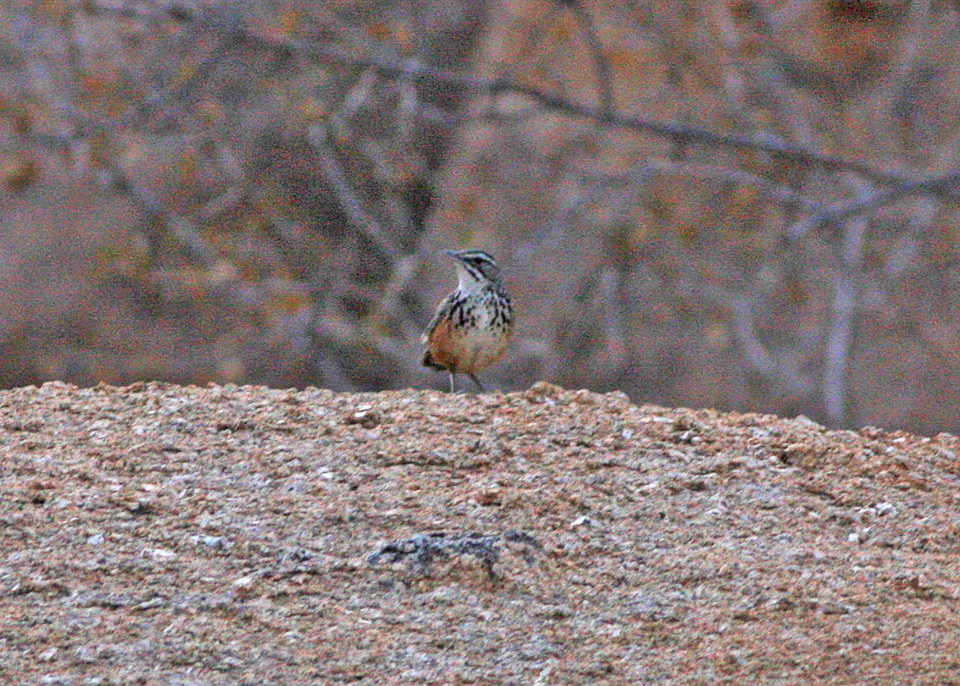
Wikimedia Commons
About the Rockrunner
The Rockrunner, or Achaetops pycnopygius, is a distinctive songbird of the Macrosphenidae family. This bird is endemic to the rocky and arid landscapes of southern Africa, notably Namibia and parts of Angola. Its presence in such specific habitats underscores its ecological significance as a specialist species. The Rockrunner thrives in areas where rocky outcrops meet sparse vegetation, primarily in semi-arid regions. Its adaptive behaviors and unique ecological niche make it a fascinating subject for both ornithologists and birdwatchers. The bird plays a critical role in its ecosystem by controlling insect populations and serving as prey for larger predators.
The Rockrunner's coloration offers both aesthetic appeal and practical camouflage. Its upperparts exhibit a rich, earthy brown, which blends seamlessly with the rocky environments it inhabits. The underparts are a contrasting pale, creamy white, providing a balance that helps in identification. The species is non-migratory, residing in its preferred habitat year-round. During the breeding season, which occurs from August to March, the Rockrunner's song becomes a prominent feature of the landscape. This period sees the birds becoming more territorial and vocal, engaging in elaborate song displays to attract mates and ward off rivals.
In terms of ecological role, the Rockrunner's foraging habits contribute significantly to the health of its habitat. By consuming insects and other invertebrates, it helps control pest populations, thus maintaining a balanced ecosystem. The bird's presence in rocky terrains also aids in seed dispersal, as it occasionally feeds on seeds and fruits. The Rockrunner's ability to thrive in harsh environments makes it an important indicator species for monitoring ecosystem health, particularly in light of climate change and habitat degradation.
The Rockrunner belongs to the family Macrosphenidae, within the order Passeriformes. These birds typically live up to 5 years in the wild..
How to Identify a Rockrunner
The Rockrunner is medium-sized, with a length of approximately 16 to 18 cm. Adult Rockrunners display a characteristic plumage that aids in identification. Their upper parts are a warm brown, while the underparts are a pale cream. This coloration provides excellent camouflage against the rocky backgrounds of their habitat. The bird has a distinct, slightly curved bill that it uses adeptly to forage for insects among rocks and crevices. Juvenile Rockrunners resemble adults but may have slightly duller plumage, which evolves as they mature. There is little sexual dimorphism, so males and females appear similar, although males tend to exhibit more vibrant plumage during the breeding season.
In flight, the Rockrunner presents a compact silhouette, with rapid wingbeats that are characteristic of many small passerines. When perched, it often adopts an upright posture, showcasing its slender profile and long tail, which aids in balance and maneuverability on uneven terrain. While there are no confusingly similar species within its limited range, birders should note its unique vocalizations and behavior to distinguish it from other sympatric species.
Having trouble telling birds apart? Upload a photo to our bird identification tool for an instant species match.
Rockrunner Habitat and Range
Preferred Habitat
The natural habitat of the Rockrunner consists of rocky outcrops, hillsides, and semi-arid regions, particularly across Namibia and southern Angola. This bird prefers areas where boulders and sparse vegetation coexist, providing both shelter and foraging opportunities. The Rockrunner thrives at elevations ranging from 300 to 1500 meters, where it can exploit the microhabitats provided by its rocky environment. While the species is predominantly found in rural and remote areas, it occasionally ventures into less disturbed urban fringes, particularly where suitable rocky habitats are preserved. Seasonal shifts in habitat use are minimal, as the Rockrunner remains in its preferred environment year-round, showing remarkable adaptability to the region's climatic conditions.
Geographic Range
The Rockrunner's range is primarily confined to southern Africa, with Namibia being the core region of its distribution. It extends into southern Angola, where similar habitat conditions prevail. Unlike many other songbirds, the Rockrunner is largely sedentary, showing little evidence of long-distance migration. As a result, its population densities are highest in regions where rocky terrains are abundant and continuous. The bird's presence in Namibia is particularly notable in the central and northern regions, where it can be observed year-round. Outside of these areas, its occurrence becomes patchier, often restricted by the availability of suitable habitat. The Rockrunner's range reflects its adaptation to specific environmental conditions, with population hotspots aligning closely with areas of geological and ecological stability.
Want to know which birds visit your area? Browse our backyard birds by location guides for region-specific species lists.
What Does the Rockrunner Eat?
The Rockrunner's diet primarily consists of insects and other small invertebrates, which it actively forages for amongst rocks and crevices. Common prey items include ants, beetles, spiders, and caterpillars. The bird employs a nimble and agile foraging technique, using its slightly curved bill to extract prey from tight spots. During the drier months, the Rockrunner may supplement its diet with seeds and small fruits, which provide essential nutrients and moisture. Its feeding schedule aligns closely with the availability of prey, peaking during the early morning and late afternoon when insect activity is highest. The Rockrunner's role as an insectivore is crucial, contributing to the control of pest populations and maintaining ecological balance in its habitat.
Rockrunner Behavior and Social Structure
The Rockrunner exhibits distinct behavioral traits that align with its rocky habitat. It is primarily a solitary bird, although pairs may be observed during the breeding season. Territories are actively defended, with males engaging in vocal displays to assert dominance and attract mates. The Rockrunner's song, a series of melodious whistles and trills, plays a critical role in territory establishment and mate attraction. Courtship displays involve synchronized vocal duets and aerial displays, reinforcing pair bonds. While generally solitary, Rockrunners may occasionally form loose flocks outside the breeding season, particularly when foraging in areas with abundant food resources.
The bird demonstrates remarkable agility and speed when navigating its rocky environment, using its long tail for balance and rapid movements to evade predators. Predation pressure comes primarily from raptors and ground predators, prompting a cautious and alert demeanor. The Rockrunner is diurnal, with peak activity occurring during the cooler parts of the day, reflecting its adaptation to the semi-arid climate.
Rockrunner Nesting and Reproduction
Rockrunners construct their nests in sheltered locations within their rocky habitat, often choosing crevices or ledges that provide protection from predators and harsh weather. The nest, a cup-shaped structure, is constructed from grasses, roots, and other plant materials, woven together with precision. A typical clutch consists of 2 to 3 eggs, which are incubated primarily by the female over a period of approximately 14 to 16 days. Once hatched, the chicks are altricial and require significant parental care. Both parents participate in feeding and caring for the young, with fledging occurring 18 to 20 days post-hatching. The Rockrunner typically raises one brood per year, although favorable conditions may allow for a second clutch. The species' breeding success is closely tied to the availability of food resources and suitable nesting sites.
Rockrunner Sounds and Vocalizations
The Rockrunner's vocal repertoire is both distinctive and melodious, characterized by a series of rich whistles and trills. Its primary song, delivered with clarity and rhythm, can be heard echoing across rocky landscapes, particularly during the breeding season. This song plays a crucial role in territorial defense and mate attraction. In addition to its song, the Rockrunner emits a variety of call notes, including sharp, quick calls used for communication between mates or alerting others to potential threats. Alarm calls are more abrupt and serve as a warning to other birds in the vicinity. The Rockrunner's vocalizations contribute to the soundscape of its habitat, especially during dawn and dusk when its song is most pronounced.
Interesting Facts About the Rockrunner
- 1The Rockrunner is one of the few bird species that has adapted to thrive in the rocky, arid landscapes of Namibia.
- 2Despite its limited range, the Rockrunner is a common sight for birders in its preferred habitats, making it an important species for eco-tourism.
- 3The Rockrunner's long tail aids in balance and agility when navigating its rocky environment, showcasing its specialized adaptation.
- 4This bird's song is not only a territorial claim but also an indicator of environmental health in its arid habitat.
- 5Rockrunners exhibit a remarkable ability to find food in seemingly barren environments, highlighting their ecological adaptability.
- 6The species' name, Achaetops pycnopygius, reflects its unique physical and behavioral characteristics, rooted in Greek terms.
- 7Rockrunner parents share responsibilities, with both taking turns to feed and care for their young during the nesting period.
Rockrunner Conservation Status
The Rockrunner is currently listed as Least Concern by the IUCN, with stable populations across its range. However, habitat destruction, particularly due to mining and urban expansion, poses a potential threat to its preferred environments. Conservation efforts focus on habitat preservation and mitigating human-induced impacts. Historical population data indicate that the Rockrunner has maintained stable numbers, benefiting from its adaptation to specific and relatively undisturbed habitats. Ongoing monitoring and habitat management are essential to ensure the long-term survival of this unique species, particularly as environmental conditions shift due to climate change.
Other Macrosphenidae Species


Birds Similar to the Rockrunner
These species are often confused with the Rockrunner due to similar appearance or overlapping range.