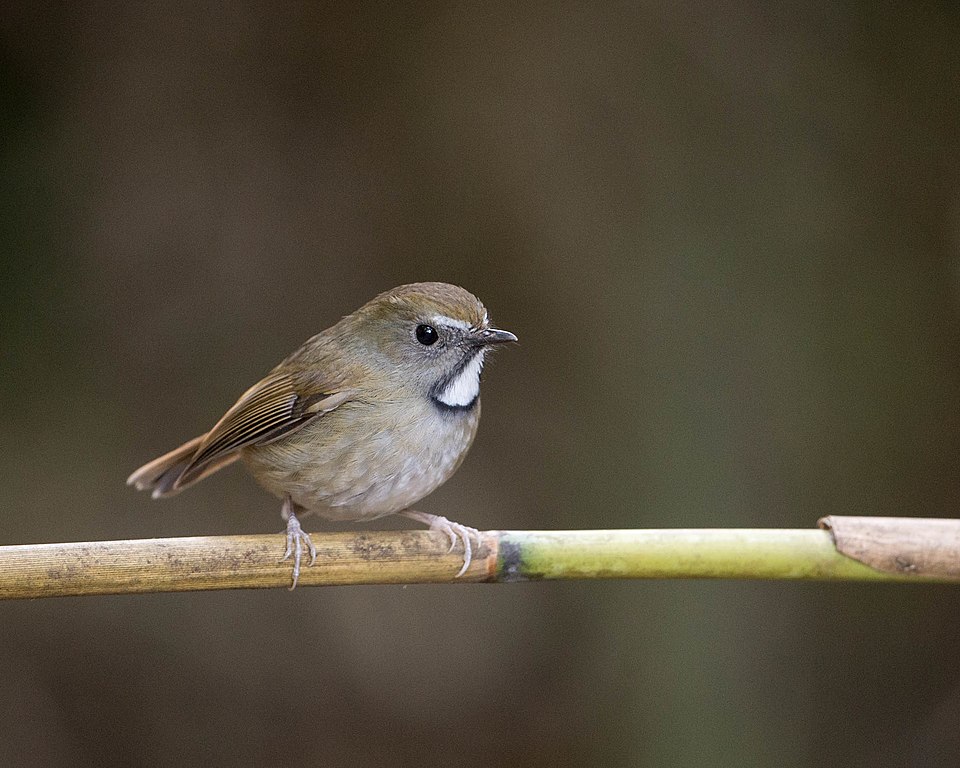
Blue-headed Crested Flycatcher
Muscicapa chalybeocephala
Order: Passeriformes / Family: Muscicapidae
About the Blue-headed Crested Flycatcher
The Blue-headed Crested Flycatcher, scientifically known as Muscicapa chalybeocephala, is a small, vibrantly colored bird belonging to the Muscicapidae family. This bird is an emblem of the African forests, with its distribution primarily across West and Central Africa. It inhabits regions with dense canopy cover, where it can be seen darting through the underbrush, skillfully catching insects mid-flight. The Blue-headed Crested Flycatcher plays a crucial ecological role as both a predator and a prey species. It helps control insect populations, thus maintaining the balance within its ecosystem. Throughout the year, this flycatcher remains mostly sedentary, showing little to no migratory behavior. However, it does exhibit some altitudinal movements in response to seasonal food availability. During the breeding season, which typically occurs in the wet months, the bird becomes more vocal and territorial. Its presence is a vital indicator of forest health, making it significant for biodiversity studies and conservation efforts in its native range.
The Blue-headed Crested Flycatcher belongs to the family Muscicapidae, within the order Passeriformes. These birds typically live typically around 4-6 years, with some living up to 8 years..
How to Identify a Blue-headed Crested Flycatcher
The adult Blue-headed Crested Flycatcher is easily identified by its distinctive blue head, which contrasts sharply with its olive-green upperparts and pale underparts. The species is sexually dimorphic, with males displaying a slightly more vivid blue coloration than females. Juveniles, on the other hand, have a duller overall appearance, lacking the full intensity of the adult's blue crest. This bird can be confused with the closely related Grey-headed Flycatcher, but the latter lacks the bright blue coloration. In flight, the Blue-headed Crested Flycatcher shows a compact silhouette with rapid wingbeats, while its perching posture is upright and alert, often seen sitting on low branches waiting to sally out for insects.
Having trouble telling birds apart? Upload a photo to our bird identification tool for an instant species match.
Blue-headed Crested Flycatcher Habitat and Range
Preferred Habitat
The Blue-headed Crested Flycatcher favors dense, humid forest environments, particularly lowland tropical rainforests. It is commonly found in primary and secondary forests, as well as in forest edges where more sunlight penetrates. The species shows a preference for elevations ranging from sea level up to 1,500 meters, although it is most abundant in lower elevations. Unlike some other flycatcher species, it is less frequently found in highly urbanized areas, although it can adapt to gardens and parks in rural settings.
Geographic Range
This flycatcher's range extends across several African countries, including Ghana, Nigeria, and Cameroon. Its presence is most concentrated in the Congo Basin, where dense forest habitats provide optimal conditions. The bird does not undertake long migrations but may show slight local movements in search of food resources. As a resident species, population densities can vary significantly, with hotspots existing in areas of high insect abundance.
Want to know which birds visit your area? Browse our backyard birds by location guides for region-specific species lists.
What Does the Blue-headed Crested Flycatcher Eat?
The diet of the Blue-headed Crested Flycatcher primarily consists of insects, particularly small flying insects such as flies, beetles, and moths. It employs a classic flycatching technique, sallying out from a perch to snatch prey mid-air with impressive agility. During the wetter months, when insect populations peak, its diet may expand to include spiders and other arthropods. The bird typically forages during daylight hours, with peak activity in the early morning and late afternoon.
Blue-headed Crested Flycatcher Behavior and Social Structure
Socially, the Blue-headed Crested Flycatcher is typically solitary or found in pairs, particularly during the breeding season. It is territorial and males often engage in vocal displays to establish dominance and attract mates. These displays involve quick, darting flights and a series of whistles and calls. The bird tends to be more active at dawn and dusk, spending the hottest part of the day resting in shaded areas. When alerted to predators, it emits a sharp alarm call and may join mixed-species flocks to enhance vigilance.
Blue-headed Crested Flycatcher Nesting and Reproduction
The Blue-headed Crested Flycatcher constructs a cup-shaped nest using fine grasses, leaves, and spider silk, typically placed in a fork of a tree branch. These nests are well-hidden within dense foliage to protect against predators. A typical clutch consists of two to three eggs, which are incubated by the female for approximately two weeks. Both parents participate in feeding the hatchlings, which fledge about 18 days after hatching. Generally, the species raises one brood per year, though in food-rich years a second brood may occur.
Blue-headed Crested Flycatcher Sounds and Vocalizations
The primary song of the Blue-headed Crested Flycatcher is a series of high-pitched whistles, often described as musical and melodic. These songs serve both to establish territory and attract mates. Its call notes are sharp and quick, acting as a means of communication between individuals. When alarmed, the bird emits a rapid series of staccato notes that alert others to the presence of a potential threat. During the dawn chorus, its song is particularly prominent and often one of the first to be heard in the forest.
Interesting Facts About the Blue-headed Crested Flycatcher
- 1The Blue-headed Crested Flycatcher can catch insects in flight with remarkable precision, a trait that defines its feeding behavior.
- 2Despite its vibrant blue head, the rest of the Blue-headed Crested Flycatcher's body is more muted, aiding in camouflage.
- 3This species is a year-round resident in its range, showing minimal migratory behavior compared to other flycatchers.
- 4The Blue-headed Crested Flycatcher's nest is often lined with spider silk, providing both structure and flexibility.
- 5Its melodious song can often be heard echoing through the African forests during the early morning hours.
- 6The species plays a crucial role in controlling insect populations, serving as a natural pest controller in its ecosystem.
- 7Though primarily insectivorous, the Blue-headed Crested Flycatcher occasionally adds small fruits to its diet.
Blue-headed Crested Flycatcher Conservation Status
Currently, the Blue-headed Crested Flycatcher is not considered at risk, classified by the IUCN as a species of Least Concern. Its population trend appears stable, but habitat destruction due to deforestation poses a potential threat. Conservation efforts focus on preserving large tracts of forest habitat to ensure the survival of this and other forest-dependent species. Historically, population numbers have fluctuated with changes in forest cover, highlighting the importance of sustainable land-use practices.