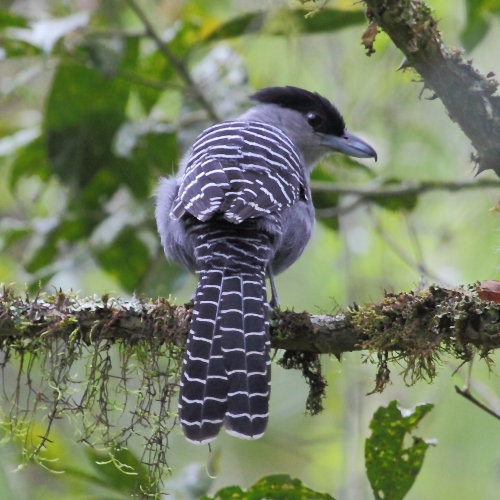
Northern Rufous-winged Antwren
Herpsilochmus scapularis
Order: Passeriformes / Family: Thamnophilidae
About the Northern Rufous-winged Antwren
The Northern Rufous-winged Antwren, Herpsilochmus scapularis, is a fascinating species within the Thamnophilidae family, primarily found in the lowland forests of South America. Characterized by its rufous-colored wing patches, this small bird thrives in the subtropical and tropical moist lowland forests, particularly in regions of Brazil and Bolivia. The antwren plays a crucial ecological role by controlling insect populations, including ants and other arthropods, which it skillfully gleans from foliage.
This bird is a year-round resident throughout its range, showing remarkable adaptability to different forest environments. It often inhabits the understory and mid-story layers, where it can be heard more often than seen due to its secretive nature. The Northern Rufous-winged Antwren is part of a diverse avian community that contributes to the rich biodiversity of the Neotropical forests.
During the breeding season, which aligns with the rainy season in its habitat, the antwren exhibits heightened territoriality and vocal activity. This period is crucial for its reproductive success, as the abundance of food resources supports its energy-demanding nesting activities. As an insectivore, the Northern Rufous-winged Antwren plays a significant role in maintaining the health of its forest ecosystem by reducing insect herbivory on plants, thus fostering plant growth and diversity.
The Northern Rufous-winged Antwren belongs to the family Thamnophilidae, within the order Passeriformes. These birds typically live average 5 years with a max recorded of 7 years..
How to Identify a Northern Rufous-winged Antwren
The Northern Rufous-winged Antwren is a small bird, measuring approximately 12-13 cm in length. The adult male is easily identified by its striking rufous wing coverts, contrasting with its mostly gray body and black-and-white streaked head. The female, while similar, often exhibits slightly duller plumage with less pronounced streaking on the head. Juveniles resemble females but with more muted tones and less defined markings.
One might confuse the Northern Rufous-winged Antwren with other Herpsilochmus species, but its unique wing coloration serves as a reliable field mark. In flight, the bird displays a rapid, fluttering motion, often interspersed with short glides. When perched, it maintains a horizontal posture, frequently flicking its tail and wings.
The antwren's vocalizations, a series of sharp, staccato notes, also aid in identification, especially in dense forest habitats where visual confirmation can be challenging. Observers should note the bird's tendency to forage actively, often in mixed-species flocks, which is another key behavioral trait.
Having trouble telling birds apart? Upload a photo to our bird identification tool for an instant species match.
Northern Rufous-winged Antwren Habitat and Range
Preferred Habitat
The Northern Rufous-winged Antwren inhabits subtropical and tropical moist lowland forests, favoring areas with dense understory and mid-story vegetation. It is found at elevations ranging from sea level up to approximately 1000 meters, though it generally prefers lower elevations. This species is predominantly associated with primary and well-preserved secondary forests, where it can find ample cover and food sources.
Unlike some other antwren species, it does not commonly venture into urban or heavily disturbed environments, relying instead on the intricate structure of mature forests to support its lifestyle. Seasonal habitat shifts are minimal as it remains within its favored forested areas year-round, but individuals may move locally in response to food availability or breeding needs.
Geographic Range
The Northern Rufous-winged Antwren is primarily distributed across the northern regions of South America, with its range encompassing parts of Brazil, Bolivia, and occasionally extending into adjacent areas. It does not undertake long-distance migrations, maintaining a relatively stable presence within its established range throughout the year.
In Brazil, it is particularly concentrated in the Amazon Basin and along the eastern slopes of the Andes. While population density can vary, the species is generally more common in regions where large tracts of suitable forest habitat remain intact. In Bolivia, its presence is noted in the lowland forests along the northern borders, where similar environmental conditions prevail.
Want to know which birds visit your area? Browse our backyard birds by location guides for region-specific species lists.
What Does the Northern Rufous-winged Antwren Eat?
The Northern Rufous-winged Antwren primarily feeds on insects, with ants and small arthropods comprising the bulk of its diet. It employs a methodical gleaning technique, picking prey from leaves and twigs with precision. This antwren often joins mixed-species foraging flocks, which increases its feeding efficiency by allowing it to exploit the disturbances caused by other birds as they move through the forest.
Seasonal changes in diet are minimal, as it relies on the consistent availability of insect prey within its forest habitat. However, during the breeding season, the bird may increase its intake to meet the higher energy demands. Prey size is generally small, with the bird focusing on easily manageable insects that support its small stature and nimble foraging style.
Northern Rufous-winged Antwren Behavior and Social Structure
The Northern Rufous-winged Antwren exhibits a predominantly solitary and territorial behavior, especially during the breeding season, when males aggressively defend their territories through vocalizations and displays. Outside of this period, it often participates in mixed-species flocks, which provide safety in numbers and increased foraging opportunities.
Courtship displays involve males showcasing their rufous wing patches through exaggerated movements and vocalizations to attract females. These displays are crucial for pair formation and the subsequent nesting period. Daily activity peaks during the early morning and late afternoon, times when the bird is most actively foraging and vocalizing.
In response to predators, the antwren employs a combination of alarm calls and evasive maneuvers, retreating into denser cover when threatened. Despite its small size, the Northern Rufous-winged Antwren is a resilient and adaptive species, navigating the complexities of its forest habitat with agility and skill.
Northern Rufous-winged Antwren Nesting and Reproduction
The Northern Rufous-winged Antwren constructs a compact cup-shaped nest, typically situated in dense foliage within the understory. The nest is constructed from fine plant materials, including twigs, leaves, and spider silk, providing both camouflage and structural integrity.
Preferred nesting sites are usually 1-3 meters above the ground, often in shrubs or lower branches of trees, where they are concealed from predators. The typical clutch consists of 2 or 3 eggs, which are incubated primarily by the female, though the male may assist occasionally.
The incubation period lasts roughly 14-16 days, after which both parents participate in feeding the altricial chicks. Fledging occurs approximately 12-15 days post-hatching, although the young may remain dependent on their parents for several weeks. The species typically raises one brood per year, although favorable conditions may allow for a second.
Northern Rufous-winged Antwren Sounds and Vocalizations
The Northern Rufous-winged Antwren produces a distinctive song composed of sharp, staccato notes delivered in rapid succession. This vocalization, often compared to the sound of a sewing machine, serves as a primary means of communication, particularly during the breeding season when establishing territory is crucial.
In addition to its song, the antwren emits short, harsh call notes used to maintain contact with mates or signal alarm. When threatened, it may produce a series of rapid, high-pitched notes to alert others of potential danger.
This bird is most vocal during dawn and dusk, participating in the forest's dynamic soundscape. Its calls, though generally subtle, are an integral part of its behavioral repertoire, enabling it to navigate and thrive in the dense forest environment.
Interesting Facts About the Northern Rufous-winged Antwren
- 1The Northern Rufous-winged Antwren's reliance on mixed-species flocks is a strategy that enhances its foraging success and protection from predators.
- 2This antwren is one of the few species that can be heard more often than seen, due to its preference for dense forest understory.
- 3Insects make up approximately 90% of the Northern Rufous-winged Antwren's diet, emphasizing its role as a dedicated insectivore.
- 4The bird's flight is characterized by rapid wing beats and short glides, a common trait among small forest birds.
- 5While many birds exhibit sexual dimorphism, the Northern Rufous-winged Antwren displays subtle differences between males and females, primarily in plumage brightness.
Northern Rufous-winged Antwren Conservation Status
The Northern Rufous-winged Antwren is currently classified as Least Concern by the IUCN, indicating a stable population trend. However, ongoing deforestation and habitat fragmentation pose significant threats, particularly in regions where logging and agricultural expansion continue. Efforts to conserve the species focus on habitat preservation and the establishment of protected areas within its range. Historical population data suggests stability, but continued monitoring is essential to ensure that environmental pressures do not lead to declines. Conservation initiatives aim to balance human development with ecosystem health, promoting sustainable practices that benefit both the antwren and other forest-dependent species.