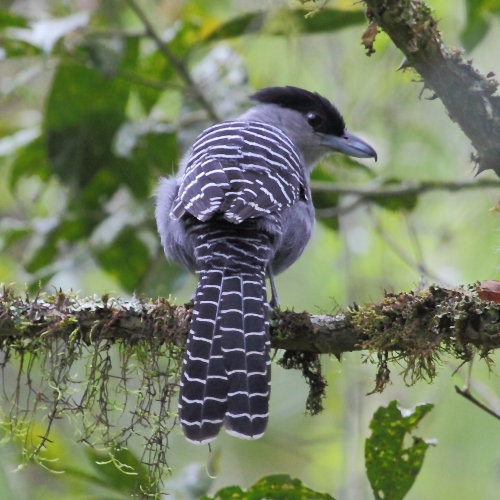
Northern Slaty-Antshrike
Thamnophilus punctatus
Order: Passeriformes / Family: Thamnophilidae

Wikimedia Commons
About the Northern Slaty-Antshrike
The Northern Slaty-Antshrike (Thamnophilus punctatus) is a notable member of the Thamnophilidae family, inhabiting the rich tropical forests of Central and South America. This species plays a critical role in the ecosystem as a predator of insects, helping to control pest populations. Found primarily in countries such as Panama, Colombia, and Venezuela, the Northern Slaty-Antshrike prefers dense understory environments where it can stealthily forage for its prey. Its presence indicates a healthy, biodiverse forest ecosystem. This bird is non-migratory and is typically observed throughout the year, with no significant shifts in range between seasons. Its ecological significance extends to its role as a prey species for larger predators, thus contributing to the food web balance. During the breeding season, which varies slightly depending on the region, the Northern Slaty-Antshrike becomes more vocal and active as it defends its territory and attracts mates. Its ability to thrive in a variety of forested habitats, from lowland rainforests to subtropical woodlands, demonstrates its adaptability, although it is sensitive to deforestation and habitat fragmentation. Conservation efforts are necessary to ensure the preservation of its natural habitats, which are increasingly threatened by human activities.
The Northern Slaty-Antshrike belongs to the family Thamnophilidae, within the order Passeriformes. These birds typically live average 5 years, with a maximum recorded of 8 years..
How to Identify a Northern Slaty-Antshrike
Identifying the Northern Slaty-Antshrike involves noting its distinctive slate-gray plumage, which sets it apart from many other forest birds. Adult males and females exhibit slight differences, with males generally having a more uniformly dark gray coloration, while females often display a slightly browner tinge on their underparts. Juveniles may appear duller, with a more mottled appearance. The bird's size is relatively small, measuring about 15 cm in length, which aids it in navigating through thick vegetation. Its sharp, slightly curved bill is adapted for insect hunting, and its short tail often flicks as it moves through the underbrush. In flight, the Northern Slaty-Antshrike appears compact and agile, though it is more commonly seen hopping and perching among dense foliage. Its posture is typically upright, which can help differentiate it from similar species like the Barred Antshrike, which tends to show more prominent barring on its body. The Northern Slaty-Antshrike's plumage and behavior make it a distinct presence in its preferred habitats.
Having trouble telling birds apart? Upload a photo to our bird identification tool for an instant species match.
Northern Slaty-Antshrike Habitat and Range
Preferred Habitat
The Northern Slaty-Antshrike thrives in tropical and subtropical forests, particularly favoring dense understory layers. It is commonly found in lowland rainforests, as well as secondary growth forests and edges. This species can be seen from sea level up to elevations of about 1,200 meters. While it primarily inhabits natural forest settings, it can sometimes be found in overgrown plantations and shrubby areas near human settlements. Unlike some forest birds, the Northern Slaty-Antshrike does not adapt well to urban environments, preferring the cover and resources provided by untouched or minimally disturbed habitats. Seasonal habitat shifts are minimal, as this bird is non-migratory and relies on the evergreen nature of its forest home for year-round sustenance and shelter.
Geographic Range
The Northern Slaty-Antshrike has a wide range across Central and South America, with its core distribution in countries like Panama, Colombia, and Venezuela. It also extends into parts of Costa Rica and northern Brazil. This species is resident throughout its range and does not exhibit migratory behavior, maintaining a year-round presence in these areas. Population densities are typically highest in regions with extensive, undisturbed forest cover, such as the Amazon basin and the Darién Gap region in Panama. Despite its broad range, local populations can be patchy, influenced by habitat availability and quality. The Northern Slaty-Antshrike tends to avoid heavily deforested or highly urbanized areas, which restricts its range in regions with significant human development.
Want to know which birds visit your area? Browse our backyard birds by location guides for region-specific species lists.
What Does the Northern Slaty-Antshrike Eat?
The diet of the Northern Slaty-Antshrike consists primarily of insects and other small arthropods. It employs a methodical foraging technique, moving through dense foliage to glean prey from leaves and branches. This bird often hunts in mixed-species flocks, taking advantage of the increased vigilance and foraging efficiency such groups provide. The Northern Slaty-Antshrike's diet can vary slightly with the seasons, depending on the availability of specific insect prey, but it generally maintains a consistent insectivorous diet throughout the year. Prey size typically ranges from small beetles and ants to larger caterpillars and spiders. The bird is most active during the early morning and late afternoon, coinciding with peak insect activity, which maximizes its foraging success.
Northern Slaty-Antshrike Behavior and Social Structure
The Northern Slaty-Antshrike displays a range of behaviors that reflect its adaptation to life in dense forest habitats. It is often observed in pairs or small family groups, maintaining a clear territory throughout the year. Territorial disputes are common, especially during the breeding season, and involve vocal displays and occasional physical confrontations. Courtship includes a series of calls and mutual preening between pairs. This species is not particularly social outside of its family unit but will join mixed-species flocks for foraging, benefiting from the collective alertness and diverse prey strategies. Its response to predators includes using dense cover for concealment and emitting sharp alarm calls to warn others. Daily activities are centered around feeding, with periods of rest during the hottest parts of the day.
Northern Slaty-Antshrike Nesting and Reproduction
The Northern Slaty-Antshrike constructs its nest low in the underbrush, often within 1 to 3 meters off the ground. The nest is a small cup made of leaves, twigs, and plant fibers, carefully woven to blend into its surroundings. A typical clutch consists of two eggs, which both parents incubate over a period of approximately 14 days. Following hatching, the altricial chicks remain in the nest for another two weeks, during which time both parents are actively involved in feeding and caring for them. The species typically raises one brood per year, although in favorable conditions, a second brood may be attempted. Parental roles are shared, with both male and female participating in brooding and feeding the young, ensuring a high level of care and protection.
Northern Slaty-Antshrike Sounds and Vocalizations
The primary song of the Northern Slaty-Antshrike is a series of sharp, metallic notes that rise and fall in a rhythmic pattern, often described as 'tik-tik-tik-tik-tik'. These calls are clear and penetrating, aiding in territory establishment and mate attraction. In addition to its primary song, the bird emits various softer call notes used for communication between mates and family members. Alarm calls are more abrupt and harsh, designed to alert others of nearby threats. The dawn chorus of the Northern Slaty-Antshrike is a robust part of its daily routine, as males and females often sing in tandem to reinforce pair bonds and territorial boundaries.
Interesting Facts About the Northern Slaty-Antshrike
- 1The Northern Slaty-Antshrike is known for its 'ant-following' behavior, where it hunts insects disturbed by army ant swarms.
- 2Despite its small size, the Northern Slaty-Antshrike is an aggressive defender of its territory, often confronting intruders with loud calls.
- 3This antshrike's diet includes a wide range of arthropods, from small ants to large spiders, showcasing its adaptability as a predator.
- 4Unlike many birds, the Northern Slaty-Antshrike often forages in mixed-species flocks, benefiting from the collective vigilance.
- 5The species' name 'punctatus' refers to the fine spotting on its plumage, a distinctive feature that aids in camouflage.
- 6The Northern Slaty-Antshrike has a relatively wide range but is highly dependent on intact forest ecosystems for survival.
- 7Birdwatchers often locate the Northern Slaty-Antshrike by its distinctive song, a series of quick, metallic notes that pierce through the forest.
Northern Slaty-Antshrike Conservation Status
The Northern Slaty-Antshrike currently holds a status of Least Concern according to the IUCN Red List. However, populations face threats from habitat loss due to deforestation and land conversion for agriculture. While the species is not considered endangered, ongoing habitat destruction could pose significant risks if not addressed. Conservation efforts focus on preserving large tracts of forest and promoting sustainable land-use practices. Historically, the Northern Slaty-Antshrike's population has remained stable where adequate habitat is available, but localized declines have been noted in heavily logged or converted areas. Continued monitoring and habitat protection are crucial for maintaining healthy populations.