
Oceanites zaloscarthmus
Oceanites zaloscarthmus
Order: Procellariiformes / Family: Hydrobatidae
About the Oceanites zaloscarthmus
The Oceanites zaloscarthmus is a fascinating seabird that occupies a niche within the family Hydrobatidae. This bird, also known as the Pincoya Storm-petrel, is primarily found in the South Atlantic Ocean, particularly around the waters off the coast of Chile and Argentina. Its presence is significant due to its niche adaptation to subtropical marine environments. As a member of the order Procellariiformes, the Pincoya Storm-petrel is closely related to other seabirds such as albatrosses and shearwaters.
In terms of ecological role, the Oceanites zaloscarthmus participates in the marine food web as both predator and prey. Its diet consists mainly of small marine organisms, making it an essential player in controlling the population of these species. This storm-petrel also provides a food source for larger predators, both avian and aquatic. The bird's seasonal behaviors are closely tied to oceanographic conditions. During the breeding season, they are known to form loose colonies on remote islands, while in non-breeding periods, they disperse across the ocean in search of food.
The Oceanites zaloscarthmus's significance extends to its role as an indicator species. Changes in its population dynamics can reflect broader environmental shifts, such as sea temperature changes or shifts in prey availability. Thus, the Pincoya Storm-petrel serves as a valuable subject for ecological and environmental studies focused on marine ecosystems. Conservationists pay close attention to this bird, as its presence and abundance can provide insights into the health of the subtropical marine environments it inhabits.
The Oceanites zaloscarthmus belongs to the family Hydrobatidae, within the order Procellariiformes. These birds typically live average 8 years with max recorded at 10 years.
How to Identify a Oceanites zaloscarthmus
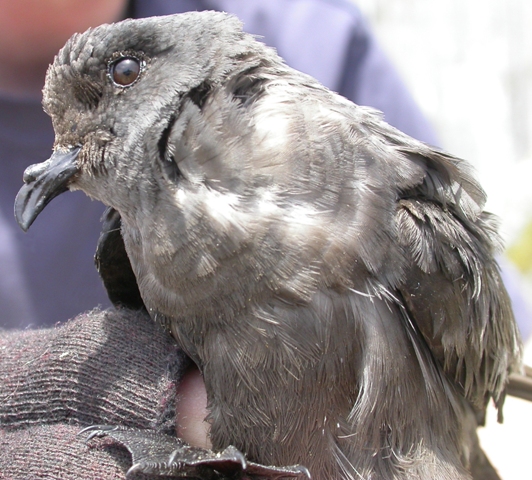
The Pincoya Storm-petrel is a small seabird, measuring about 18 to 21 centimeters in length with a wingspan of approximately 46 centimeters. Adult plumage is predominantly dark, with a distinctive white rump that is visible in flight, a key field mark for identification. The bird's upperparts are sooty black, while its underparts are slightly lighter. Juveniles resemble adults but may exhibit a duller plumage.
In terms of sexual dimorphism, there are no significant differences between males and females in plumage or size, making visual identification of sex challenging. However, during the breeding season, males may exhibit slightly more aggressive behaviors as part of their courtship displays.
The Oceanites zaloscarthmus can be confused with the Wilson's Storm-petrel, which shares similar habitats. The most noticeable difference is the Pincoya's more pronounced white rump and slightly longer legs. In flight, the Pincoya Storm-petrel exhibits a distinctive fluttering pattern interspersed with glides, and it rarely perches, preferring to remain airborne or on the water's surface.
Having trouble telling birds apart? Upload a photo to our bird identification tool for an instant species match.
Oceanites zaloscarthmus Habitat and Range
Preferred Habitat
The Pincoya Storm-petrel inhabits subtropical marine environments, specifically the open ocean waters of the South Atlantic. It is commonly found in areas with warm sea temperatures and is known to frequent upwelling zones rich in marine life, which provide ample feeding opportunities.
The bird typically occupies zones close to the continental shelf but is also seen far from land, especially during foraging trips. While primarily pelagic, it returns to land during the breeding season, nesting on remote, predator-free islands. It does not show a preference for urban areas and is rarely seen in coastal or inland habitats.
The Oceanites zaloscarthmus exhibits some seasonal habitat shifts associated with breeding and non-breeding periods. During the breeding season, it may be found closer to its nesting sites, while in non-breeding periods, it disperses over wide oceanic areas. This bird is not commonly observed at high elevations, as it prefers the sea level habitat of the open ocean.
Geographic Range
The breeding range of the Oceanites zaloscarthmus is concentrated around the southern coasts of South America, specifically near Chile and Argentina. During the breeding season, colonies are often established on isolated islands in the South Atlantic, where human disturbance and predation are minimal.
Its wintering range extends over a broader expanse of the South Atlantic Ocean, as these birds are pelagic and capable of covering great distances in search of food. Migration corridors are not well-defined due to the bird's pelagic nature, but movements are largely influenced by ocean currents and food availability.
Population density hotspots for the Pincoya Storm-petrel are typically associated with areas of oceanic upwelling, where nutrient-rich waters support abundant marine life. These hotspots are often transient, shifting with changes in oceanographic conditions. The bird is not prevalent in inland areas and is rarely observed along the coast outside the breeding season.
Want to know which birds visit your area? Browse our backyard birds by location guides for region-specific species lists.
What Does the Oceanites zaloscarthmus Eat?
The Oceanites zaloscarthmus primarily feeds on small marine organisms, including plankton, small fish, and crustaceans. Its diet varies seasonally, with a greater reliance on zooplankton during non-breeding periods when fish and crustaceans are less available.
Foraging techniques are adapted to its pelagic lifestyle. The Pincoya Storm-petrel often employs a surface-seizing method, skimming the water's surface to catch prey with its beak. This technique is facilitated by its long legs and wings, which allow it to hover close to the water while maintaining a balanced flight.
Prey size is typically small, reflecting the availability of oceanic plankton and small fish. The bird's feeding schedule is largely dictated by the diurnal movements of its prey, with increased feeding activity observed during dawn and dusk when marine life is more accessible near the surface. This adaptability in diet and foraging behavior underscores the bird's resilience in the dynamic marine environment.
Oceanites zaloscarthmus Behavior and Social Structure
The Pincoya Storm-petrel exhibits intriguing social and territorial behaviors, often forming loose colonies during the breeding season. While generally solitary in feeding, they exhibit cooperative behaviors when nesting, sharing territories with other storm-petrels to reduce predation risks.
Courtship displays involve aerial maneuvers, where males perform intricate flight patterns to attract females. This behavior is coupled with vocalizations that are less frequent outside the breeding season. The bird shows minimal territorial aggression, relying instead on its remote nesting sites for protection.
In response to predators, such as larger seabirds and marine mammals, the Oceanites zaloscarthmus relies on its agile flight and elusive behavior. It often takes to the air quickly and may choose isolated oceanic areas to minimize encounters. Daily activity patterns reflect the availability of prey, with increased activity during dawn and dusk. The bird remains largely inactive at night, resting on the water's surface.
Oceanites zaloscarthmus Nesting and Reproduction
The Oceanites zaloscarthmus prefers to nest in crevices or burrows on remote islands, often utilizing natural rock formations or burrowing into soft soil. These nests offer protection from the elements and predators. The bird constructs its nest using materials such as small twigs, grass, and feathers, forming a simple structure to house its eggs.
A typical clutch consists of a single egg, which is incubated by both parents over a period of approximately 40 to 50 days. The shared incubation duties allow one parent to forage while the other remains on the nest. Once hatched, the chick is cared for by both parents, who continue to alternate between foraging and guarding.
Fledging occurs after about 60 to 70 days, with the young bird gaining independence soon after. The Pincoya Storm-petrel typically raises one brood per year, as the extended care required for each chick limits the potential for multiple broods. This low reproductive rate emphasizes the importance of high chick survival for population stability.
Oceanites zaloscarthmus Sounds and Vocalizations
The primary song of the Oceanites zaloscarthmus is a series of soft, repetitive chirps, with a rhythm that increases during courtship. The pitch is relatively high, and the quality is described as a gentle twittering.
Call notes are brief and are often heard during flight, serving as communication between individuals within a flock. Alarm calls are sharper and more urgent, signaling the presence of a threat.
During the dawn chorus, particularly at breeding colonies, these birds produce a more varied repertoire, although they remain quieter than many other seabirds. The sound is reminiscent of soft whistles, punctuated by occasional trills. These vocalizations are crucial for maintaining pair bonds and coordinating group activities.
Interesting Facts About the Oceanites zaloscarthmus
- 1Oceanites zaloscarthmus was only described as a distinct species in 2011, highlighting its elusive nature.
- 2The Pincoya Storm-petrel has one of the most restricted breeding ranges of any storm-petrel, confined to a few islands.
- 3Despite its small size, the Pincoya Storm-petrel can travel hundreds of kilometers in search of food.
- 4Its white rump acts as a visual cue during flight, helping individuals maintain contact in flocks.
- 5The name 'zalo scarthmus' derives from Greek, meaning 'clear water', referencing its oceanic habitat.
- 6This storm-petrel uses its long legs to patter on the water's surface, a unique feeding behavior.
- 7The Pincoya Storm-petrel's breeding colonies are so remote that they are rarely disturbed by humans.
Oceanites zaloscarthmus Conservation Status
As of the latest assessments, the Oceanites zaloscarthmus is classified as Near Threatened by the IUCN. The population trend appears to be stable, though data is limited due to the bird's remote habitat. Primary threats include climate change, which affects ocean temperatures and prey availability, as well as potential disturbances from human activities on breeding islands. Conservation efforts focus on protecting breeding sites by establishing marine reserves and minimizing human impact. Historically, the population has experienced fluctuations linked to environmental changes. Current efforts aim to monitor these trends through ongoing research and habitat protection, ensuring the species' continued survival in a rapidly changing world.
Other Hydrobatidae Species



Birds Similar to the Oceanites zaloscarthmus
These species are often confused with the Oceanites zaloscarthmus due to similar appearance or overlapping range.

