Ocellated Antbird
Phaenostictus mcleannani
Order: Passeriformes / Family: Thamnophilidae

Wikimedia Commons
About the Ocellated Antbird
The Ocellated Antbird (Phaenostictus mcleannani) is a unique and captivating species that thrives in the understory of humid tropical forests. This bird is primarily found in Central America, with its range extending from Honduras through Costa Rica and into western Panama. It plays a crucial role in the ecosystem as a specialized ant-following bird, relying heavily on army ant swarms to flush out insect prey. The Ocellated Antbird's ecological significance cannot be overstated, as it helps control insect populations and contributes to the biodiversity of its forest habitat.
Renowned for its striking appearance, the Ocellated Antbird is named for the distinctive ocelli, or eye-like spots, on its plumage. These spots are not merely ornamental; they serve as a form of camouflage, breaking up the bird's outline among the dappled light of the forest floor. The antbird's behavior is deeply intertwined with the army ants it follows. These birds are most active when the ant swarms are at their peak, usually during the wet season when ant activity increases.
During the dry season, the Ocellated Antbird may exhibit nomadic tendencies, moving in search of active ant swarms. Its dependence on army ants makes it vulnerable to changes in ant population dynamics, which can be influenced by climate and habitat alterations. Despite these challenges, the Ocellated Antbird remains a vital component of its ecosystem, illustrating the complex interplay between species within tropical forests.
The Ocellated Antbird belongs to the family Thamnophilidae, within the order Passeriformes. These birds typically live average 5-7 years, with a maximum recorded of 10 years..
How to Identify a Ocellated Antbird
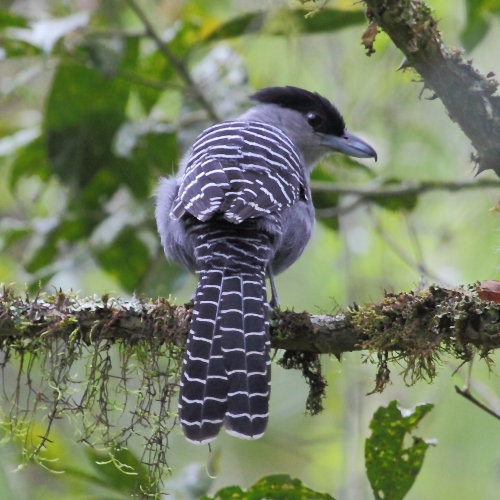
The adult Ocellated Antbird boasts a distinctive plumage, with a base color of rich brown. Its most notable feature is the series of blue-black spots that resemble eyes, or ocelli, adorning its wings and back. These spots provide excellent camouflage in the dappled light of the forest understory. In addition to these spots, the bird's head is marked by a striking blue facial skin that surrounds its eyes, adding to its unique appearance.
Juveniles of the species exhibit a duller plumage, with less pronounced ocelli and a more muted blue around their eyes, making them less conspicuous in their natural habitat. Both males and females share similar plumage, although males tend to be slightly larger, a common trait among many bird species. When comparing the Ocellated Antbird to similar species, such as the Bicolored Antbird, the ocelli serve as a definitive field mark, as the latter lacks these eye-catching spots.
In flight, the Ocellated Antbird presents a compact silhouette, with short, rounded wings and a relatively long tail. Its flight is typically low and direct, moving between the dense vegetation of the understory. When perching, the bird often adopts an upright posture, allowing its distinctive plumage to blend seamlessly with the surrounding foliage.
Having trouble telling birds apart? Upload a photo to our bird identification tool for an instant species match.
Ocellated Antbird Habitat and Range
Preferred Habitat
The Ocellated Antbird thrives in the dense, humid underbrush of lowland tropical forests. These habitats often include primary forests with a closed canopy that provides the darkness and dampness favored by army ants, the primary catalyst for the antbird's foraging. The species prefers elevations up to 1,200 meters, rarely venturing into higher altitudes.
While primarily associated with undisturbed forests, the Ocellated Antbird can occasionally be found in secondary forests, provided they are close to army ant movements. Seasonal shifts in habitat use are generally minimal, but during the dry season, the antbird may expand its range slightly in search of active ant colonies.
Unlike some bird species, the Ocellated Antbird does not adapt well to urban environments. Its reliance on the specific conditions provided by tropical forests means that habitat destruction poses a significant threat to its survival. Conservation efforts focus on preserving large tracts of forest to maintain the ecological balance necessary for the antbird's and the army ant's coexistence.
Geographic Range
The range of the Ocellated Antbird spans the humid tropical forests of Central America, primarily confined to the countries of Honduras, Nicaragua, Costa Rica, and Panama. Within these nations, the bird is most frequently observed in national parks and protected reserves where dense, undisturbed forests offer the ideal conditions for its lifestyle.
During the breeding season, the Ocellated Antbird remains within its established territories, making it a sedentary species. However, outside the breeding period, particularly in the dry season, it may exhibit localized movements driven by the availability of army ant swarms. These movements are typically short-range, involving shifts within the same forest rather than long migrations.
Certain areas, such as Costa Rica's La Selva Biological Station, are known hotspots for observing the Ocellated Antbird due to the consistent presence of army ants and the well-preserved forest habitat. Population densities tend to be higher in regions where army ant activity is most prolific, underscoring the bird's reliance on these insects for survival.
Want to know which birds visit your area? Browse our backyard birds by location guides for region-specific species lists.
What Does the Ocellated Antbird Eat?
The diet of the Ocellated Antbird is intricately linked to army ant swarms, which it follows to capture insects and other small prey flushed out by the ants. This bird primarily feeds on small arthropods, including beetles, spiders, and cockroaches, that are disturbed as the ants move through the forest.
During the wet season, when army ant activity peaks, the Ocellated Antbird's feeding opportunities increase significantly. It spends a considerable amount of time tracking ant swarms, taking advantage of the abundance of prey. In the dry season, when ants are less active, the antbird's diet may become more varied as it forages independently, although it remains primarily insectivorous.
The Ocellated Antbird employs a patient and deliberate foraging technique, often perching quietly until a swarm passes by before quickly darting to capture its prey. Prey size is generally small, aligning with the insects displaced by the ants. The bird is most active during daylight hours, synchronizing its feeding schedule with the ants' movements.
Ocellated Antbird Behavior and Social Structure
The Ocellated Antbird exhibits fascinating behaviors, particularly its symbiotic relationship with army ants. It is seldom seen alone, as these birds typically follow ant swarms in small groups, taking advantage of the insects flushed out by the ants. This association is not mutualistic; the ants gain no benefit from the birds' presence.
Territorial behavior is less pronounced in the Ocellated Antbird compared to other species, as its movements are largely dictated by the availability of ant swarms. However, it may defend feeding sites from competitors, especially during times when prey is scarce. Courtship displays are subtle, often involving quiet vocalizations and mutual preening rather than elaborate dances or plumage displays.
The antbird's daily activity patterns are closely aligned with those of the army ants. It is most active during the day, especially in the morning and late afternoon when ants are foraging. In response to predators, the Ocellated Antbird relies on its cryptic plumage to remain undetected, often freezing in place amid the dense vegetation.
Ocellated Antbird Nesting and Reproduction
The nesting habits of the Ocellated Antbird reflect its secretive nature. Nests are typically constructed in dense undergrowth or low shrubs, well hidden from potential predators. They are cup-shaped and composed of twigs, leaves, and other plant materials that blend seamlessly with the forest floor.
The clutch size generally consists of two eggs, which are carefully incubated by both parents. The incubation period lasts approximately two weeks, during which the adult birds vigilantly guard the nest against intruders. After hatching, the chicks remain in the nest for another two weeks before fledging.
Parental roles are shared, with both the male and female involved in feeding and caring for the young. The Ocellated Antbird typically raises only one brood per year, although in years with abundant resources, a second brood may occasionally be attempted. The timing of breeding coincides with the wet season, aligning with the increased availability of food.
Ocellated Antbird Sounds and Vocalizations
The vocalizations of the Ocellated Antbird are understated yet distinctive. Its primary song consists of a series of soft, repetitive whistles that can be easily overlooked amidst the cacophony of the forest. These whistles possess a rhythmic quality, rising and falling in pitch, and are often used for communication between mates or to signal the presence of a promising ant swarm.
In addition to its song, the Ocellated Antbird produces a variety of call notes, including sharp chits and soft purrs, which facilitate group cohesion and coordination while following ant swarms. Alarm calls are infrequent and subdued, reflecting the bird's reliance on camouflage rather than vocal warnings to evade predators.
During the dawn chorus, the Ocellated Antbird's contributions are subtle, woven into the broader tapestry of forest sounds. Its vocalizations can be likened to the gentle rustling of leaves, providing an auditory complement to its cryptic plumage.
Interesting Facts About the Ocellated Antbird
- 1The Ocellated Antbird, uniquely adapted to follow army ants, rarely strays far from their swarms.
- 2Despite its reliance on army ants, the Ocellated Antbird is not mutualistic and provides no benefit to the ants.
- 3Its striking ocelli serve as effective camouflage, mimicking the dappled light of the forest floor.
- 4The Ocellated Antbird's range is limited to Central America, making it a regional endemic.
- 5The bird's quiet vocalizations often go unnoticed, allowing it to blend acoustically into the forest environment.
- 6Unlike many birds, the Ocellated Antbird has a relatively stable population, aided by protected habitats.
- 7The species displays remarkable patience when foraging, waiting for the perfect moment to catch fleeing prey.
Ocellated Antbird Conservation Status
The Ocellated Antbird is currently listed as Least Concern by the IUCN, with populations considered stable. However, habitat loss due to deforestation poses a significant threat. As a specialist species reliant on army ants, any decline in ant populations could directly impact the antbird. Conservation efforts focus on preserving large tracts of tropical forest in Central America. Protected areas like Costa Rica's national parks play a crucial role in safeguarding the habitats essential for the antbird's survival. Historical population changes are not well-documented, but the ongoing threats of deforestation and climate change necessitate continued monitoring. Efforts to educate local communities about the importance of maintaining intact forest ecosystems are also vital. By promoting sustainable land-use practices, conservationists aim to secure a future for the Ocellated Antbird and the myriad species with which it shares its habitat.