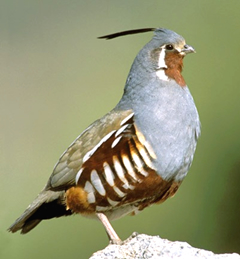
Odontophorus gujanensis
Odontophorus gujanensis
Order: Galliformes / Family: Odontophoridae

Wikimedia Commons
About the Odontophorus gujanensis
The Odontophorus gujanensis, commonly known as the Marbled Wood-Quail, is a visually striking bird belonging to the family Odontophoridae. Native to the neotropical regions, this bird is distributed predominantly across northern South America, including countries like Colombia, Venezuela, Brazil, Ecuador, Peru, and Bolivia. The Marbled Wood-Quail thrives in dense, humid forests and subtropical woodlands, where its cryptic plumage provides excellent camouflage against the forest floor. This bird plays a crucial role in the ecosystem as both a seed disperser and a prey species for larger predators.
Primarily found at elevations ranging from sea level to about 1,800 meters, the Marbled Wood-Quail prefers areas with dense undergrowth and ample tree cover. Its presence is often indicative of the overall health of the forest habitat, as it requires undisturbed environments to thrive. As a terrestrial bird, it spends much of its time foraging on the ground, using its robust bill to sift through leaf litter in search of food.
The Marbled Wood-Quail is a non-migratory species, exhibiting relatively stable territorial behaviors throughout the year. However, it may move to different parts of its territory seasonally, depending on food availability. Despite being somewhat elusive, it can often be located by its distinctive vocalizations, which resonate through the forest during dawn and dusk. These calls are not only crucial for communication within family groups but also play a role in establishing territory boundaries and attracting mates. Due to deforestation and habitat fragmentation, the conservation status of the Marbled Wood-Quail is of increasing concern, highlighting the need for effective conservation strategies.
The Odontophorus gujanensis belongs to the family Odontophoridae, within the order Galliformes. These birds typically live averages 5-7 years in the wild, with a maximum recorded of 10 years..
How to Identify a Odontophorus gujanensis
Identifying the Marbled Wood-Quail involves noting its richly patterned plumage and stocky build. Adults typically display a mottled appearance, with a mixture of brown, black, and white feathers that blend seamlessly into the forest floor. Their underparts are generally lighter, exhibiting a speckled pattern that aids in camouflage. Males and females are similar in appearance, with slight variations in size, as males tend to be marginally larger.
Juveniles resemble adults but have duller and less distinct markings. The Marbled Wood-Quail's rounded wings and short tail are characteristic field marks, especially when the bird is seen in brief flight. Unlike other quail species, their flight is typically short and direct, often used as a last resort when escaping predators.
The Marbled Wood-Quail's posture while perching or on the ground is notably upright, and it often remains motionless to avoid detection. This behavior can sometimes lead to confusion with similar ground-dwelling species, such as the Rufous-fronted Wood-Quail. However, the Marbled Wood-Quail's more intricate plumage pattern and distinctive vocalizations provide reliable identification cues.
Having trouble telling birds apart? Upload a photo to our bird identification tool for an instant species match.
Odontophorus gujanensis Habitat and Range
Preferred Habitat
The Marbled Wood-Quail inhabits primarily tropical and subtropical forests, favoring areas with dense undergrowth and thick canopy cover. These environments provide the necessary cover and food resources for their survival. They are frequently found in lowland rainforests and foothill regions, extending up to elevations of 1,800 meters.
In some regions, the Marbled Wood-Quail can also be found in secondary forests, provided that these areas have sufficient underbrush and minimal human disturbance. Unlike some other bird species, the Marbled Wood-Quail does not adapt well to urban environments or heavily altered landscapes, further emphasizing the importance of preserving its natural habitat. Seasonal shifts in habitat are minimal, as this species is non-migratory, but they may move within their range to exploit different food sources or breeding sites.
Geographic Range
The range of the Marbled Wood-Quail spans across several countries in northern South America. It is primarily found in Colombia, Venezuela, Brazil, Ecuador, Peru, and Bolivia. Within these countries, its distribution is somewhat patchy, often constrained by specific habitat requirements.
The Marbled Wood-Quail is a resident species, meaning it does not undertake long migrations. However, its range can vary locally based on environmental conditions and food availability. In areas where suitable habitat is widespread, such as the Amazon basin, population densities can be relatively high. Conversely, in regions experiencing deforestation and habitat fragmentation, the bird's presence may be more sporadic.
By understanding the specific range and habitat preferences of the Marbled Wood-Quail, conservationists can better target efforts to protect and restore the environments crucial for their survival.
Want to know which birds visit your area? Browse our backyard birds by location guides for region-specific species lists.
What Does the Odontophorus gujanensis Eat?
The diet of the Marbled Wood-Quail primarily consists of seeds, fruits, and small invertebrates, reflecting its omnivorous feeding habits. Foraging takes place on the forest floor, where it uses its strong bill to sift through leaf litter and soil. This bird is particularly fond of fallen fruits and seeds, making it an important agent of seed dispersal within its habitat.
During certain times of the year, particularly when fruit abundance is low, the Marbled Wood-Quail will consume more insects and other small animals, such as beetles, ants, and worms. This adaptability in diet allows it to survive in various forest conditions throughout the year.
Feeding typically occurs in the early morning and late afternoon, times when the bird is most active. The Marbled Wood-Quail's feeding strategy is opportunistic, as it takes advantage of the varying availability of food resources across its habitat.
Odontophorus gujanensis Behavior and Social Structure
The social structure of the Marbled Wood-Quail is generally characterized by small family groups, which can consist of the mating pair and their offspring. These groups exhibit strong territorial behavior, often defending their home range from intruders. The birds communicate through a series of calls that help maintain group cohesion and establish territorial boundaries.
Courtship displays are subtle, involving mutual preening and soft vocalizations between potential mates. Once a pair bond is formed, the quail remain monogamous, often breeding together across multiple seasons.
In response to predators, the Marbled Wood-Quail relies on its cryptic plumage to remain undetected. If threatened, they may freeze or take short, rapid flights to nearby cover. Daily activity peaks during dawn and dusk, aligning with the availability of food and the cooler temperatures of the forest floor.
Odontophorus gujanensis Nesting and Reproduction
Marbled Wood-Quails typically nest on the ground, constructing their nests in concealed locations under dense vegetation or fallen logs. The nest itself is a simple scrape lined with leaves and other organic materials, providing a modicum of insulation and camouflage.
The female lays a clutch of about 4 to 8 eggs, which she incubates for approximately 18 to 22 days. During this period, the male remains nearby, helping to defend the nesting territory against potential threats.
Once hatched, the chicks are precocial, meaning they are relatively mature and mobile shortly after birth. Both parents participate in feeding and protecting the young, guiding them to food sources and shelter. The family group stays together until the juveniles are fully independent, at which point they may disperse to establish their own territories.
Odontophorus gujanensis Sounds and Vocalizations
The Marbled Wood-Quail is known for its distinctive vocalizations, which consist of a series of rhythmic, resonant calls. These calls are characterized by a rich, melodic quality, often described as a series of descending whistles.
In addition to their primary song, these birds produce a variety of call notes used for communication within family groups. Alarm calls are sharp and abrupt, designed to alert other members of potential danger.
The Marbled Wood-Quail participates in a dawn chorus, during which its calls resonate through the forest, especially during the breeding season. This behavior is crucial for maintaining territory boundaries and attracting mates.
Interesting Facts About the Odontophorus gujanensis
- 1The Marbled Wood-Quail can be quite elusive and is often more easily detected by its distinctive calls than by sight.
- 2Despite being a ground-dwelling bird, the Marbled Wood-Quail can fly short distances if startled, though it prefers to run.
- 3The Marbled Wood-Quail's plumage pattern is so effective that they can remain undetected even when nearby.
- 4In their natural habitat, Marbled Wood-Quails often form small family groups that forage together.
- 5Marbled Wood-Quails are important seed dispersers, aiding in the regeneration of their forest habitats.
- 6The vocalizations of the Marbled Wood-Quail are often used by birdwatchers to identify its presence in dense forests.
- 7Marbled Wood-Quails have a monogamous breeding system, with pairs often forming long-term bonds.
Odontophorus gujanensis Conservation Status
Currently, the Marbled Wood-Quail is listed as a species of Least Concern by the IUCN. However, its population trend is decreasing due to ongoing habitat destruction and fragmentation, primarily from deforestation and land conversion for agriculture. Conservation efforts are focused on habitat preservation, including the establishment of protected areas and the promotion of sustainable land use practices. In some regions, community-based conservation initiatives are also being implemented to engage local populations in preserving the natural habitats of this and other forest-dependent species. Historically, the Marbled Wood-Quail has experienced fluctuations in population size, largely driven by changes in forest cover. Ensuring the continued survival of this species requires a commitment to maintaining the integrity of its natural environment.