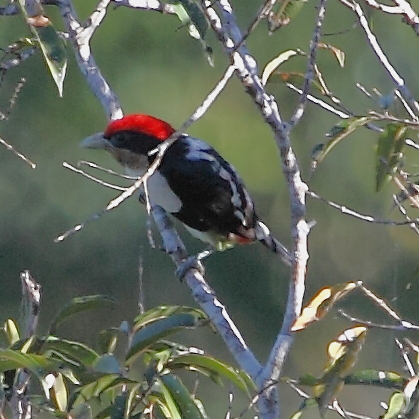
Orange-fronted Barbet
Capito squamatus
Order: Piciformes / Family: Capitonidae

Wikimedia Commons
About the Orange-fronted Barbet
The Orange-fronted Barbet (Capito squamatus) stands out as one of the more vividly colored members of the family Capitonidae. This species is primarily found in the humid forests of western Colombia and Ecuador. The barbet plays a significant role in these ecosystems by aiding in seed dispersal and pollination, thanks to its fruit-based diet. Its bright plumage not only makes it a favorite among birdwatchers but also signifies its ecological importance in tropical food webs.
The Orange-fronted Barbet is also notable for its adaptability to different forested environments, ranging from lowland rainforests to subtropical and montane forests up to 1,500 meters in elevation. This versatility allows it to thrive in regions that undergo significant seasonal changes, such as variations in rainfall and fruit availability, which affect its feeding and breeding habits.
This bird's presence in a forest signifies a healthy ecosystem, as it requires a rich diversity of fruiting plants to sustain its diet. Barbets are often observed in small family groups or pairs, engaging in social behaviors that strengthen group cohesion and increase their chances of survival. Their interactions with native plant species help maintain forest biodiversity, making them an integral part of their environment.
The Orange-fronted Barbet belongs to the family Capitonidae, within the order Piciformes. These birds typically live typically 7-9 years, with a maximum recorded of 12 years..
How to Identify a Orange-fronted Barbet
Identifying the Orange-fronted Barbet involves noting its distinctive orange forehead and crown, which contrasts beautifully with its green back and wings. The bird also has a white belly and a striking black face mask that further enhances its colorful appearance. Juveniles tend to have duller plumage, lacking the intense vibrancy of the adults, and their orange markings are less pronounced.
Males and females are similar in appearance, though males may display slightly brighter colors during the breeding season. This can make it challenging to distinguish between the sexes purely by visual cues. In terms of size, the Orange-fronted Barbet is medium-sized, measuring approximately 18-20 cm in length, which helps differentiate it from smaller or larger sympatric species.
In flight, the barbet's silhouette is characterized by a relatively short, rounded tail and a stout body. When perching, its upright posture and tendency to remain motionless for extended periods can make it difficult to spot in dense foliage. The bird's call, however, often reveals its presence before it is seen.
Having trouble telling birds apart? Upload a photo to our bird identification tool for an instant species match.
Orange-fronted Barbet Habitat and Range
Preferred Habitat
The Orange-fronted Barbet thrives in diverse forest habitats, including tropical rainforests, subtropical forests, and montane regions. It prefers areas with abundant fruiting trees and dense canopy cover, which provide both food and protection from predators.
In Colombia and Ecuador, the barbet is commonly found in forests ranging from sea level to about 1,500 meters in elevation. These areas often experience distinct wet and dry seasons, influencing the availability of food resources and, consequently, the barbet's feeding and breeding behaviors.
This species is not typically found in urban areas; however, it can sometimes be seen in rural or semi-urban settings where forest patches remain intact. Seasonal shifts in habitat are minimal, as the barbet does not migrate long distances, instead adjusting its range locally to follow fruiting cycles.
Geographic Range
The Orange-fronted Barbet has a relatively restricted range within South America, primarily found along the Pacific slopes of the Andes in western Colombia and Ecuador. Its range does not extend into countries beyond these two, making it a region-specific species of interest to ornithologists and conservationists alike.
Within its range, the barbet occupies forests that offer abundant fruiting plants. While it does not undertake long migratory journeys, it may move short distances to exploit seasonal food availability. These movements are generally confined within the upper and lower limits of its elevation range.
Population density tends to be higher in undisturbed forests, where human activity is minimal. However, deforestation and habitat fragmentation pose significant threats, potentially isolating populations and reducing genetic diversity.
Want to know which birds visit your area? Browse our backyard birds by location guides for region-specific species lists.
What Does the Orange-fronted Barbet Eat?
The diet of the Orange-fronted Barbet is predominantly frugivorous, with a strong preference for a wide variety of fruits and berries found in its native habitat. This includes figs, drupes, and other fleshy fruits that are abundant in tropical forests. The bird's stout bill is well-adapted for grasping and consuming these foods.
Seasonal changes in fruit availability dictate the barbet's foraging patterns. During periods of fruit scarcity, it may supplement its diet with insects, small invertebrates, and occasionally nectar, though this constitutes a minor part of its overall diet.
Orange-fronted Barbets typically forage high in the forest canopy, often in pairs or small groups. They employ a methodical approach, hopping from branch to branch and carefully selecting ripe fruits. This behavior not only sustains them but also aids in the dispersal of seeds, benefiting the forest ecosystem.
Want to attract Orange-fronted Barbets to your yard? See our recommended feeders and seed types for the best results.
Orange-fronted Barbet Behavior and Social Structure
Orange-fronted Barbets exhibit a range of intriguing behaviors that make them fascinating subjects for study. They are generally social birds, often seen in pairs or small family groups. This social structure facilitates cooperative foraging and enhances their ability to fend off predators.
Territorial behavior is evident, particularly during the breeding season, when pairs become more vocal and actively defend their chosen nesting sites. Courtship involves mutual preening and vocal exchanges, strengthening pair bonds before nesting begins.
Their daily activity patterns are shaped by the availability of food, with foraging occurring primarily in the early morning and late afternoon. During midday, barbets often retreat to shaded perches to rest. In response to predators, they rely on their cryptic plumage and stillness to blend into the foliage, minimizing detection.
Orange-fronted Barbet Nesting and Reproduction
The Orange-fronted Barbet exhibits fascinating nesting habits, constructing its nests in tree cavities, which it either excavates itself or appropriates from previous occupants. These cavities are typically located at heights between 3 to 15 meters above ground level, offering protection from ground-dwelling predators.
The barbet's nest is lined with plant material, providing a soft bed for the eggs. Females lay a clutch of 2 to 4 eggs, which they incubate for approximately 14 to 16 days. Both parents participate in feeding the chicks, which fledge about 28 to 30 days after hatching.
Barbets typically raise one brood per year, although in favorable conditions with abundant resources, they may attempt a second. Parental roles are shared, with both male and female engaging in feeding and protection of the young.
Orange-fronted Barbet Sounds and Vocalizations
The primary song of the Orange-fronted Barbet is a series of rhythmic, melodious notes that carry well over the dense forest canopy. This song serves as a territorial marker and a mating call, especially pronounced during the breeding season.
In addition to their song, these barbets emit a variety of calls, including sharp, repetitive notes that function as alarm signals when a predator is nearby. The dawn chorus of barbets often includes both songs and calls, contributing to the cacophony of sounds typical of tropical forests.
Compared to more familiar birds, the barbet's song can be likened to a softer version of a woodpecker's drumming, though it is distinctly musical.
Interesting Facts About the Orange-fronted Barbet
- 1The Orange-fronted Barbet's diet is predominantly frugivorous, making it a key seed disperser in its ecosystem.
- 2Despite their vibrant colors, barbets can remain remarkably well-camouflaged when motionless in dense foliage.
- 3Orange-fronted Barbets are known for their cavity-nesting behavior, often reusing old woodpecker nests.
- 4Their primary song is a series of melodious notes that can be heard over great distances in the forest.
- 5The Orange-fronted Barbet's range is relatively restricted to the rainforests and subtropical regions of Colombia and Ecuador.
- 6This species plays an essential role in pollination and seed dispersal, crucial for maintaining rainforest biodiversity.
- 7Orange-fronted Barbets exhibit cooperative breeding behaviors, with both parents involved in raising the young.
Orange-fronted Barbet Conservation Status
The Orange-fronted Barbet currently holds a conservation status of Least Concern according to the IUCN. However, its populations face ongoing pressures from habitat loss due to deforestation and agricultural expansion in its range. Despite a relatively stable population, these threats could impact long-term survival if not addressed. Conservation efforts focus on habitat preservation and the establishment of protected areas to ensure the continuity of suitable environments for this species. Historically, population numbers have remained relatively stable, but monitoring is essential to detect any early signs of decline. Encouraging sustainable land-use practices in regions where the barbet resides can help mitigate some of the primary threats it faces.
Attracting Orange-fronted Barbets to Your Feeder
The Orange-fronted Barbet is a regular visitor to backyard bird feeders across its range. At the Eye On The Fly feeding station, we observe Orange-fronted Barbets regularly and capture footage with our feeder cameras.