Ornate Antwren
Epinecrophylla ornata
Order: Passeriformes / Family: Thamnophilidae

Wikimedia Commons
About the Ornate Antwren
The Ornate Antwren (Epinecrophylla ornata) captivates birders with its finely detailed plumage and enigmatic behavior. Native to the tropical rainforests of South America, this small passerine bird is an integral part of the forest ecosystem, where it thrives in the undergrowth. The species is primarily found in the western Amazon basin, with populations in countries such as Peru, Ecuador, Colombia, and Brazil. Within these regions, the Ornate Antwren plays a crucial ecological role, contributing to the control of insect populations and participating in mutualistic relationships with other species. The dense, humid forests it inhabits provide a perfect backdrop for its secretive lifestyle, often seen darting among leaves in search of prey. Seasonally, the Ornate Antwren does not exhibit significant migratory behavior, maintaining a year-round presence in its preferred habitat. However, some altitudinal movements may occur, as individuals seek optimal conditions for feeding and breeding. During the breeding season, typically aligned with the rainy season, the antwren becomes more vocal and active, establishing territories and engaging in courtship displays. The Ornate Antwren's significance extends beyond its role in the ecosystem; it also serves as an indicator species for the health of tropical forest environments. Its presence, or absence, can signal changes in habitat quality, influenced by factors such as deforestation and climate change. Conservation efforts focus on preserving its native forests, ensuring that this delicate balance is maintained.
The Ornate Antwren belongs to the family Thamnophilidae, within the order Passeriformes. These birds typically live typically around 3-5 years, with some living up to 7 years..
How to Identify a Ornate Antwren
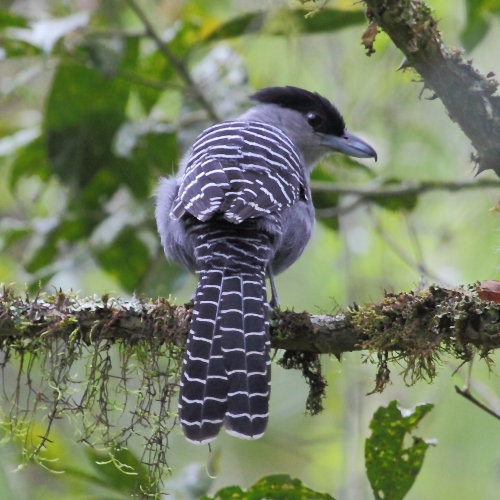
The Ornate Antwren is a small bird, measuring about 9-10 cm in length, with a strikingly intricate plumage pattern. Adult males primarily exhibit a grayish-brown coloration with delicate white streaks on the crown and back, giving them a finely ornate appearance. The throat and upper breast are marked with blackish streaks, contrasting with the paler underparts. Females differ slightly, possessing a more subdued coloration with less pronounced streaking. Juvenile birds resemble females but are generally duller and may lack the distinct streaking seen in adults. One can differentiate the Ornate Antwren from similar species by its unique plumage and its preference for dense undergrowth. In flight, this bird shows a compact silhouette with rapid wingbeats, typical of antbirds. When perched, it often adopts a horizontal posture, blending seamlessly into its surroundings. Despite its intricate appearance, the Ornate Antwren's small size and secretive behavior can make it a challenge to spot in the field.
Having trouble telling birds apart? Upload a photo to our bird identification tool for an instant species match.
Ornate Antwren Habitat and Range
Preferred Habitat
The Ornate Antwren inhabits the humid tropical rainforests of the western Amazon basin, preferring areas with dense undergrowth and ample leaf litter. It is commonly found in lowland forests, up to elevations of about 1,200 meters. While predominantly a forest species, the Ornate Antwren occasionally ventures into secondary growth and edge habitats, where it continues to seek dense cover. Unlike some avian species, the Ornate Antwren does not typically adapt well to urban environments, remaining closely tied to forested areas throughout the year. Seasonal habitat shifts are minimal, as the species remains resident in its preferred environment, though local movements may occur in response to resource availability.
Geographic Range
The Ornate Antwren's range spans several countries within the western Amazon basin, including Peru, Ecuador, Colombia, and Brazil. It occupies a relatively narrow band of suitable habitat across this region, with population densities highest in areas of undisturbed forest. While the species does not engage in long-distance migrations, some altitudinal movements may occur, as individuals respond to seasonal changes in food availability and breeding conditions. These movements are typically limited to the species' established range, ensuring that it remains a stable presence in its native forests. Population hotspots are often found in protected areas, where the Ornate Antwren benefits from reduced habitat disturbance and greater availability of resources.
Want to know which birds visit your area? Browse our backyard birds by location guides for region-specific species lists.
What Does the Ornate Antwren Eat?
The Ornate Antwren primarily feeds on small insects and other arthropods, which it gleans from the foliage and forest floor. Its diet consists mainly of ants, beetles, and spiders, though it may also consume small caterpillars and other invertebrates. The bird's foraging technique involves meticulously searching through leaves and branches, often in the company of mixed-species flocks. This behavior not only aids in food location but also offers protection from predators. Seasonal variations in diet are minimal, though the availability of certain prey items may fluctuate with changes in the forest's microclimate. The Ornate Antwren typically feeds throughout the day, with peak activity occurring during the cooler morning and late afternoon hours.
Ornate Antwren Behavior and Social Structure
The Ornate Antwren exhibits a social yet cautious nature, often participating in mixed-species flocks that move through the forest understory. These flocks provide increased vigilance against predators and enhance foraging efficiency. Within its social structure, the Ornate Antwren is territorial, with pairs establishing and defending small territories during the breeding season. Courtship displays are subtle, involving vocalizations and mutual preening as a pair bond strengthens. The species tends to maintain a low profile, using its cryptic plumage and preference for dense cover to avoid detection. In response to predators, the Ornate Antwren will freeze or retreat into thick vegetation, relying on its camouflage to evade capture. Daily activity peaks during the early morning and late afternoon, when cooler temperatures allow for more energetic foraging.
Ornate Antwren Nesting and Reproduction
The nest of the Ornate Antwren is a delicate cup constructed from fine plant fibers, roots, and leaves, typically situated low in the understory. This strategic placement offers protection from predators and environmental elements. Clutch size ranges from 2 to 3 eggs, with both parents sharing incubation duties over a period of about 14-16 days. Once hatched, the chicks remain in the nest for approximately 10-12 days before fledging. Parental care continues for several weeks post-fledging, as juveniles learn essential survival skills. The species usually raises one brood per year, though favorable conditions may allow for a second.
Ornate Antwren Sounds and Vocalizations
The primary song of the Ornate Antwren is a soft, melodious series of whistles and trills, often described as a gentle, bubbling chorus. These vocalizations serve to establish territory and maintain pair bonds. In addition to its song, the Ornate Antwren produces a variety of call notes, including sharp 'chip' sounds used for communication within flocks. Alarm calls, more harsh and rapid, are employed to alert nearby birds to potential threats. During the dawn chorus, the Ornate Antwren's song is more frequent and prominent, contributing to the vibrant soundscape of the forest.
Interesting Facts About the Ornate Antwren
- 1The Ornate Antwren was first described in the early 19th century, reflecting its long-standing intrigue to ornithologists.
- 2Pairs of Ornate Antwrens often engage in 'duet' singing, which strengthens their bond and aids in territory defense.
- 3Despite their small size, Ornate Antwrens play a pivotal role in controlling insect populations, showcasing their ecological importance.
- 4The bird's intricate plumage pattern not only aids in camouflage but also in species recognition among conspecifics.
- 5The Ornate Antwren's participation in mixed-species flocks enhances its foraging efficiency and reduces predation risk.
- 6While primarily insectivorous, the Ornate Antwren occasionally supplements its diet with small fruits and seeds.
- 7The species' preference for dense undergrowth makes it a key indicator of forest health and biodiversity.
Ornate Antwren Conservation Status
The Ornate Antwren is currently listed as Least Concern by the IUCN, with stable population trends in most of its range. However, habitat loss due to deforestation and land conversion poses a significant threat to its long-term survival. Conservation efforts focus on preserving large tracts of primary forest, which are essential for maintaining viable populations. Historical data indicates that the species has managed to persist despite localized disturbances, aided by its adaptability to secondary growth areas. Continued monitoring and habitat protection remain critical to securing the future of this species.