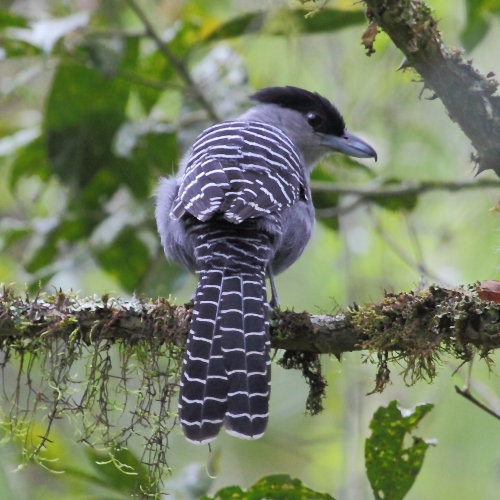
Parker's Antbird
Cercomacra parkeri
Order: Passeriformes / Family: Thamnophilidae

Wikimedia Commons
About the Parker's Antbird
Parker's Antbird, scientifically known as Cercomacra parkeri, is a species endemic to the humid montane forests of Colombia. This bird inhabits the subtropical and tropical moist lowland forests, particularly favoring the Chocó region, known for its exceptional biodiversity. This antbird plays a significant role in the ecosystem by participating in mixed-species flocks, contributing to insect population control through its foraging activities. Parker's Antbird displays remarkable adaptability to the dense foliage, where it forages primarily on insects and other arthropods. The species is known for its specialized ecological niche, preferring the understory of intact forest habitats, which are unfortunately threatened by deforestation and habitat fragmentation. The bird is named in honor of Theodore A. Parker III, a renowned ornithologist, which underscores its importance in ornithological studies. Parker's Antbird is non-migratory, meaning it resides year-round within its limited range. Seasonal behaviors include more vocal activity during the breeding season, which coincides with the onset of the rainy season, providing ample resources for raising young. This bird's elusive behavior and preference for dense cover make it a challenge to observe, yet it remains a species of interest for birdwatchers and researchers aiming to understand the intricate dynamics of tropical montane forest ecosystems.
The Parker's Antbird belongs to the family Thamnophilidae, within the order Passeriformes. These birds typically live average 5 years, with a maximum recorded of 7 years..
How to Identify a Parker's Antbird
Parker's Antbird is a small passerine, measuring approximately 14 cm in length. Adults exhibit striking sexual dimorphism. Males boast a predominantly black plumage with a contrasting white throat and belly, while females display a more subdued grayish-brown coloration with a lighter throat. Juveniles resemble females but with duller plumage. The bird's sturdy legs and strong bill are adapted for gleaning insects from foliage. Field identification is aided by the bird's distinct plumage and its preference for staying close to the ground in dense forest undergrowth. Despite its bold coloration, Parker's Antbird can be mistaken for other species within the Thamnophilidae family, particularly those with overlapping ranges. However, its specific vocalizations and habitat preferences aid in differentiation. In flight, Parker's Antbird exhibits short, rapid wingbeats, often staying within the confines of the forest understory. Perching posture tends to be upright, with the tail held slightly cocked, providing a brief glimpse of its white undertail coverts.
Having trouble telling birds apart? Upload a photo to our bird identification tool for an instant species match.
Parker's Antbird Habitat and Range
Preferred Habitat
Parker's Antbird finds its niche in the humid, subtropical, and tropical moist lowland forests of Colombia. It is most commonly found in the Chocó bioregion, where dense forest floors provide ample cover and feeding opportunities. This bird inhabits elevations from 800 to 1600 meters, with a strong preference for primary forests. Seasonal shifts in habitat are minimal, as Parker's Antbird is non-migratory, relying on the stable environment of the montane forest. While primarily a forest dweller, Parker's Antbird avoids urban areas, preferring the tranquility and resource abundance of undisturbed habitats.
Geographic Range
The range of Parker's Antbird is restricted to Colombia, specifically within the Chocó region along the western slopes of the Andes. The species occupies a relatively narrow altitudinal band, thriving in elevations from 800 to 1600 meters. Its range does not extend beyond Colombia, with no known migration patterns. Population densities are highest in areas of undisturbed primary forest, where the ecological conditions meet the bird's specific habitat requirements. Despite its limited range, Parker's Antbird remains an important species for studies on endemism and biodiversity within the region.
Want to know which birds visit your area? Browse our backyard birds by location guides for region-specific species lists.
What Does the Parker's Antbird Eat?
Parker's Antbird primarily feeds on insects and other arthropods, making it an insectivorous species. Its diet consists of ants, beetles, spiders, and caterpillars, which it gleans from the forest understory. The bird employs a methodical foraging technique, moving deliberately through dense vegetation and occasionally joining mixed-species flocks to increase foraging success. Seasonal changes in diet are minimal, as the bird's habitat provides a consistent supply of prey throughout the year. Prey size varies, but Parker's Antbird tends to select medium-sized insects that can be easily handled and consumed. Feeding occurs throughout the day, with peak activity during the cooler morning and late afternoon hours.
Parker's Antbird Behavior and Social Structure
Parker's Antbird exhibits a solitary or paired social structure, often seen foraging alone or with a mate. Territorial behavior is pronounced, with males defending their territories through vocalizations and displays. Courtship displays involve the male showcasing his plumage and performing subtle aerial maneuvers. Flocking patterns are generally limited to participation in mixed-species flocks, which helps reduce predation risk and increase foraging efficiency. In response to predators, Parker's Antbird relies on its camouflage and dense vegetation for protection, rarely resorting to flight. Daily activity patterns are diurnal, with heightened vocal and foraging activities during the early morning and late afternoon.
Parker's Antbird Nesting and Reproduction
Parker's Antbird constructs cup-shaped nests using leaves, twigs, and moss, typically situated low in the understory of the forest. This strategic location provides concealment from predators. Clutch size ranges from two to three eggs, which the female incubates for approximately 14 days. Both parents participate in feeding the chicks, which fledge around two weeks after hatching. Parker's Antbird may raise one to two broods per year, depending on resource availability and environmental conditions. Parental roles are shared, with both sexes involved in nest building, incubation, and chick-rearing.
Parker's Antbird Sounds and Vocalizations
Parker's Antbird produces a distinctive song characterized by a series of rapid, high-pitched notes that rise and fall in pitch, resembling a trill. This song serves both territorial and courtship functions. Call notes consist of sharp 'chip' sounds used for communication between mates and within mixed-species flocks. Alarm calls are more abrupt and harsh, signaling potential threats. During the dawn chorus, Parker's Antbird's song is particularly prominent, contributing to the auditory tapestry of the montane forest.
Interesting Facts About the Parker's Antbird
- 1Parker's Antbird was named after Theodore A. Parker III, who was an influential figure in Neotropical ornithology.
- 2This bird is endemic to Colombia, making it an important species for studying regional biodiversity and endemism.
- 3Unlike many bird species, Parker's Antbird is non-migratory, maintaining territories throughout the year.
- 4The antbird's preference for dense undergrowth makes it a challenging species to observe, favoring the most secluded forest areas.
- 5Parker's Antbird is part of the diverse Thamnophilidae family, which consists of over 230 species of antbirds.
- 6Its diet mainly consists of ants and other insects, playing a crucial role in controlling insect populations in its habitat.
- 7This species participates in mixed-species flocks, benefiting from cooperative foraging and predator avoidance.
Parker's Antbird Conservation Status
Parker's Antbird is currently listed as Near Threatened by the IUCN, with population trends showing a decline due to habitat loss and fragmentation. The primary threats include deforestation for agriculture and infrastructure development. Conservation efforts focus on habitat protection and restoration, particularly in the Chocó region, which is a biodiversity hotspot. Historical population changes are not well-documented, but the increasing pressure on its limited range highlights the need for continued conservation actions.