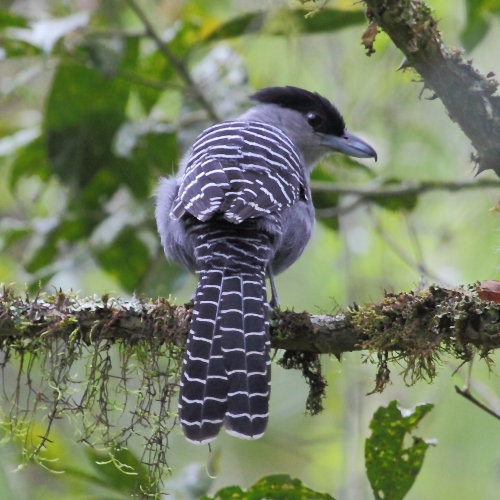
Pearly Antshrike
Megastictus margaritatus
Order: Passeriformes / Family: Thamnophilidae

Wikimedia Commons
About the Pearly Antshrike
The Pearly Antshrike (Megastictus margaritatus) is a striking bird of the Thamnophilidae family, predominantly found in the intricate network of the Amazon rainforest. This species plays an integral role in the ecosystem by controlling insect populations, including ants, beetles, and other arthropods. The Pearly Antshrike's presence is often an indicator of healthy forest environments. These birds thrive in the subtropical and tropical moist lowland forests of South America, with a particular concentration in Brazil, Colombia, and Peru. They exhibit some seasonal altitudinal movements, descending to lower elevations during the wet season when food becomes more abundant. Unlike many neotropical birds, the Pearly Antshrike does not undertake long-distance migrations but rather adjusts its range slightly based on local environmental conditions. The ecological significance of the Pearly Antshrike extends beyond its role as a predator. It also contributes to the forest's acoustic landscape with its distinctive calls and songs. By maintaining insect populations at balanced levels, the Pearly Antshrike helps ensure the health of the trees and plants that make up the dense forest canopy. This bird's adaptability to changes in food availability and its ability to utilize a variety of microhabitats within the forest underline its resilience. The Pearly Antshrike's survival is closely linked to the conservation of its rainforest habitat, making it a key species in discussions about preserving South America's biodiversity. With its striking visual appearance and important ecological role, the Pearly Antshrike captures the interest of ornithologists and birdwatchers alike. Its subtle yet complex interactions within the ecosystem exemplify the delicate balance of tropical forest environments. As environmental pressures threaten these habitats, the Pearly Antshrike stands as both a symbol of the intricate beauty of the Amazon and a reminder of the need for vigilant conservation efforts.
The Pearly Antshrike belongs to the family Thamnophilidae, within the order Passeriformes. These birds typically live typically around 4-6 years, with a maximum recorded of 8 years..
How to Identify a Pearly Antshrike
The Pearly Antshrike exhibits a distinct plumage pattern that makes it relatively easy to identify in the field. Adult males display a striking pattern of white speckles against a dark slate-gray background, resembling the sheen of pearls. These markings are most prominent on the upperparts and wings, providing excellent camouflage among the forest understory. Females, while similarly patterned, tend to have a more muted coloration with browner tones, especially on their underparts and flanks. Juveniles resemble females but with even less pronounced markings. When observing this species, note the compact body, short tail, and robust bill, all adaptations for a life spent in dense vegetation. The Pearly Antshrike might be confused with other antbirds, but its unique speckling and relatively smaller size help distinguish it from species such as the Dot-winged Antwren. In flight, the Pearly Antshrike appears as a quick, darting shadow, often difficult to follow due to its preference for remaining low to the ground and within thick foliage. Its perching posture is typically upright, allowing it to scan its surroundings for prey effectively. Observers should listen for its distinctive calls, which can aid in location and identification when visual confirmation is challenging.
Having trouble telling birds apart? Upload a photo to our bird identification tool for an instant species match.
Pearly Antshrike Habitat and Range
Preferred Habitat
The Pearly Antshrike is primarily associated with the dense, humid lowland forests of the Amazon Basin. It favors the tangled understory and secondary growth areas where leaf litter and fallen branches provide an ideal hunting ground. This species is typically found at elevations from sea level up to 1,000 meters, although it may venture slightly higher in certain regions. Seasonal shifts in habitat preference are minor, with the bird occasionally moving to more open areas during wetter months when prey abundance increases. Unlike some other forest-dwelling birds, the Pearly Antshrike shows little tolerance for urban environments, remaining in more pristine habitats. Within its preferred regions, it often inhabits areas that have been lightly disturbed, such as forest edges and clearings, which can offer abundant feeding opportunities.
Geographic Range
The Pearly Antshrike's range is restricted to the tropical regions of South America, specifically within the Amazon Basin. It can be found across a broad swath of the continent, including the countries of Brazil, Colombia, Peru, and Venezuela. The species is largely resident, with populations remaining within their established territories year-round. However, there may be some local movements related to seasonal changes in food availability and habitat conditions. In areas where its habitat overlaps with other antbird species, the Pearly Antshrike tends to occupy the mid-levels of the forest, avoiding direct competition with ground-foraging relatives. While its population is considered stable in many parts of its range, habitat loss poses a continual threat, particularly in regions experiencing deforestation.
Want to know which birds visit your area? Browse our backyard birds by location guides for region-specific species lists.
What Does the Pearly Antshrike Eat?
The Pearly Antshrike is an insectivore, with a diet primarily consisting of ants, beetles, spiders, and other small arthropods. It forages by gleaning prey from leaves and branches, often in the lower to mid-levels of the forest. This bird employs a methodical approach, systematically inspecting foliage and bark for hidden insects. The Pearly Antshrike may occasionally join mixed-species foraging flocks, taking advantage of the increased feeding opportunities these groups provide. Its diet shifts slightly with the seasons, as it takes advantage of temporary abundances of certain prey types, such as caterpillars during the rainy season. The bird's robust bill is well-suited for grasping and manipulating a variety of prey sizes, allowing it to exploit a wide range of food sources efficiently.
Pearly Antshrike Behavior and Social Structure
Pearly Antshrikes exhibit a generally solitary or paired lifestyle, with individuals or pairs maintaining small territories that they defend actively. These territories are marked by vocalizations and occasional physical displays designed to deter intruders. During the breeding season, males perform courtship displays, which include wing flicking and tail fanning, accompanied by calls to attract females. Outside of breeding periods, Pearly Antshrikes can be seen participating in mixed-species flocks, which provide safety in numbers and increased foraging efficiency. Their response to predators includes remaining motionless in dense cover or giving alarm calls to alert other birds. Daily activity patterns are diurnal, with most foraging and social interactions occurring during the early morning and late afternoon.
Pearly Antshrike Nesting and Reproduction
The nesting behavior of the Pearly Antshrike involves constructing cup-shaped nests made from twigs, leaves, and other plant materials. These nests are typically located in the dense understory vegetation, often well-concealed among vines or branches. The female lays a clutch of 2-3 eggs, which she incubates for approximately 14 days. Both parents participate in feeding the chicks, which fledge after about 12-14 days. Parental care extends beyond fledging, with both adults continuing to feed and protect the young until they become independent. The Pearly Antshrike usually raises one brood per year, although favorable conditions may allow for a second.
Pearly Antshrike Sounds and Vocalizations
The Pearly Antshrike's vocalizations include a series of sharp, high-pitched notes that resemble the sound of tapping pebbles. These calls serve multiple functions, including maintaining contact between mates and warning off potential intruders. The typical song comprises a rapid sequence of notes that accelerates and rises in pitch, often delivered from a hidden perch within dense foliage. Alarm calls are harsher and more abrupt, signaling potential threats to conspecifics and other birds in the vicinity. During the dawn chorus, the Pearly Antshrike contributes a distinctive rhythm to the symphony of sounds that characterizes its forest habitat.
Interesting Facts About the Pearly Antshrike
- 1The Pearly Antshrike's scientific name, Megastictus margaritatus, means 'large-spotted', referring to its pearl-like markings.
- 2Despite its name, the Pearly Antshrike rarely consumes ants, preferring a diet of various arthropods instead.
- 3This species is a member of the diverse Thamnophilidae family, which includes over 200 species known as antbirds.
- 4Pearly Antshrikes are often heard before they are seen, due to their preference for dense, shadowy habitats.
- 5The bird's coloration provides excellent camouflage against the dappled light of the forest understory.
- 6Unlike many birds, the Pearly Antshrike does not migrate long distances, preferring to remain within its territory.
- 7Their nests are expertly hidden and often placed low to the ground, making them challenging for predators to find.
Pearly Antshrike Conservation Status
Currently, the Pearly Antshrike is listed as Least Concern by the IUCN, with a stable population trend across its range. However, its reliance on intact forest habitats makes it vulnerable to ongoing deforestation and habitat fragmentation, particularly in the Amazon. Conservation efforts focus on preserving large tracts of rainforest and implementing sustainable land-use practices to mitigate habitat loss. While not currently endangered, the Pearly Antshrike serves as an important species for monitoring the health of tropical forest ecosystems. Historical data suggest that the species has maintained a relatively stable population, but continued environmental pressures could impact its future viability.