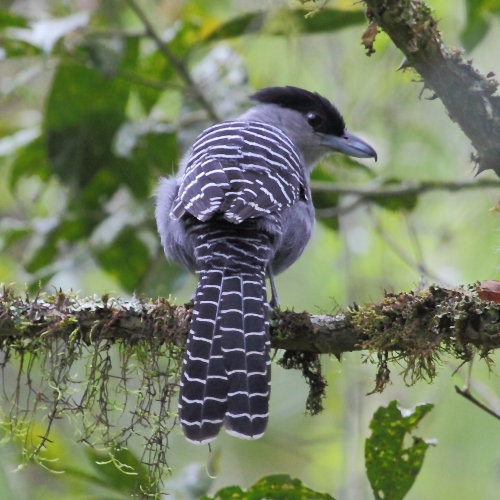
Plumbeous Antvireo
Dysithamnus plumbeus
Order: Passeriformes / Family: Thamnophilidae

Wikimedia Commons
About the Plumbeous Antvireo
The Plumbeous Antvireo (Dysithamnus plumbeus) is a small passerine bird endemic to the Atlantic Forest of southeastern Brazil. This bird is a member of the Thamnophilidae family, known for its specialized insectivorous diet and tight association with forested environments. The Atlantic Forest is one of the most biodiverse regions on the planet, and the presence of the Plumbeous Antvireo is a strong indicator of healthy forest ecosystems. The antvireo thrives in the understory of these dense forests, where it plays a crucial role in controlling insect populations. Birdwatchers and researchers alike hold the species in high regard, as it represents both the ecological richness and the conservation challenges of its habitat.
The Plumbeous Antvireo exhibits a strong preference for subtropical and tropical moist lowland and montane forests. Its range is confined to the states of Espírito Santo, Rio de Janeiro, and São Paulo. These regions are characterized by high humidity and a lush, complex structure of vegetation, which provides ample foraging opportunities and cover. The species' ecological role extends beyond pest control; it also serves as prey for larger birds and mammals, thus being an integral part of the food web.
Ecologically, the Plumbeous Antvireo contributes to the maintenance of forest health by participating in the insectivore guild. This role involves not only direct predation on insects but also influencing the behavior of their prey, which can affect plant health indirectly. Seasonal behaviors of the Plumbeous Antvireo include shifts in foraging strategies and habitat use, often related to the breeding season when males become more vocal and territorial. Despite its relatively restricted range, the bird has adapted to seasonal variations in insect abundance by adjusting its foraging techniques, demonstrating a remarkable resilience within its ecological niche.
The Plumbeous Antvireo belongs to the family Thamnophilidae, within the order Passeriformes. These birds typically live average 5-7 years, with a max recorded of 9 years..
How to Identify a Plumbeous Antvireo
The Plumbeous Antvireo is a compact bird, measuring about 13 centimeters in length and weighing approximately 15 to 18 grams. Adult males display a uniform slate-gray plumage, which can appear almost blue in certain lighting conditions. Their coloration provides excellent camouflage against the forest understory. Females, on the other hand, are slightly paler with a subtle brownish tinge on the wings and tail, which distinguishes them from the males. Juvenile birds resemble females but typically have a more pronounced brown wash throughout their plumage.
In the field, the bird's short tail and rounded wings are key identification features, along with its distinctive white wing bars that contrast sharply against the gray body. The Plumbeous Antvireo's perching posture is often upright, with a slight forward lean that allows it to scan for insects efficiently. When in flight, which is usually brief and direct within the dense forest, the bird shows rapid wingbeats and swift movements.
Confusion with similar species might occur, particularly with sympatric antbirds, but the combination of size, plumage color, and habitat preferences helps in accurate identification. The uniformity of the male's slate-gray color, in particular, sets it apart from other antvireos and antbirds that might share its range.
Having trouble telling birds apart? Upload a photo to our bird identification tool for an instant species match.
Plumbeous Antvireo Habitat and Range
Preferred Habitat
The Plumbeous Antvireo is intimately tied to the Atlantic Forest's subtropical and tropical moist lowland and montane forests. It thrives in dense, humid environments, often below 1,000 meters in elevation, where the forest structure is complex and diverse. Such habitats offer abundant insect prey and dense foliage for concealment from predators.
This species does not typically inhabit urban environments, instead favoring pristine forested regions where human disturbance is minimal. However, it can occasionally be found in secondary forests, provided that these areas have a sufficiently developed understory and canopy.
Seasonally, the Plumbeous Antvireo may adjust its preferred habitat slightly to exploit areas with higher insect activity or to accommodate breeding activities. During the breeding season, it may be more frequently encountered in forest edges or clearings where it can establish and defend a territory.
Geographic Range
Endemic to Brazil, the Plumbeous Antvireo occupies a relatively narrow range within the southeastern portion of the country. Its presence is confirmed in the states of Espírito Santo, Rio de Janeiro, and São Paulo, where it inhabits the remaining tracts of the Atlantic Forest.
The bird's distribution is closely tied to the availability of suitable forest habitat. It does not undertake long-distance migrations but may show some local movements in response to seasonal variations in food availability.
Population density hotspots are primarily located in areas where the forest remains intact and protected. This includes several national parks and conservation areas that represent crucial refuges for the species. The fragmentation of its habitat due to deforestation poses a significant challenge to the Plumbeous Antvireo, limiting its range and potentially leading to isolated populations.
Want to know which birds visit your area? Browse our backyard birds by location guides for region-specific species lists.
What Does the Plumbeous Antvireo Eat?
Primarily insectivorous, the Plumbeous Antvireo's diet consists of various arthropods, including ants, beetles, and caterpillars. Insects are the primary food source year-round, but the bird may also consume spiders and small invertebrates.
Seasonal changes in diet occur as the availability of certain insect species fluctuates. During the breeding season, when energy demands increase, the antvireo may focus on larger or more energetically rich prey to sustain itself and its offspring.
Foraging behavior is characterized by deliberate movement through the understory, where the bird gleans insects from leaves, branches, and the forest floor. The Plumbeous Antvireo uses a methodical approach, often working in mixed-species flocks that help reduce individual predation risk and increase foraging efficiency.
The bird generally feeds throughout the day, with peak activity during the cooler morning and late afternoon hours when insect activity is highest. Its foraging technique involves short, swift flights between perches, where it pauses to scan for prey before making quick, precise strikes.
Plumbeous Antvireo Behavior and Social Structure
Socially, the Plumbeous Antvireo is typically found in pairs or as part of mixed-species flocks, particularly outside the breeding season. Such flocking behavior provides security against predators and enhances foraging efficiency.
Territoriality is pronounced during the breeding season, with males becoming more vocal and aggressive in defending their nesting area. Courtship displays involve a combination of vocalizations and subtle physical gestures, such as wing flicking and tail spreading.
In response to predators, the Plumbeous Antvireo employs a range of behaviors, including freezing in place and remaining motionless to avoid detection. This cryptic behavior is highly effective given the bird's camouflaged plumage.
The bird's daily activity pattern involves early morning and late afternoon peaks in vocalization and foraging activity. Midday periods are often spent in rest or minimal movement, likely as an adaptation to the warmer temperatures and reduced insect activity during this time.
Plumbeous Antvireo Nesting and Reproduction
Nesting for the Plumbeous Antvireo occurs during the rainy season, which generally spans from October to March in southeastern Brazil. The nest is a small, cup-shaped structure intricately woven from plant fibers, moss, and spider silk. It is typically situated in the fork of a low tree or shrub, well-concealed by foliage.
Clutch size usually consists of two eggs, which are incubated by both parents for about 14 days. The eggs are white with reddish-brown speckles, providing some camouflage against potential predators.
After hatching, both parents share the responsibility of feeding the chicks and keeping the nest clean. The fledging period lasts approximately 12 to 14 days, after which the young birds remain dependent on their parents for several weeks.
The Plumbeous Antvireo typically raises one brood per year, though in areas with abundant resources and favorable conditions, a second brood may occasionally be attempted.
Plumbeous Antvireo Sounds and Vocalizations
The primary song of the Plumbeous Antvireo is a series of clear, melodious whistles that rise and fall in pitch. These vocalizations are often delivered from a concealed perch deep within the forest understory.
In addition to its song, the bird emits a variety of call notes, including short, sharp chips used for communication between mates or to signal alarm. When threatened, the antvireo's alarm calls become more rapid and strident, serving to alert other birds to potential danger.
During the dawn chorus, the Plumbeous Antvireo is a prominent participant, its song mingling with those of other avian species to create a rich tapestry of sound. The bird's vocal repertoire is not only a means of communication but also a tool for establishing and defending territory, particularly during the breeding season.
Interesting Facts About the Plumbeous Antvireo
- 1The Plumbeous Antvireo is one of over 200 bird species found in the Atlantic Forest, a biodiversity hotspot.
- 2Despite its small size, the Plumbeous Antvireo can consume insects nearly half its body weight in a single day.
- 3The bird's name 'plumbeous' refers to its lead-gray coloration, resembling the metal lead.
- 4The Plumbeous Antvireo often joins mixed-species flocks for increased foraging success and predator avoidance.
- 5This antvireo has adapted to changes in forest structure by altering its foraging strategies seasonally.
- 6The Plumbeous Antvireo's vocalizations are used extensively in field studies to monitor population densities.
- 7The Atlantic Forest, home to the Plumbeous Antvireo, has lost over 85% of its original cover due to deforestation.
Plumbeous Antvireo Conservation Status
The Plumbeous Antvireo is currently classified as Near Threatened on the IUCN Red List, reflecting concerns over its declining population and habitat loss. The primary threat to the species is deforestation within the Atlantic Forest, which reduces available habitat and fragments existing populations. Conservation efforts are focused on protecting and restoring critical habitat through the establishment of reserves and the promotion of sustainable land-use practices. Some areas within its range are now protected by national parks, which serve as vital refuges for the species and other forest-dependent wildlife. Population trends indicate a gradual decline, attributable to ongoing habitat destruction and fragmentation. However, increased awareness and conservation initiatives offer hope for stabilizing and potentially reversing these trends in the future.