
Pollen's Vanga
Xenopirostris polleni
Order: Passeriformes / Family: Vangidae

Wikimedia Commons
About the Pollen's Vanga
Pollen's Vanga (Xenopirostris polleni) is a distinctive bird species native to Madagascar, a member of the Vangidae family. This medium-sized passerine is an integral part of Madagascar's unique avifauna. Found primarily in the dry deciduous forests of the island, Pollen's Vanga plays a crucial ecological role as an insectivore, helping regulate insect populations. Its preference for lowland habitats, particularly in the northwest and central western regions like Ankarafantsika and Kirindy, highlights its adaptation to these specific forest ecosystems. During the breeding season, which aligns with Madagascar's rainy months from November to April, Pollen's Vanga's behavior becomes more conspicuous. It engages in intricate courtship displays and territorial singing, both of which reinforce pair bonds and deter rivals. Outside of the breeding season, this bird is less vocal and slightly more elusive, though its bold markings make it identifiable. Pollen's Vanga's ecological significance extends beyond insect control. Through its foraging activities, it contributes to the health of the forest by aiding in seed dispersal and maintaining plant diversity. This role underscores the interconnectedness of species within Madagascar's unique biodiversity. Conservation of its habitat is vital, as deforestation poses a threat to its population. Efforts to preserve the dry forests ensure the sustainability not just of Pollen's Vanga, but of the myriad other species that share its home.
The Pollen's Vanga belongs to the family Vangidae, within the order Passeriformes. These birds typically live generally 5-8 years, with some individuals living longer in protected areas..
How to Identify a Pollen's Vanga
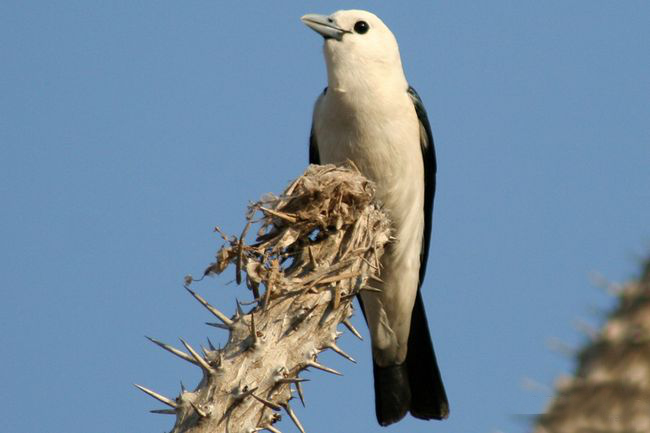
Pollen's Vanga is easily recognized by its stark black and white plumage. Adult males are predominantly white with a glossy black head, back, and wings, creating a bold contrast. Females, while similar, tend to have a slightly duller black, providing subtle sexual dimorphism. Juveniles resemble females but exhibit a more subdued coloration overall, with brownish tones replacing the stark black. This species' robust, slightly curved bill is another distinctive feature, adapted for its insectivorous diet. In flight, Pollen's Vanga displays a distinctive silhouette, with its broad wings and short tail. When perched, it often adopts an upright stance, showcasing its striking coloration. Confusion with other vanga species is possible, particularly with the Sickle-billed Vanga and Lafresnaye's Vanga. However, the uniform head coloration and specific habitat preferences help avoid misidentification.
Having trouble telling birds apart? Upload a photo to our bird identification tool for an instant species match.
Pollen's Vanga Habitat and Range
Preferred Habitat
Pollen's Vanga primarily inhabits the dry deciduous forests of Madagascar, favoring areas with dense foliage and abundant insect life. These forests, found in regions like Ankarafantsika and Kirindy, provide the cover and resources needed for foraging and breeding. The species is typically found at low elevations, rarely venturing into higher altitudes. Seasonal habitat shifts are minimal, as Pollen's Vanga relies heavily on the consistent environment of these dry forests. It is largely absent from urban areas, favoring pristine or lightly disturbed forest habitats.
Geographic Range
Pollen's Vanga is endemic to Madagascar, with its range primarily in the northwest and central western parts of the island. It is not migratory and remains within this confined range year-round. Regions such as Ankarafantsika, Kirindy, and the surrounding areas serve as population density hotspots. Its absence from eastern rainforests and southern spiny forests reflects its specific habitat requirements. The species' limited distribution emphasizes the importance of local conservation efforts to maintain its habitat.
Want to know which birds visit your area? Browse our backyard birds by location guides for region-specific species lists.
What Does the Pollen's Vanga Eat?
As an insectivore, Pollen's Vanga's diet consists mainly of insects and larvae, which it gleans from bark and foliage. It employs a methodical foraging technique, often working in pairs or small family groups, to search for prey among the tree trunks and branches. Seasonal changes in diet are minimal, though the abundance of certain insects may vary with the rainy season. The bird's strong, slightly curved bill is adapted for prying insects from crevices, allowing it to tackle a range of prey sizes effectively.
Pollen's Vanga Behavior and Social Structure
Pollen's Vanga exhibits a primarily solitary or paired lifestyle outside the breeding season, with pairs strengthening bonds through mutual preening and vocalizations. During the breeding season, males perform elaborate courtship displays, which include vocalizations and wing-fluttering to attract mates. The species defends its territory aggressively, especially during breeding, using vocalizations as a primary deterrent. These birds tend to be more active during the cooler parts of the day, foraging and interacting socially in early mornings and late afternoons. Their response to predators involves both vocal alarms and evasive maneuvers.
Pollen's Vanga Nesting and Reproduction
The nesting habits of Pollen's Vanga involve constructing cup-shaped nests made from twigs and leaves, often located in the fork of a tree branch. The female typically lays a clutch of 2-3 eggs, which both parents incubate for about 14 days. Once hatched, the chicks remain in the nest for approximately 18 days before fledging. Both parents share in feeding and protecting the chicks, ensuring their survival during the vulnerable early stages. Generally, only one brood is raised per year, aligning with the rainy season's resource abundance.
Pollen's Vanga Sounds and Vocalizations
The primary song of Pollen's Vanga is a series of sharp, clear whistles, often delivered in rapid succession. These calls serve to establish territory and attract mates during the breeding season. Alarm calls consist of harsh, chattering notes, signaling potential threats to conspecifics. At dawn, males begin their vocal performances, often engaging in duets with their mates. The clarity and rhythm of their song bear resemblance to certain whistle-like calls of other vanga species, aiding identification by sound.
Interesting Facts About the Pollen's Vanga
- 1Pollen's Vanga is named after François Pollen, a 19th-century Dutch naturalist who studied Madagascar's wildlife.
- 2This vanga's bill is specially adapted to pry insects from under bark, showcasing its specialized feeding strategy.
- 3The species' distinctive calls are crucial for maintaining territories and pair bonds in the dense forest environment.
- 4Unlike many birds, Pollen's Vanga does not exhibit significant seasonal migration, remaining within its forested range year-round.
- 5The bird's striking black and white coloration aids in camouflage among the dappled light of Madagascar's dry forests.
- 6Researchers have observed that Pollen's Vanga often forages in mixed-species flocks, increasing its foraging efficiency.
- 7Despite its limited range, Pollen's Vanga plays a significant role in controlling insect populations in its native forest.
Pollen's Vanga Conservation Status
Pollen's Vanga is currently classified as Least Concern by the IUCN, though its population is thought to be decreasing due to habitat loss. Deforestation, primarily for agriculture and logging, poses the greatest threat. Conservation efforts focus on protecting Madagascar's dry forests through reserves and sustainable land management practices. Historical data indicates a stable population until recent decades, when human activities began to more significantly impact its habitat.
Other Vangidae Species


Birds Similar to the Pollen's Vanga
These species are often confused with the Pollen's Vanga due to similar appearance or overlapping range.

