Rüppell's Robin-Chat
Cossypha semirufa
Order: Passeriformes / Family: Muscicapidae
Wikimedia Commons
About the Rüppell's Robin-Chat
Rüppell's Robin-Chat (Cossypha semirufa) inhabits the montane forests of East Africa, where its melodious song and vibrant plumage play an integral role in the ecosystem. This bird is often found in Ethiopia, Uganda, and Kenya, with its range extending to the southern reaches of the African continent. Its presence is significant in promoting seed dispersal and insect population control. The bird's adaptability to diverse habitats like highland woodlands and gardens underscores its ecological importance. During the breeding season, typically from March to May, Rüppell's Robin-Chat exhibits increased vocal activity as males sing to attract mates and defend territories. This period also marks a time of heightened foraging as they gather food for their young. In non-breeding months, these birds maintain a more subdued presence, blending into mixed-species flocks to navigate the forest understory. Such seasonal behaviors highlight their role in sustaining the ecological balance within their habitats. The Rüppell's Robin-Chat is closely linked to the health of montane ecosystems. Its preference for forest edges and clearings facilitates interactions with various other species, making it a vital participant in the biodiversity of its range. Observations of this species provide valuable insights into habitat conditions, offering clues about environmental changes. The bird's resilience and adaptability make it a key indicator species for the health of its habitats, drawing attention to conservation efforts necessary for preserving these rich ecosystems.
The Rüppell's Robin-Chat belongs to the family Muscicapidae, within the order Passeriformes. These birds typically live average 5 years, with a maximum recorded of 8 years..
How to Identify a Rüppell's Robin-Chat
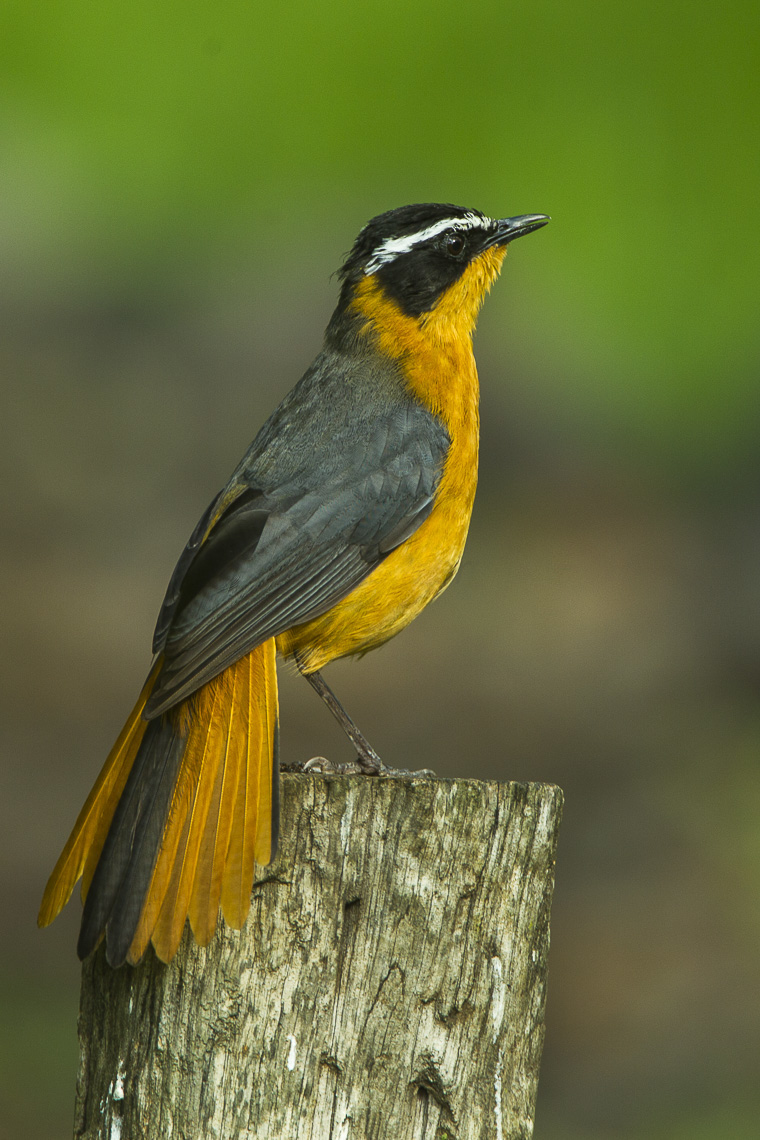
The Rüppell's Robin-Chat is easily recognized by its vivid orange underparts contrasted with a slate-gray upper body. Adults possess a distinctive white eyebrow stripe, adding to their striking appearance. The bird measures approximately 19 to 20 centimeters in length, making it a medium-sized songbird. Juveniles exhibit a more muted coloration with speckled patterns that serve as camouflage. Male and female Rüppell's Robin-Chats are similar in plumage, though females tend to display slightly duller hues. This species can be confused with the Cape Robin-Chat, but the latter lacks the prominent white eyebrow and has a more subdued orange belly. In flight, Rüppell's Robin-Chat shows a quick, darting silhouette, often staying close to the ground. When perched, it maintains an upright posture with frequent tail flicks, a behavior that aids in distinguishing it from similar species.
Having trouble telling birds apart? Upload a photo to our bird identification tool for an instant species match.
Rüppell's Robin-Chat Habitat and Range
Preferred Habitat
Rüppell's Robin-Chat primarily inhabits montane forest regions, thriving in areas between 1,500 to 3,000 meters in elevation. Commonly found in Ethiopia's Bale Mountains and Kenya's Aberdare Range, this bird favors forest edges and clearings. It adapts to cultivated areas and gardens, showcasing its flexibility in habitat preference. Unlike some forest species, the Rüppell's Robin-Chat does not migrate extensively, although it may shift to lower elevations during colder months. Its presence in urban gardens highlights its ability to coexist with human development, provided sufficient vegetation and shelter are available.
Geographic Range
The Rüppell's Robin-Chat occupies a stable range across the highlands of East Africa. It breeds and resides year-round in Ethiopia, particularly in the Simien and Bale Mountains, and extends south through Kenya and Uganda. While primarily a resident species, some local altitudinal movements occur in response to seasonal changes in temperature and food availability. In Kenya, significant populations exist in the Aberdare and Mount Kenya regions, where dense montane forests provide ideal conditions for breeding and foraging. The bird's distribution is concentrated in areas with suitable forest cover, impacting its visibility and study in different regions.
Want to know which birds visit your area? Browse our backyard birds by location guides for region-specific species lists.
What Does the Rüppell's Robin-Chat Eat?
Rüppell's Robin-Chat has a diverse diet primarily consisting of insects and other invertebrates, which it gleans from leaf litter and underbrush. This bird also consumes small berries and fruits, especially during the non-breeding season when insect availability decreases. Its foraging technique involves hopping along the forest floor, flipping leaves and debris to uncover hidden prey. The bird exhibits diurnal feeding patterns, with peak activity occurring in the early morning and late afternoon. This opportunistic diet allows it to thrive in varied environments, from dense forests to cultivated gardens.
Rüppell's Robin-Chat Behavior and Social Structure
Rüppell's Robin-Chat is a solitary or paired bird outside the breeding season, displaying territorial behavior with aggressive displays and vocalizations to defend its area. During courtship, males perform elaborate song displays, often engaging in a duet with the female. These birds are known for their acrobatic maneuvers during territorial disputes, using their agility to assert dominance. In response to predators, they emit sharp alarm calls and may adopt a skulking behavior to avoid detection. Daily activities include foraging and preening, with peak activity during cooler parts of the day. Their interactions with other species in mixed flocks facilitate information exchange about food resources and threats.
Rüppell's Robin-Chat Nesting and Reproduction
Rüppell's Robin-Chat constructs cup-shaped nests using twigs, leaves, and moss, often lining the interior with softer materials. Nests are typically located in dense shrubbery or low trees, providing concealment from predators. The female lays 2 to 3 eggs per clutch, with an incubation period of approximately 14 to 16 days. Both parents participate in feeding the chicks, which fledge about 18 days after hatching. The pair may rear multiple broods per year, depending on environmental conditions and food availability. The parental roles are shared, with both adults actively involved in nurturing and protecting their offspring.
Rüppell's Robin-Chat Sounds and Vocalizations
The primary song of the Rüppell's Robin-Chat is a rich, melodious series of whistles and trills, often delivered from a concealed perch. This song, characterized by its rhythm and pitch variation, serves both courtship and territorial defense purposes. Call notes include soft 'chuck' sounds and sharper alarm calls in response to disturbances. During the dawn chorus, their song blends with those of other forest birds, creating a symphonic backdrop to the early morning. Their vocalizations are an essential component of their interaction with the environment, facilitating communication over long distances in dense habitats.
Interesting Facts About the Rüppell's Robin-Chat
- 1Rüppell's Robin-Chat was named after the German explorer Eduard Rüppell, reflecting its discovery in Africa.
- 2This bird's song repertoire includes imitations of other bird species, showcasing its vocal adaptability.
- 3Despite its vibrant colors, Rüppell's Robin-Chat can remain well-concealed in dense foliage due to its behavior.
- 4The species is known to hybridize with the White-browed Robin-Chat in areas where their ranges overlap.
- 5Rüppell's Robin-Chat is one of the few robin-chats that can thrive in urban gardens, provided there is sufficient vegetation.
Rüppell's Robin-Chat Conservation Status
The Rüppell's Robin-Chat is currently listed as Least Concern by the IUCN, with stable population trends across its range. However, habitat loss due to deforestation and agricultural expansion poses substantial threats. Conservation efforts focus on habitat preservation, particularly in key areas like Ethiopia's montane forests. Historical data suggest the species has maintained stable numbers, but ongoing environmental changes necessitate continuous monitoring. Protecting forest habitats remains crucial to ensuring the bird's long-term survival and ecological contribution.