Recurve-billed Bushbird
Clytoctantes alixii
Order: Passeriformes / Family: Thamnophilidae

Wikimedia Commons
About the Recurve-billed Bushbird
The Recurve-billed Bushbird (Clytoctantes alixii) is a striking member of the Thamnophilidae family, known for its uniquely curved bill and elusive nature. This bird is endemic to the northwestern regions of South America, primarily observed in Colombia and Venezuela. Its presence underscores the rich biodiversity of the tropical forests it inhabits. The dense understory and thickets of these regions provide both shelter and feeding opportunities for the Recurve-billed Bushbird. Despite its striking appearance, this bird remains a rare sight due to its preference for secluded habitats. Its ecological role is significant, as it helps control insect populations within its ecosystem. The bushbird thrives in humid environments, particularly in subtropical and tropical moist lowland forests and montane forests. During the wet season, from April to November, the abundance of insects provides ample feeding opportunities, while in the drier months, the Recurve-billed Bushbird adapts by expanding its diet to include a wider range of arthropods. The bushbird's role as an insectivore is crucial, as it aids in maintaining the balance of its ecological niche. In Colombia, the Serranía de las Quinchas and the Sierra Nevada de Santa Marta are key habitats where this species can be found, often cohabiting with other antbird species. These areas are characterized by a mix of primary and secondary forests, providing an ideal environment for mating and nesting. The Recurve-billed Bushbird's elusive nature and specialized habitat preferences highlight the importance of conservation efforts to preserve these environments, ensuring that this rare species continues to thrive. Its presence is an indicator of the health of its habitat, making it a subject of interest for ornithologists and conservationists alike.
The Recurve-billed Bushbird belongs to the family Thamnophilidae, within the order Passeriformes. These birds typically live average 4-5 years, with the maximum recorded being 6 years..
How to Identify a Recurve-billed Bushbird
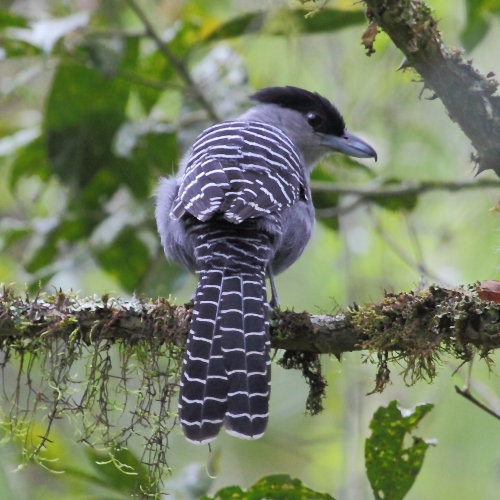
The Recurve-billed Bushbird is a small, distinct bird with adults typically measuring about 16 cm in length. Its most defining feature is its black, strongly curved bill, which it uses adeptly to probe for insects in dense foliage. Adult males display a striking combination of black and chestnut plumage, with the head and upperparts predominantly black, while the underparts are a rich chestnut. Females, however, exhibit a more subdued coloration, with olive-brown upperparts and lighter chestnut below, which aids in camouflage. Juveniles resemble females but with even duller tones, allowing them to blend into their surroundings effectively. Unlike many birds, there is minimal sexual dimorphism beyond coloration, with both sexes displaying the same distinctive bill shape. In flight, the Recurve-billed Bushbird exhibits a short, rounded wing silhouette, which is adapted for maneuvering through dense vegetation. When perched, its posture is upright, often clinging vertically to branches as it searches for prey. Its unique bill and coloration make it difficult to confuse with other species, although the Black-headed Antbird shares a similar habitat and could potentially cause confusion from a distance. However, the bushbird's distinctive bill and contrasting plumage serve as reliable identification markers.
Having trouble telling birds apart? Upload a photo to our bird identification tool for an instant species match.
Recurve-billed Bushbird Habitat and Range
Preferred Habitat
The Recurve-billed Bushbird is primarily found in tropical and subtropical moist lowland forests and montane forests. These habitats are rich in dense understory vegetation, which is essential for the bushbird's foraging activities. In Colombia, they inhabit regions like the Serranía de las Quinchas and Sierra Nevada de Santa Marta, which provide the mix of primary and secondary forests ideal for their needs. The bushbird is typically observed at elevations ranging from 600 to 1,800 meters, though it occasionally ventures to lower altitudes. Seasonal habitat shifts are minimal, as the bird generally remains within the same region year-round. Its preference for dense, humid environments means it avoids urban and heavily altered rural areas, thriving instead in remote forested locations that offer ample cover and food sources.
Geographic Range
The Recurve-billed Bushbird's range is relatively restricted to the northwestern regions of South America, particularly within Colombia and Venezuela. In Colombia, it is predominantly found in the Magdalena Valley and the foothills of the eastern Andes. Venezuela hosts these birds mainly in its western regions, where similar ecological conditions prevail. The bird does not engage in long-distance migrations, preferring to inhabit the same general area throughout the year. Although its range is limited, the Recurve-billed Bushbird occupies a variety of microhabitats within its preferred forest ecosystems. Population density tends to be highest in areas with dense understory and minimal human disturbance, which facilitate the bird's feeding and nesting behaviors.
Want to know which birds visit your area? Browse our backyard birds by location guides for region-specific species lists.
What Does the Recurve-billed Bushbird Eat?
The diet of the Recurve-billed Bushbird primarily consists of insects and other arthropods. It uses its distinctive curved bill to probe into crevices and dense foliage to extract prey, a foraging technique that allows it to exploit food sources inaccessible to many other birds. During the wet season, when insect populations are at their peak, the bushbird focuses on feeding on various caterpillars, beetles, and spiders. As the dry season approaches and insect availability decreases, it expands its diet to include a broader range of arthropods, ensuring a steady food supply. The bird typically forages alone or in pairs, methodically moving through the understory to maximize its hunting efficiency. Its feeding schedule is most active during the early morning and late afternoon, when insect activity is high.
Recurve-billed Bushbird Behavior and Social Structure
The Recurve-billed Bushbird exhibits a predominantly solitary lifestyle, though it may occasionally form pairs, especially during the breeding season. The bird is territorial, often defending its feeding grounds from intruders with vocal displays and physical posturing. Courtship involves intricate displays, where the male showcases his plumage and bill in a series of movements designed to attract a mate. Although not a flocking species, the bushbird sometimes joins mixed-species feeding parties, which offer increased protection from predators through safety in numbers. When confronted by predators, the bushbird relies on its agility and dense habitat for concealment, often remaining perfectly still until danger passes. Daily activity peaks during the cooler hours of the day, as it avoids the midday heat by retreating to shaded areas.
Recurve-billed Bushbird Nesting and Reproduction
Nesting for the Recurve-billed Bushbird involves constructing a deep cup-shaped nest, typically nestled in the fork of a tree or shrub. The nest is composed of leaves, twigs, and fine plant fibers, providing a secure environment for the eggs. Preferred nesting locations are at heights of 1-3 meters above the ground, offering both protection from ground predators and concealment from aerial threats. The clutch size usually consists of two eggs, which are incubated by both parents over a period of about 14 days. After hatching, the chicks remain in the nest for another 12-15 days before fledging. Both parents share the responsibility of feeding and protecting the young, often engaging in distraction displays to deter potential predators. The Recurve-billed Bushbird typically raises one brood per year, although favorable conditions may occasionally lead to a second.
Recurve-billed Bushbird Sounds and Vocalizations
The primary song of the Recurve-billed Bushbird is a series of sharp, rhythmic notes that rise and fall in pitch, resembling a series of 'chip-chip-chip' sounds. These vocalizations serve as both territorial markers and mate attraction calls. The bird's call notes are short and staccato, often used for communication between mates or signaling alarm. Alarm calls are more urgent and repetitive, intended to alert nearby birds of potential threats. During the dawn chorus, the bushbird's voice stands out due to its unique rhythm and clarity, contributing to the rich tapestry of sounds in its forest environment.
Interesting Facts About the Recurve-billed Bushbird
- 1The Recurve-billed Bushbird's bill is not only curved but also highly sensitive, enabling precise detection of prey in dense foliage.
- 2It shares its habitat with several other rare bird species, making its ecosystem a hotspot for biodiversity.
- 3Despite its rarity, the Recurve-billed Bushbird can sometimes be found in mixed-species feeding flocks, benefiting from group foraging.
- 4This bird's reliance on dense understory vegetation makes it an indicator species for the health of its forest environment.
- 5The bushbird's distinctive song can be heard over 50 meters away, often the first hint of its presence in thick vegetation.
- 6Its preference for secluded habitats makes it a challenging subject for bird watchers and researchers alike.
- 7The Recurve-billed Bushbird's population is believed to number fewer than 10,000 individuals, highlighting its conservation importance.
Recurve-billed Bushbird Conservation Status
The IUCN currently lists the Recurve-billed Bushbird as Vulnerable, with its population trend showing signs of decline. Habitat destruction, primarily due to deforestation and land conversion for agriculture, poses the greatest threat to its survival. Conservation efforts focus on habitat preservation and restoration, particularly in protected areas within its range. Historical population changes indicate that the species was once more widespread, but human activities have significantly reduced its suitable habitats. Efforts to curb deforestation and promote sustainable land use are crucial for stabilizing and potentially increasing its population in the future.