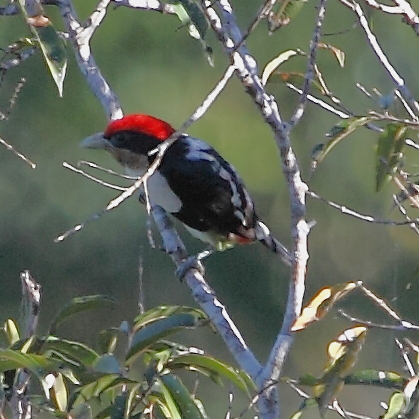
Red-headed Barbet
Eubucco bourcierii
Order: Piciformes / Family: Capitonidae

Wikimedia Commons
About the Red-headed Barbet
The Red-headed Barbet (Eubucco bourcierii) is a striking and colorful resident of the Neotropical forests. This small bird belongs to the family Capitonidae, known for their stout bills and vibrant coloration. Found primarily in the montane forests of Central and South America, the Red-headed Barbet inhabits regions from Costa Rica to northern Ecuador. This species thrives in the humid, dense canopies and middle strata of forests, where it plays a crucial role in seed dispersal and insect population control. The Red-headed Barbet is a year-round resident, showing little to no migratory behavior. Its presence is significant for maintaining the ecological balance within its habitat. By consuming a variety of fruits and insects, this bird aids in the propagation of plant species and helps keep insect populations in check, thus contributing to the health of its ecosystem. Seasonal behaviors include increased vocal activity during the breeding season, when males become particularly territorial and active in courtship displays. In the non-breeding season, these birds might form small mixed-species flocks, which enhances their foraging efficiency and predator avoidance. The Red-headed Barbet is of particular interest to ornithologists due to its vibrant plumage and unique ecological niche, making it a focal species for studies on avian biodiversity in tropical montane ecosystems.
The Red-headed Barbet belongs to the family Capitonidae, within the order Piciformes. These birds typically live typically 6-9 years, with a maximum recorded of 13 years..
How to Identify a Red-headed Barbet
The Red-headed Barbet is easily recognized by its vivid red head, which contrasts sharply with its green wings and back. Adult males possess a bright red head, throat, and upper breast, with a distinct yellow band across the lower breast, transitioning into green on the belly. Females differ significantly, displaying more subdued colors with an olive-green head and less distinct red markings. Juvenile birds resemble females but have even duller plumage. This sexual dimorphism aids in field identification. The bird measures approximately 17-18 cm in length, with a robust, slightly curved bill ideal for its frugivorous diet. In flight, the Red-headed Barbet presents a compact silhouette with rapid wingbeats. When perching, it typically adopts an upright posture, often seen in the mid-level canopy or perched quietly while foraging. Confusion may arise with similar species like the Scarlet-rumped Toucanet, but the barbet's smaller size and distinct coloration patterns provide clear differentiation.
Having trouble telling birds apart? Upload a photo to our bird identification tool for an instant species match.
Red-headed Barbet Habitat and Range
Preferred Habitat
The Red-headed Barbet inhabits montane forests, thriving at elevations ranging from 900 to 2400 meters. It prefers dense, humid forests with a high diversity of fruiting trees. These birds are commonly found in the middle to upper canopies, where the foliage provides ample cover and foraging opportunities. In regions such as the cloud forests of Costa Rica and the Andean foothills, the Red-headed Barbet finds ideal conditions for feeding and nesting. While primarily a forest dweller, it can occasionally be found in adjacent secondary growth and edges, especially in less disturbed areas. Unlike many other bird species, the Red-headed Barbet shows little variation in habitat preference throughout the year, maintaining a consistent presence in these montane environments.
Geographic Range
The Red-headed Barbet occupies a range that extends from the highlands of Costa Rica through Panama and into the Andean regions of Colombia and Ecuador. This species is a resident throughout its range, showing no significant migratory patterns. In Costa Rica and Panama, it is most frequently observed in the central and eastern mountain ranges. In Colombia, the species is common in the western and central Andes, whereas in Ecuador, its presence is noted along the eastern Andean slopes. Population density tends to be higher in areas with abundant fruiting trees, such as those found in protected cloud forests and national parks. Although not considered a migratory bird, some local movements may occur in response to seasonal fruit availability, ensuring the Red-headed Barbet can locate sufficient food sources year-round.
Want to know which birds visit your area? Browse our backyard birds by location guides for region-specific species lists.
What Does the Red-headed Barbet Eat?
The diet of the Red-headed Barbet primarily consists of fruits, making it an important seed disperser in its ecosystem. It feeds on a variety of fruits, including those from fig and berry-producing plants. In addition to its frugivorous habits, the Red-headed Barbet also consumes insects and small invertebrates, supplementing its diet with protein-rich sources. During the breeding season, its diet shifts slightly to include more insects, which provide essential nutrients for raising young. Foraging typically occurs in the mid to upper canopy, where these barbets use their strong bills to pluck fruits and probe for insects. They are often seen foraging alone or in pairs, though during non-breeding seasons, they may join mixed-species flocks to increase foraging success and reduce predation risks. Red-headed Barbets exhibit a diurnal feeding schedule, with peak activity occurring in the early morning and late afternoon when temperatures are cooler and insect activity is high.
Want to attract Red-headed Barbets to your yard? See our recommended feeders and seed types for the best results.
Red-headed Barbet Behavior and Social Structure
The Red-headed Barbet is a relatively solitary bird, often seen alone or in pairs, especially during the breeding season. Males become highly territorial, using their distinctive calls to defend their breeding areas. Courtship involves a series of elaborate displays, including vocalizations and posturing to attract females. Outside the breeding season, Red-headed Barbets may join mixed-species flocks, which provide safety in numbers and increased foraging opportunities. These flocks are typically loose aggregations of different insectivorous and frugivorous birds. In the presence of predators, Red-headed Barbets rely on their cryptic coloration and the dense foliage of the canopy for concealment. They are diurnal, with most activity concentrated in the early morning and late afternoon. During these peak times, they engage in feeding, territorial displays, and social interactions. Their behavior is marked by a blend of boldness when foraging in open areas and cautiousness when potential threats are near.
Red-headed Barbet Nesting and Reproduction
Red-headed Barbets create cavity nests, often excavating holes in decaying trees or using abandoned woodpecker cavities. The nesting site is typically located in the mid to upper canopy, providing protection from ground predators. Nests are lined with soft plant material to insulate the eggs. The clutch size ranges from 2 to 4 eggs, which both parents incubate over a period of 14 to 18 days. After hatching, both male and female share feeding duties, bringing regurgitated fruit and insects to the chicks. Fledging occurs approximately 30 days after hatching, although fledglings remain dependent on parental care for several weeks post-fledging. This species typically raises one brood per year, although favorable conditions may lead to a second brood.
Red-headed Barbet Sounds and Vocalizations
The Red-headed Barbet's primary song is a series of short, resonant notes delivered in rapid succession, resembling a rhythmic drumming sound. This song plays a crucial role during the breeding season, serving both as a territorial call and a courtship display. The bird also produces a variety of call notes, including sharp 'peet' and 'pik' sounds, used for communication between mates and as alarm calls. During the dawn chorus, males are particularly vocal, establishing territory and attracting mates. Their vocalizations are less complex than those of songbirds but are distinctive and effective for their ecological needs.
Interesting Facts About the Red-headed Barbet
- 1The Red-headed Barbet's diet includes a unique mix of fruits and insects, making it an essential seed disperser and pest controller.
- 2Despite its vibrant colors, the Red-headed Barbet is adept at blending into the dense foliage of its montane forest habitat.
- 3During courtship, male Red-headed Barbets engage in elaborate vocal displays to attract potential mates.
- 4Red-headed Barbets often reuse old woodpecker cavities for nesting, saving energy on excavation.
- 5Their strong bill is specially adapted for frugivory, allowing them to crack open tough fruit skins.
- 6The Red-headed Barbet's range overlaps with many protected areas, providing a buffer against habitat loss.
- 7They are non-migratory, which means they rely heavily on the stability of their forest habitats year-round.
Red-headed Barbet Conservation Status
The Red-headed Barbet is currently listed as Least Concern by the IUCN. Its population appears stable, benefiting from large expanses of suitable montane forest habitat. However, threats such as deforestation and habitat fragmentation pose risks, particularly in regions undergoing rapid agricultural expansion. Conservation efforts focus on preserving primary forest habitats and establishing protected areas. Historical population changes have been minimal, but continued monitoring is essential to ensure the species remains secure. Citizen science initiatives and ecotourism may help bolster conservation awareness and efforts.
Attracting Red-headed Barbets to Your Feeder
The Red-headed Barbet is a regular visitor to backyard bird feeders across its range. At the Eye On The Fly feeding station, we observe Red-headed Barbets regularly and capture footage with our feeder cameras.