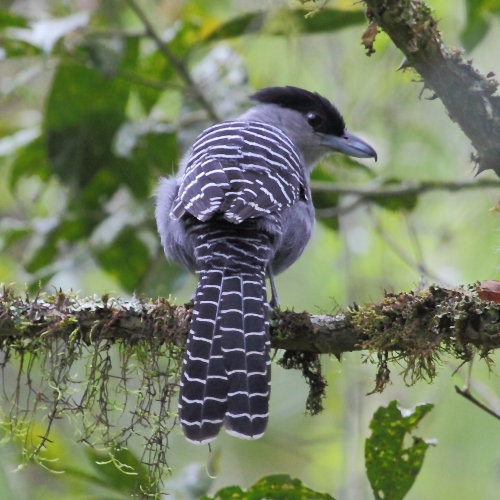
Rio de Janeiro Antwren
Myrmotherula fluminensis
Order: Passeriformes / Family: Thamnophilidae
About the Rio de Janeiro Antwren
The Rio de Janeiro Antwren (Myrmotherula fluminensis) is a diminutive bird that inhabits the remaining tracts of the Atlantic Forest in southeastern Brazil. This bird is significant due to its restricted range and the highly fragmented nature of its habitat, making it one of the more vulnerable species within the Thamnophilidae family. The Atlantic Forest, once sprawling along the Brazilian coast, has been significantly reduced, yet it remains a biodiversity hotspot, hosting numerous endemic species like the Rio de Janeiro Antwren. This bird plays a crucial role in the ecosystem by controlling insect populations and participating in the complex web of ecological interactions that characterize these forests.
An understory specialist, the Rio de Janeiro Antwren predominantly occupies lowland and foothill forests, typically below 800 meters in elevation. Its preference for dense, tangled vegetation allows it to deftly move through the thicket in search of food, primarily insects and other arthropods. The species exhibits subtle seasonal behaviors; during the wet season, it might venture slightly beyond its usual territories to exploit the abundance of prey, although such movements are limited. This antwren's reliance on intact forest ecosystems underscores the importance of habitat preservation in safeguarding its future.
The Rio de Janeiro Antwren's ecological role extends beyond its immediate environment. As an insectivore, it helps regulate insect populations, contributing to the forest's health and productivity. This regulation is vital for maintaining the balance within the forest, as unchecked insect populations could lead to significant vegetation damage, affecting not only the antwren but other species as well. Given the declining state of the Atlantic Forest, efforts to conserve and restore these habitats are critical for the survival of the Rio de Janeiro Antwren and countless other species that depend on this unique ecosystem.
The Rio de Janeiro Antwren belongs to the family Thamnophilidae, within the order Passeriformes. These birds typically live average 5 years with a maximum recorded of 8 years..
How to Identify a Rio de Janeiro Antwren
The Rio de Janeiro Antwren is a small bird, typically measuring around 10 to 11 centimeters in length. Adult males are characterized by their striking black-and-white plumage, with a predominantly black back and white underparts. The wings are marked with white spots, creating a distinct pattern that aids in identification. Females, on the other hand, exhibit more subdued colors, with brownish tones replacing the stark black of the males, and a buffy wash on the underparts. Juveniles closely resemble females but can be identified by their more muted appearance and less defined markings.
In the field, one must take care not to confuse the Rio de Janeiro Antwren with similar species like the Unicolored Antwren, which shares the same habitat. However, the latter lacks the distinctive wing spots and has a more uniform appearance. When observed in flight, the Rio de Janeiro Antwren shows rapid, fluttering wingbeats typical of small passerines, quickly disappearing into dense foliage. Its perching posture is often horizontal, as it clings to branches within the understory, scanning for prey. This bird's agility and quick movements make it a challenging but rewarding species to observe in its natural habitat.
Having trouble telling birds apart? Upload a photo to our bird identification tool for an instant species match.
Rio de Janeiro Antwren Habitat and Range
Preferred Habitat
The Rio de Janeiro Antwren is intimately associated with the Atlantic Forest, particularly favoring the dense understory of lowland and foothill forests. Within these forests, it thrives in areas with thick vegetation, which provides ample cover and foraging opportunities. The species is typically found at elevations ranging from sea level to about 800 meters, though it is most commonly encountered in the lower elevations where the forest is densest. While primarily a forest-dwelling bird, it is occasionally spotted in secondary growth areas, especially where primary forests have been disturbed. Unlike some other antbirds, the Rio de Janeiro Antwren does not commonly venture into urban areas, maintaining a presence in more natural, less disturbed environments. Seasonal habitat shifts are limited, as this species tends to remain within its established territories throughout the year.
Geographic Range
The range of the Rio de Janeiro Antwren is one of the smallest among the antbirds, restricted primarily to the Atlantic Forest of southeastern Brazil. The core of its distribution lies within the states of Rio de Janeiro, São Paulo, and Espírito Santo, where it inhabits the fragmented remnants of its once vast forest home. There is no evidence to suggest that this species undertakes long-distance migrations; instead, it remains a year-round resident within its range. Population density tends to be higher in well-preserved forest patches, particularly in protected areas where habitat quality is maintained. However, habitat fragmentation and ongoing deforestation pose significant challenges, leading to isolated populations that are vulnerable to genetic bottlenecks. Conservation efforts in these regions focus on habitat restoration and protection to ensure the species' continued survival.
Want to know which birds visit your area? Browse our backyard birds by location guides for region-specific species lists.
What Does the Rio de Janeiro Antwren Eat?
The diet of the Rio de Janeiro Antwren consists primarily of insects and other small arthropods. This insectivorous bird employs a variety of foraging techniques, including gleaning insects from leaves and branches within the dense understory. Its prey includes ants, beetles, spiders, and caterpillars, among other small invertebrates. Seasonal changes in prey availability can lead to slight variations in diet composition; during the wet season, when insect activity peaks, the antwren may consume a greater variety of prey. Typically, this bird forages in mixed-species flocks, a behavior that enhances its feeding efficiency by reducing the risk of predation and increasing the likelihood of flushing out hidden prey. The Rio de Janeiro Antwren is most active during the early morning and late afternoon, taking advantage of the cooler temperatures to forage and avoid the midday heat.
Rio de Janeiro Antwren Behavior and Social Structure
The Rio de Janeiro Antwren exhibits interesting social and territorial behaviors. It is known to live in monogamous pairs, often maintaining the same territory throughout the year. These territories are vigorously defended against intruders, with both males and females participating in territorial displays. Such displays may involve vocalizations and physical posturing to intimidate rivals. During the breeding season, courtship displays become more pronounced, with males performing elaborate movements to attract mates.
This species is also known for its participation in mixed-species flocks, a common strategy among understory birds to enhance foraging success and reduce predation risk. Within these flocks, the Rio de Janeiro Antwren is often one of the more active members, constantly on the move as it searches for food. Despite its small size, the antwren appears confident within these flocks, frequently taking the lead in foraging movements.
Predator avoidance behaviors are crucial for this bird, given its size and habitat. When threatened, it may freeze in place or rapidly retreat to denser cover. Daily activity patterns typically involve a peak in activity during the cooler hours of the day, with periods of rest during the midday heat, reflecting an adaptation to the forest's microclimate.
Rio de Janeiro Antwren Nesting and Reproduction
The nesting habits of the Rio de Janeiro Antwren are typical of many antbirds. It constructs a small, cup-shaped nest using fine twigs, leaves, and fibers, skillfully woven into a secure structure. These nests are usually placed low in the understory, well hidden among the dense foliage to protect against predators. The typical clutch size is two eggs, which are incubated by both parents for about 14 to 16 days. During the incubation period, the parents are highly attentive, taking turns to ensure the eggs are kept at the right temperature.
Once hatched, the chicks are altricial, meaning they are born relatively undeveloped and require significant parental care. Both parents participate in feeding and caring for the young, with the fledging period lasting approximately 12 to 14 days after hatching. After fledging, the young remain dependent on their parents for several weeks as they learn to forage and navigate their complex environment. The Rio de Janeiro Antwren typically raises one brood per year, although in some instances, a second brood may be attempted if conditions are favorable.
Rio de Janeiro Antwren Sounds and Vocalizations
The Rio de Janeiro Antwren's vocalizations are distinctive and play a crucial role in communication. Its primary song consists of a series of sharp, metallic notes delivered in rapid succession. The pitch is relatively high, with a rhythm that can be described as a quick, staccato series of "chik-chik-chik" sounds. In addition to its song, the antwren produces a variety of call notes used for different purposes, such as contact calls between mates or alarm calls when predators are nearby. The alarm calls tend to be sharper and more insistent, serving as an effective warning signal to other birds in the area.
During the dawn chorus, the Rio de Janeiro Antwren often participates with vigor, its song contributing to the vibrant acoustic landscape of the forest. Its calls are comparable to the sound of tapping on hollow wood, which may help in distinguishing it from other species in its habitat.
Interesting Facts About the Rio de Janeiro Antwren
- 1The Rio de Janeiro Antwren was only officially described in 1990, highlighting the challenges of studying cryptic forest species.
- 2Despite its small size, the Rio de Janeiro Antwren has a surprisingly loud call that can carry through dense forest understory.
- 3The species is named after the region of Rio de Janeiro, where its type specimen was collected, reflecting its limited range.
- 4The Rio de Janeiro Antwren's participation in mixed-species flocks allows it to forage more efficiently while minimizing predation risk.
- 5This bird's habitat, the Atlantic Forest, is considered one of the world's most endangered biomes, with only about 15% remaining.
- 6Research indicates that the Rio de Janeiro Antwren plays a role in seed dispersal through its insectivorous diet, indirectly aiding forest regeneration.
- 7The Rio de Janeiro Antwren's plumage provides excellent camouflage in the dappled light of the understory, making it challenging to spot.
Rio de Janeiro Antwren Conservation Status
The Rio de Janeiro Antwren is currently classified as Endangered by the IUCN due to its restricted range and the ongoing threat of habitat loss. The Atlantic Forest, its sole habitat, has been reduced to a fraction of its original size, primarily due to agriculture, urbanization, and logging. These activities have led to significant fragmentation of the forest, isolating populations and increasing their vulnerability to extinction. Conservation efforts focus on protecting remaining forest patches and promoting reforestation projects to restore connectivity between fragmented habitats. Given the species' reliance on intact forest ecosystems, these efforts are crucial for its survival. Historical population declines have been significant, yet recent interest in its conservation provides hope for stabilizing and potentially increasing its numbers through targeted actions.