
Round-tailed Manakin
Pipra chloromeros
Order: Passeriformes / Family: Pipridae

Wikimedia Commons
About the Round-tailed Manakin
The Round-tailed Manakin, scientifically known as Pipra chloromeros, is a small passerine bird found predominantly in the tropical forests of South America. This species, belonging to the Pipridae family, plays a significant role in its ecosystem by aiding seed dispersal and pollination due to its frugivorous diet. The bird's striking plumage and unique courtship displays make it a subject of interest for ornithologists and bird enthusiasts alike.
The Round-tailed Manakin is most commonly observed in the dense, humid lowland forests of countries like Brazil, Peru, and Bolivia. Its preference for undisturbed forests underscores its importance as an indicator of forest health. The species can thrive in both primary and secondary growth forests, although it demonstrates a marked preference for areas with dense canopy cover and plentiful fruiting trees.
Ecologically, the Round-tailed Manakin contributes to the forest dynamics by dispersing the seeds of various fruit-bearing plants. This behavior not only assists in plant propagation but also supports the regeneration of forested areas. During the breeding season, which typically coincides with the wet season, these birds engage in elaborate lekking displays. Males congregate in specific areas to perform intricate dances and vocalizations, showcasing their vibrant plumage to attract females. The Round-tailed Manakin's role in its habitat is integral, linking the health of the forest ecosystem with its own survival.
As a non-migratory species, the Round-tailed Manakin does not undertake long-distance migrations, although it may move locally within its range in response to changes in fruit availability. The bird's presence is a testament to the richness of the tropical ecosystems of South America, signaling a well-balanced environment where species interactions thrive.
The Round-tailed Manakin belongs to the family Pipridae, within the order Passeriformes. These birds typically live typically 5-7 years, with some individuals living up to 9 years..
How to Identify a Round-tailed Manakin
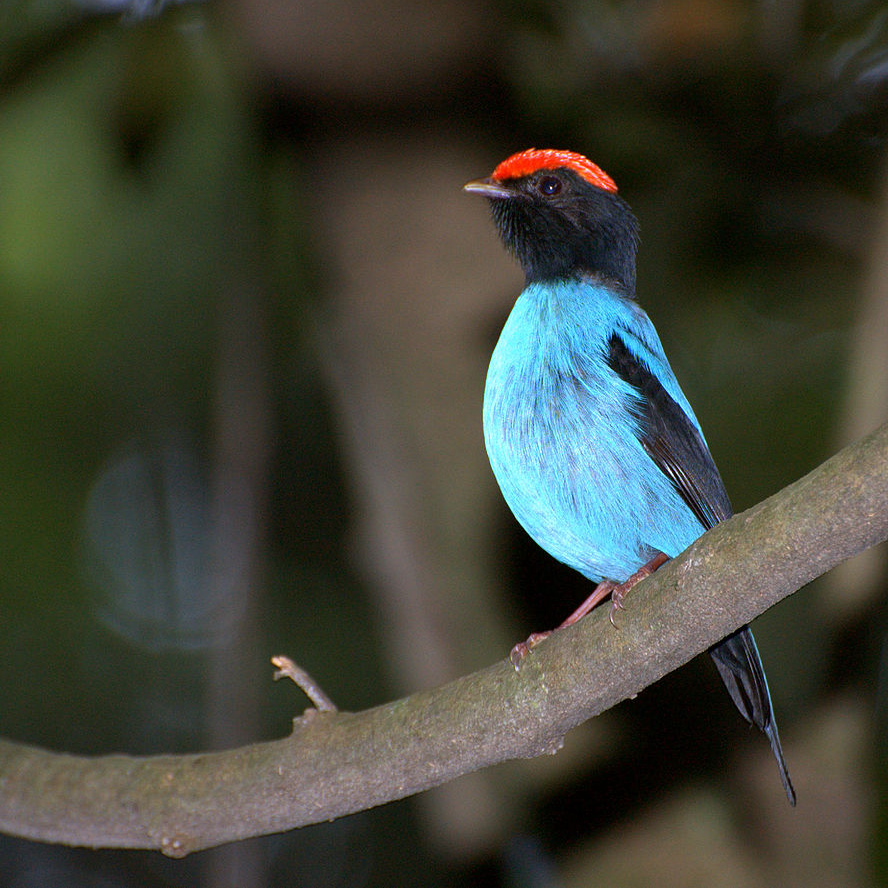
Adult male Round-tailed Manakins are easily recognizable by their bright red crowns, contrasting sharply with their otherwise black plumage. The lower back and rump display a striking lime green, adding to the bird's allure. Females, on the other hand, exhibit a more subdued olive-green plumage, which aids in camouflage within the dense foliage. Juveniles resemble females but with paler underparts and less defined color contrasts.
The Round-tailed Manakin's compact body, measuring approximately 10 centimeters in length, is complemented by its round tail, from which it derives its common name. This feature, in conjunction with its bright coloration and active movements, helps distinguish it from other manakin species. While in flight, these birds exhibit rapid, direct flight patterns with short bursts, unlike the more soaring flight styles of larger birds.
Despite its striking colors, the Round-tailed Manakin can be confused with similar species such as the Band-tailed Manakin. However, the latter lacks the vivid red crown and has a notably different tail shape. Observing these field marks carefully can help birders accurately identify the Round-tailed Manakin in its natural habitat.
Having trouble telling birds apart? Upload a photo to our bird identification tool for an instant species match.
Round-tailed Manakin Habitat and Range
Preferred Habitat
The Round-tailed Manakin thrives in tropical moist lowland forests, particularly favoring dense, evergreen forest areas with abundant fruiting trees. Found primarily in the Amazon Basin, it inhabits regions in Brazil, Peru, and Bolivia. The species is most frequently observed at elevations ranging from sea level to 1,000 meters, although it occasionally ventures to higher altitudes in search of food.
This bird prefers undisturbed primary forests but can also adapt to secondary growth areas, provided they offer sufficient canopy cover and fruit availability. Seasonal shifts in habitat use are limited, as the species is largely sedentary, although local movements in response to fruiting patterns are common.
The Round-tailed Manakin is less frequently seen in urban or heavily disturbed areas, as it relies on the complex structure of the rainforest for its foraging and breeding activities. Its presence in a forest is often an indicator of the area's ecological health.
Geographic Range
The Round-tailed Manakin's range is primarily centered in the Amazon Basin, covering areas in Brazil, Peru, and Bolivia. In Brazil, it is found in the western and central regions, including the states of Acre and Rondônia. In Peru, the bird is common in the lowland forests of the Loreto and Ucayali regions. In Bolivia, it inhabits areas within the departments of Pando and Beni.
This species is non-migratory, meaning it does not participate in long-distance migrations. Instead, it remains within its tropical range year-round, exploiting the resources of the rich Amazonian forests. Despite its relatively stable geographical range, local populations may shift slightly in response to changes in fruit availability or habitat disturbance.
Population density hotspots for the Round-tailed Manakin typically coincide with areas of high fruit abundance and low human disturbance. Here, the species can be observed engaging in its characteristic courtship displays and foraging activities.
Want to know which birds visit your area? Browse our backyard birds by location guides for region-specific species lists.
What Does the Round-tailed Manakin Eat?
The diet of the Round-tailed Manakin primarily consists of fruits, which it skillfully plucks from trees and shrubs. The bird favors small, fleshy fruits from a variety of plant species, including those from the genera Ficus and Cecropia. This frugivorous diet plays a crucial role in seed dispersal within its habitat, contributing to forest regeneration.
In addition to fruits, the Round-tailed Manakin occasionally supplements its diet with small insects, providing a source of protein. This dietary flexibility enables the bird to adapt to seasonal variations in fruit availability. During the wet season, when fruit is abundant, the bird's diet is almost exclusively frugivorous, while in drier periods, it may increase its insect consumption.
Foraging typically occurs in the mid to upper canopy, where the bird employs agile movements and quick flights to reach food sources. The Round-tailed Manakin often feeds alone or in small groups, showing a preference for early morning and late afternoon when temperatures are cooler and fruit is more accessible.
Round-tailed Manakin Behavior and Social Structure
The Round-tailed Manakin exhibits fascinating social and courtship behaviors, particularly during the breeding season. Males participate in lekking, a form of competitive display where they gather in designated areas to perform elaborate displays for visiting females. These displays include a combination of acrobatic flights, wing snaps, and vocalizations designed to attract a mate.
Outside of the breeding season, the Round-tailed Manakin is generally solitary or found in small flocks, maintaining a low profile as it forages for food. Territorial behavior is prominent during the lekking period, with males defending their display sites from rivals. These sites, often located in the mid-canopy, serve as focal points for female visitation and subsequent mate selection.
The bird's response to predators involves quick, evasive flights into dense foliage where they can effectively hide. Daily activity patterns are largely diurnal, with peak activity occurring during the cooler parts of the day, aligning with optimal foraging and lekking conditions. The Round-tailed Manakin's behavioral repertoire underscores its adaptation to the complex dynamics of its tropical forest environment.
Round-tailed Manakin Nesting and Reproduction
The Round-tailed Manakin constructs a small, cup-shaped nest, typically situated in the fork of a tree branch within the dense foliage of the forest mid-story. The nest is composed of fine plant materials such as rootlets and fibers, bound together with spider silk, providing both stability and flexibility.
Females are solely responsible for nest building and incubation, laying a clutch of two eggs that are pale and speckled. The incubation period lasts approximately 18 to 20 days, after which the altricial chicks hatch. The female continues to care for the young, feeding them regurgitated fruit and insects until they fledge at around 15 to 20 days old.
The Round-tailed Manakin typically raises one brood per year, although favorable conditions may occasionally allow for a second. The species' nesting habits reflect its reliance on undisturbed forest habitats, where suitable nesting sites and abundant food resources can support successful reproduction.
Round-tailed Manakin Sounds and Vocalizations
The vocalizations of the Round-tailed Manakin are integral to its courtship displays. Males produce a series of sharp, metallic notes, often described as 'tik-tik-tik', which resonate through the forest. These calls serve both to attract females and to assert dominance over display sites in the lek.
In addition to these primary songs, the Round-tailed Manakin emits softer calls and chattering notes during interactions with conspecifics. Alarm calls are less frequently heard but consist of brief, sharp notes used to warn of predators.
During the dawn chorus, the bird's calls are more pronounced, contributing to the vibrant soundscape of the tropical forest. The rhythmic and repetitive nature of the Round-tailed Manakin's song is reminiscent of a woodpecker tapping, making it distinctive among the ambient forest sounds.
Interesting Facts About the Round-tailed Manakin
- 1The Round-tailed Manakin is known for its intricate lekking displays, where males perform acrobatic flight maneuvers to attract females.
- 2Its diet mainly consists of fruits, making it an important seed disperser in the Amazonian forests.
- 3During courtship, males can spend hours perfecting their displays, often using the same lekking site year after year.
- 4Unlike many birds, the Round-tailed Manakin does not migrate, remaining in its tropical habitat year-round.
- 5The vivid red crown of the male Round-tailed Manakin is a key feature that distinguishes it from similar species.
- 6Females construct their nests using spider silk, providing elasticity and strength to the structure.
- 7The species is found at elevations from sea level up to 1,000 meters, showing adaptability to different forest conditions.
Round-tailed Manakin Conservation Status
The Round-tailed Manakin is currently listed as Least Concern by the IUCN, with stable population trends across its range. However, the species faces ongoing threats from habitat destruction due to deforestation and agricultural expansion in the Amazon Basin. Conservation efforts focus on preserving large tracts of continuous forest, essential for maintaining viable populations. Protected areas and national parks within Brazil, Peru, and Bolivia play a critical role in safeguarding the bird's habitat. While historical population changes have been minimal, the increasing pressure on Amazonian forests necessitates continued vigilance. Conservation initiatives that promote sustainable land use and forest restoration are vital for the long-term survival of the Round-tailed Manakin and other forest-dependent species.
Other Pipridae Species


Birds Similar to the Round-tailed Manakin
These species are often confused with the Round-tailed Manakin due to similar appearance or overlapping range.