Rufous-tailed Antbird
Drymophila genei
Order: Passeriformes / Family: Thamnophilidae
Wikimedia Commons
About the Rufous-tailed Antbird
The Rufous-tailed Antbird, known scientifically as Drymophila genei, is a captivating species endemic to the lush montane forests of southeastern Brazil. As a member of the Thamnophilidae family, it plays a vital role in the ecosystem by controlling insect populations. This small, active bird is often encountered flitting in the understory of Atlantic Forest remnants, where its presence indicates a healthy and diverse habitat. Its ecological significance is underscored by its preference for densely vegetated areas, where it participates in the complex food web by preying on insects and arthropods.
Inhabiting regions such as the Serra do Mar and Serra da Mantiqueira, the Rufous-tailed Antbird thrives in elevations ranging from 500 to 2,000 meters. This species is particularly reliant on the microhabitats provided by the dense foliage and tangled vines typical of these montane forests. Its activities contribute to the ecological balance, as it aids in regulating insect populations that could otherwise become pests. The bird's presence is also an indicator of the health of these biodiverse ecosystems, which are under constant threat from deforestation and habitat fragmentation.
The Rufous-tailed Antbird exhibits fascinating seasonal behaviors, particularly during the breeding season, which typically spans from September to January. During this time, males engage in territorial displays to ward off competitors and attract mates. The bird's reliance on specific habitat conditions makes it vulnerable to environmental changes, emphasizing the importance of conservation efforts aimed at preserving its natural habitat. As an integral part of the Atlantic Forest ecosystem, the Rufous-tailed Antbird exemplifies the intricate connections between species and their environments.
The Rufous-tailed Antbird belongs to the family Thamnophilidae, within the order Passeriformes. These birds typically live typically 5-6 years, with some living up to 8 years..
How to Identify a Rufous-tailed Antbird
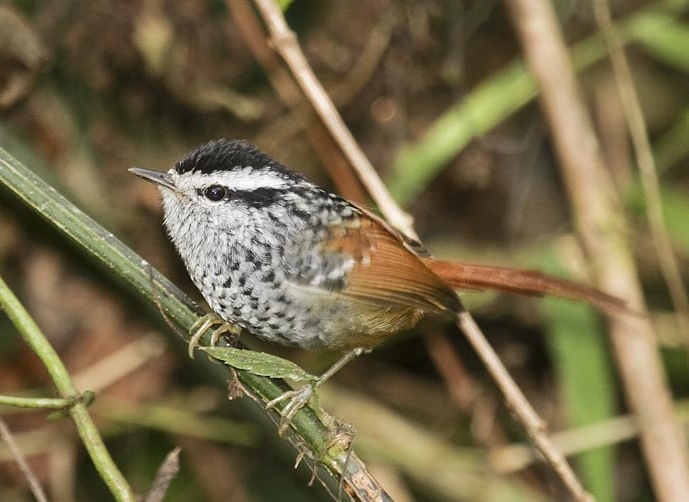
The Rufous-tailed Antbird is a small passerine characterized by its distinctive rufous tail, which contrasts with its otherwise predominantly brown and gray plumage. Adult males and females are similar in appearance, though males may exhibit slightly more vibrant coloration. The upperparts are generally a rich brown, whereas the underparts show a mix of gray and buff tones. Both sexes have a subtle white spotting pattern on their wings, which can help in distinguishing them from similar species.
Juveniles resemble adults but often have duller plumage and lack the full intensity of the rufous tail. This species can be confused with other antbirds, such as those in the Myrmotherula genus, but the Rufous-tailed Antbird's distinctive tail and vocalizations are key differentiators. Its flight silhouette is fairly typical of small forest birds, with rapid, direct flight interspersed with short glides.
In terms of perching posture, the Rufous-tailed Antbird often adopts a horizontal stance, frequently flicking its tail as it actively searches for prey. This behavior, coupled with its characteristic vocalizations, aids birders in identifying this otherwise inconspicuous forest dweller.
Having trouble telling birds apart? Upload a photo to our bird identification tool for an instant species match.
Rufous-tailed Antbird Habitat and Range
Preferred Habitat
The Rufous-tailed Antbird thrives in the dense, humid understory of the Atlantic Forest in southeastern Brazil. This biome, known for its high biodiversity and endemism, provides the ideal environment for the species. The bird is typically found at elevations ranging from 500 to 2,000 meters, with a preference for areas with dense foliage and a rich layer of leaf litter.
While primarily a forest-dwelling species, it can occasionally be found in secondary growth forests and forest edges, though it remains less common in these areas. Unlike many other bird species, the Rufous-tailed Antbird does not typically venture into urban environments, as it requires the intact understory and complex vegetation structure of its native forests.
Seasonal habitat shifts are minimal, as the bird tends to remain in its preferred forest habitat year-round. This reliance on specific habitat conditions highlights the importance of preserving these forested areas to ensure the species' continued survival.
Geographic Range
The Rufous-tailed Antbird is largely confined to the Atlantic Forest regions of southeastern Brazil, with its range encompassing the states of Rio de Janeiro, São Paulo, Minas Gerais, and Espírito Santo. This area represents one of the most biodiverse yet threatened ecosystems on the planet. Although the bird does not undertake long migrations, it may shift locally within its range in response to specific environmental conditions or availability of resources.
Within its limited range, the Rufous-tailed Antbird demonstrates a preference for montane and submontane forest habitats, where it occupies the dense understory. Despite its relatively narrow geographic distribution, the species can be locally abundant in suitable habitats, particularly within protected areas and reserves where the forest remains largely intact.
Current population densities are highest in regions where conservation efforts have successfully preserved larger tracts of the Atlantic Forest. However, ongoing habitat destruction and fragmentation pose significant threats to its range stability, necessitating continued conservation initiatives to safeguard its future.
Want to know which birds visit your area? Browse our backyard birds by location guides for region-specific species lists.
What Does the Rufous-tailed Antbird Eat?
The Rufous-tailed Antbird's diet primarily consists of insects and other small arthropods, including beetles, ants, and spiders. It employs a highly active foraging strategy, using quick, agile movements to search through leaf litter and among dense vegetation. This bird often uses its slender bill to probe into crevices and flip over leaves in search of prey.
Seasonal changes in food availability can influence its diet composition, although insects remain the primary food source throughout the year. During periods of abundance, the bird may also consume small caterpillars and other larvae, which provide a rich source of protein. The Rufous-tailed Antbird typically forages alone or in pairs, maintaining a territory that it defends vigorously from intruders.
Feeding primarily occurs during daylight hours, with peak activity in the early morning and late afternoon. This schedule allows the bird to capitalize on the daily rhythms of insect activity, ensuring a steady food supply. Its foraging behavior is an essential component of its ecological role, contributing to the control of insect populations within its habitat.
Rufous-tailed Antbird Behavior and Social Structure
The Rufous-tailed Antbird exhibits a variety of intriguing behaviors that reflect its adaptation to life in the dense understory of the Atlantic Forest. It is generally solitary or found in pairs, with both males and females maintaining a well-defined territory that they defend aggressively against intruders. Territorial disputes frequently involve vocalizations and visual displays, as the bird seeks to establish dominance and secure resources.
During the breeding season, which occurs from September to January, males engage in elaborate courtship displays to attract mates. These displays often involve a combination of vocalizations and physical posturing, showcasing the bird's vibrant plumage and energetic personality. The Rufous-tailed Antbird is monogamous, with pairs forming strong bonds that last throughout the breeding season.
In terms of daily activity patterns, the Rufous-tailed Antbird is most active during the early morning and late afternoon. This behavior aligns with the periods of increased insect activity, allowing the bird to maximize its foraging efficiency. In response to predators, the Rufous-tailed Antbird relies on its agile movements and cryptic plumage to evade detection, often retreating into dense vegetation where it becomes nearly invisible.
Rufous-tailed Antbird Nesting and Reproduction
The nesting behavior of the Rufous-tailed Antbird is a testament to its adaptation to the challenges of life in the dense understory. The species typically constructs cup-shaped nests using materials such as twigs, leaves, and plant fibers. These nests are skillfully woven and often positioned low in shrubs or small trees, well-concealed among the foliage.
Nesting pairs exhibit strong site fidelity, often returning to the same location in subsequent breeding seasons. The female typically lays a clutch of two to three eggs, which she incubates for approximately 14 to 16 days. Both parents share the responsibility of feeding the hatchlings, which fledge after about 10 to 12 days.
The Rufous-tailed Antbird may raise multiple broods per year, depending on environmental conditions and food availability. Parental care extends beyond fledging, with adults continuing to feed and protect their young as they learn to forage independently. This extended care is crucial for the survival of the offspring, particularly in the complex and competitive environment of the Atlantic Forest.
Rufous-tailed Antbird Sounds and Vocalizations
The Rufous-tailed Antbird is known for its distinctive vocalizations, which play a crucial role in territory establishment and mate attraction. Its primary song features a series of sharp, staccato notes delivered in rapid succession, creating a sound reminiscent of a miniature percussion instrument. This song is typically repeated in bursts, serving as both a territorial proclamation and a means of communication between mates.
In addition to its primary song, the Rufous-tailed Antbird produces a variety of call notes, including harsh, chattering sounds used in aggressive interactions or as alarm calls when predators are nearby. During the dawn chorus, the bird's vocalizations contribute to the vibrant soundscape of the forest, as it joins other species in a morning symphony.
The bird's calls are an essential component of its behavior, facilitating social interactions and enabling it to maintain contact with its mate and offspring. These vocalizations are both a practical tool for survival and a defining characteristic of the species.
Interesting Facts About the Rufous-tailed Antbird
- 1The Rufous-tailed Antbird is often found in pairs, highlighting its monogamous nature and strong pair bonds.
- 2Despite its small size, the Rufous-tailed Antbird is a formidable defender of its territory, often engaging in aggressive displays.
- 3This species is an indicator of a healthy ecosystem, as its presence often signifies a rich diversity of insect life.
- 4The Rufous-tailed Antbird's vocalizations can be heard echoing through the forest during the dawn chorus, contributing to the morning soundscape.
- 5Unlike many birds, the Rufous-tailed Antbird does not migrate long distances, remaining within its montane forest habitat year-round.
- 6Females of this species play a significant role in nest construction, using their beaks to weave intricate structures.
- 7The Rufous-tailed Antbird's diet changes with the seasons, reflecting the availability of different insect prey throughout the year.
Rufous-tailed Antbird Conservation Status
The Rufous-tailed Antbird is currently listed as Near Threatened by the IUCN, with its population trend showing signs of decline due to habitat loss and fragmentation. The primary threat to this species is the ongoing destruction of the Atlantic Forest, which has been significantly reduced and fragmented by agricultural expansion, urban development, and logging. Despite these challenges, conservation efforts aimed at preserving the remaining forest tracts have shown promise in stabilizing some populations. Protected areas and reserves play a crucial role in safeguarding the habitat of the Rufous-tailed Antbird, offering a refuge from the pressures of human encroachment. Historical changes in population distribution underscore the importance of continued conservation initiatives. By focusing on habitat restoration and protection, conservationists hope to secure a future for this enigmatic bird, ensuring that it remains a part of the Atlantic Forest's rich biodiversity.