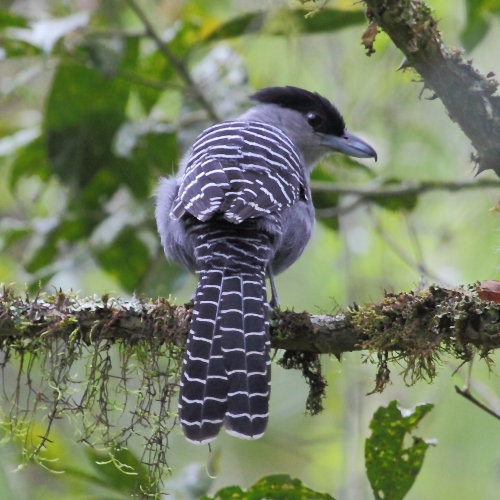
Rufous-throated Antbird
Gymnopithys rufigula
Order: Passeriformes / Family: Thamnophilidae

Wikimedia Commons
About the Rufous-throated Antbird
The Rufous-throated Antbird (Gymnopithys rufigula) is a captivating songbird belonging to the Thamnophilidae family, commonly found in the lowland tropical forests of South America. Its presence is particularly notable in countries such as Brazil, Venezuela, Colombia, and the Guianas. This species thrives in the humid, dense undergrowth of the Amazon Basin, where it plays a crucial ecological role in controlling insect populations. The Rufous-throated Antbird is often observed foraging in mixed-species flocks, a behavior that enhances its foraging efficiency and provides increased protection from predators.
The ecological significance of the Rufous-throated Antbird cannot be understated. As an insectivorous bird, it helps manage insect populations, maintaining a balance in its ecosystem. This bird often follows swarms of army ants, a behavior known as 'ant-following.' By capitalizing on the disturbance caused by the ants, the Rufous-throated Antbird captures insects that are flushed out of hiding. This mutualistic relationship highlights the interdependent nature of forest ecosystems.
In terms of seasonal behaviors, the Rufous-throated Antbird remains fairly sedentary throughout the year, exhibiting minimal migratory tendencies. Its year-round presence in tropical forests indicates a stable adaptation to its environment, although it may exhibit slight altitudinal movements in response to food availability. The bird's ability to thrive in diverse regions of the Amazon underscores its adaptability and resilience in the face of environmental changes.
The Rufous-throated Antbird serves as an important indicator species for the health of tropical forests. Its presence signifies a robust ecosystem with sufficient insect populations and undisturbed forest habitats. Conservation efforts to protect the Rufous-throated Antbird invariably contribute to the preservation of entire forest ecosystems, highlighting the interconnectedness of species within these biodiverse regions.
The Rufous-throated Antbird belongs to the family Thamnophilidae, within the order Passeriformes. These birds typically live average 3-5 years, with a max recorded at 7 years..
How to Identify a Rufous-throated Antbird
Identifying the Rufous-throated Antbird requires attention to several distinct features. Adults display a prominent rufous throat and upper breast, which contrast sharply with the otherwise predominantly black plumage that covers much of their body. Their wings and back often exhibit subtle grayish tones, blending seamlessly with the black. Males and females share similar plumage, though females may appear slightly duller in coloration. Juveniles can be recognized by their less defined rufous throat and more mottled appearance.
The Rufous-throated Antbird is often confused with similar species such as the Spot-backed Antbird. However, the latter lacks the distinct rufous throat and instead displays a spotted pattern on its back. During flight, the Rufous-throated Antbird reveals a compact silhouette with rounded wings and a slightly squared-off tail. When perched, its posture is upright, often with a slight forward lean as it intently watches the ground for insect movements.
Field marks to note include the bird's medium size, typically ranging from 13 to 15 centimeters in length, and its piercing dark eyes, which stand out against its rufous and black facial features. Observers may also notice its strong, straight bill, adapted for capturing insects. The Rufous-throated Antbird’s plumage and behavior make it a striking presence in the dense underbrush of its forest home.
Having trouble telling birds apart? Upload a photo to our bird identification tool for an instant species match.
Rufous-throated Antbird Habitat and Range
Preferred Habitat
The Rufous-throated Antbird inhabits the rich, dense tropical forests of South America, thriving particularly in the Amazon Basin's lowland regions. It prefers primary forests with thick understories, which provide cover and abundant insect prey. These birds are most commonly found at elevations ranging from sea level to about 1000 meters.
Despite the dense forest cover, they occasionally venture into secondary growth areas, especially where these border primary forests. Seasonal habitat shifts are minimal due to their largely sedentary nature, though some localized movement may occur in response to changes in food availability. While the Rufous-throated Antbird is primarily a forest-dweller, it is not typically found in urban areas, as it requires the intricate forest structure to support its foraging habits.
The bird's preference for undisturbed forest habitats makes it susceptible to habitat loss due to deforestation. Protecting the mature forests of the Amazon is vital for the continued survival of this species and the myriad other organisms that share its ecosystem.
Geographic Range
The Rufous-throated Antbird boasts a range that spans several countries across northern and central South America. Its breeding range primarily includes the Amazon Basin, covering vast expanses of Brazil, eastern Peru, southern Venezuela, and the Guianas. The bird is also found in parts of Colombia, where suitable habitats exist.
Unlike many migratory birds, the Rufous-throated Antbird does not engage in long-distance seasonal migrations. Instead, it remains within its breeding territories year-round, making use of the rich resources provided by the Amazonian forests. This sedentary lifestyle is typical of many tropical bird species that inhabit stable environments with consistent food supplies.
Population density hotspots for the Rufous-throated Antbird align with areas of extensive continuous forest, such as those found in the central Amazon. While the species is widespread within its range, habitat fragmentation poses significant challenges to its populations. Conservation efforts focused on maintaining large forest tracts are crucial for sustaining healthy populations of this antbird.
Want to know which birds visit your area? Browse our backyard birds by location guides for region-specific species lists.
What Does the Rufous-throated Antbird Eat?
The Rufous-throated Antbird primarily feeds on a diet of insects and other small arthropods, which it skillfully captures in the underbrush of tropical forests. Its diet includes ants, beetles, spiders, and caterpillars, all of which are abundant in its habitat. During periods of army ant activity, the bird follows the swarms, capitalizing on the insects flushed out by the ants.
This ant-following behavior is particularly pronounced during the wet season when ant swarms are more active. The Rufous-throated Antbird exhibits a foraging technique known as sallying, where it darts out from a perch to snatch prey disturbed by the ants. It also gleans insects directly from foliage and the forest floor.
The bird's feeding schedule is largely dictated by the activity of its prey. It often forages actively during the cooler morning and late afternoon hours when insect activity is highest. The ability to adapt its diet to the availability of prey allows the Rufous-throated Antbird to thrive in various parts of its range, underscoring its ecological adaptability.
Rufous-throated Antbird Behavior and Social Structure
The Rufous-throated Antbird exhibits a range of intriguing behaviors that reflect its adaptation to life in the dense tropical forests. Socially, it is often observed in mixed-species flocks, a strategy that provides collective vigilance against predators and increases foraging success.
Territorial behavior is evident in the Rufous-throated Antbird, with pairs maintaining and defending territories throughout the year. During the breeding season, males engage in vocal displays to establish dominance and attract mates. These displays are often accompanied by physical posturing and chasing behaviors.
Courtship in the Rufous-throated Antbird involves mutual preening and the presentation of food items by the male to the female. Once paired, these birds exhibit strong pair bonds, often remaining together throughout the year. In the presence of predators, the Rufous-throated Antbird employs a combination of vocal alarms and evasive maneuvers, retreating into denser cover when threatened.
Daily activity patterns revolve around foraging, with peak activity during the cooler parts of the day. Their reliance on army ants for foraging means they are often most active when these ants are on the move. The Rufous-throated Antbird's behaviors highlight its intricate relationship with the forest ecosystem and its role as both predator and prey.
Rufous-throated Antbird Nesting and Reproduction
The Rufous-throated Antbird constructs its nest within the tangled undergrowth of tropical forests, choosing sites with ample cover to protect against predators. The nest itself is a modest cup structure, constructed from leaves, twigs, and other plant materials, and is usually placed a few feet off the ground.
Clutch size for the Rufous-throated Antbird typically ranges from two to three eggs. These eggs are incubated by both parents, reflecting their cooperative breeding strategy. The incubation period lasts approximately 14 to 16 days, during which time the parents take turns sitting on the eggs and foraging for food.
Upon hatching, the chicks remain in the nest for about 10 to 12 days before fledging. During this time, both parents actively feed and care for the young. Parental roles are shared, with each bird contributing to feeding and protection duties. The Rufous-throated Antbird generally raises one brood per year, though some pairs may attempt a second if conditions are favorable.
The choice of nesting site and materials reflects the bird's adaptation to its forest environment, providing the necessary camouflage and security to ensure the survival of its young.
Rufous-throated Antbird Sounds and Vocalizations
The vocalizations of the Rufous-throated Antbird are a defining aspect of its presence in the forest. Its primary song is a series of clear, melodious whistles that rise and fall in pitch, often described as resembling the sound of a distant train whistle. This song serves both territorial and mate attraction purposes.
In addition to its song, the Rufous-throated Antbird produces a variety of call notes, including sharp 'chip' sounds used for communication between mates or within mixed-species flocks. Alarm calls are more abrupt and harsh, designed to alert others to potential threats.
During the dawn chorus, the Rufous-throated Antbird's song is a prominent feature of the forest soundscape, weaving through the cacophony of other bird calls. Its vocalizations are not only a vital part of its communication but also an integral element of the auditory environment of tropical forests.
Interesting Facts About the Rufous-throated Antbird
- 1The Rufous-throated Antbird is known for its ability to follow army ants, a behavior called 'ant-following,' which helps it find food more efficiently.
- 2Despite its vibrant rufous throat, the Rufous-throated Antbird is adept at staying hidden in dense underbrush, making it a challenge to spot in the wild.
- 3The Rufous-throated Antbird's diet consists primarily of insects, but it will opportunistically consume small vertebrates if encountered.
- 4These birds are part of the Thamnophilidae family, a group of birds renowned for their intricate songs and diverse vocalizations.
- 5The Rufous-throated Antbird's presence in a forest can indicate a healthy ecosystem with an abundant insect population.
- 6During the breeding season, Rufous-throated Antbirds engage in elaborate vocal duets, strengthening pair bonds and coordinating parental duties.
- 7This species has a strong pair bond, often remaining with the same mate for multiple breeding seasons.
Rufous-throated Antbird Conservation Status
The Rufous-throated Antbird is currently listed as Least Concern by the IUCN, reflecting its relatively stable population levels across its range. However, the species faces ongoing threats from habitat loss due to deforestation and land conversion for agriculture and development. Despite these challenges, the Rufous-throated Antbird benefits from its presence in several protected areas throughout the Amazon Basin, where conservation efforts are focused on preserving large tracts of intact forest. These efforts are vital for maintaining the biodiversity of the region and supporting the myriad species that depend on these habitats. Historically, population levels of the Rufous-throated Antbird have remained stable, but continued deforestation poses a long-term threat to its habitat. Conservation initiatives aimed at sustainable forest management and reforestation are essential for ensuring the survival of this species and the ecological health of its environment.