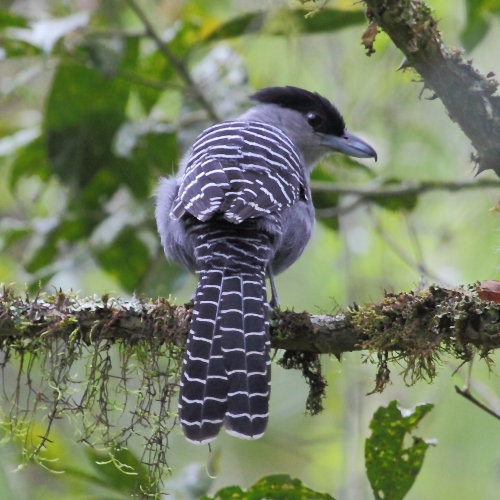
Salvadori's Antwren
Myrmotherula minor
Order: Passeriformes / Family: Thamnophilidae

Wikimedia Commons
About the Salvadori's Antwren
The Salvadori's Antwren, scientifically known as Myrmotherula minor, is an enigmatic member of the Thamnophilidae family, thriving in the dense lowland forests of the Amazon basin. Found predominantly in Brazil, Peru, and Bolivia, this small passerine has carved out a niche within the biodiverse tapestry of the Amazon rainforest. These birds are notable for their role in the ecosystem as insectivores, consuming a variety of arthropods and thus helping control insect populations. Typically, they inhabit the lower strata of the forest, often seen flitting through the understory and mid-canopy levels. Their presence serves as an indicator of healthy forest ecosystems, where they play a part in the complex web of tropical biodiversity.
The Salvadori's Antwren exhibits seasonal behaviors largely dictated by the region's wet and dry seasons, which affect food availability and breeding patterns. During the wet season, when insects are abundant, these birds increase their foraging activity. As the dry season approaches, they may exhibit a slight shift in their foraging range, often venturing into areas where water sources persist. Their ecological role extends beyond pest control; they also contribute to seed dispersal indirectly by influencing the behavior of the insects they prey on, which interact with seeds and fruit.
In terms of significance, the Salvadori's Antwren represents a crucial link in the trophic chain of its habitat. This species helps maintain the balance of insect populations, thereby supporting plant health and regeneration processes. Understanding the habits and requirements of Salvadori's Antwren is essential for conservation efforts, particularly as their habitat faces threats from deforestation and climate change. Efforts to study and protect these birds can offer insights into broader ecological dynamics and the health of Amazonian environments.
The Salvadori's Antwren belongs to the family Thamnophilidae, within the order Passeriformes. These birds typically live average 4-5 years, with a maximum recorded of 7 years..
How to Identify a Salvadori's Antwren
Salvadori's Antwren boasts a distinctive plumage that aids in identification. Adult males display a striking contrast of black and white, with black predominating on the upperparts and wings while white adorns the underparts. Females, in comparison, exhibit a more subdued coloration with olive-brown tones replacing the stark black, and a lighter belly. Juveniles resemble females but with even less contrast and more mottled patterns.
A closer look at their field marks reveals that both males and females possess a short, stubby bill adapted for insectivory. Their small, compact body and relatively short tail further aid in maneuvering through dense foliage. When in flight, Salvadori's Antwren maintains a low, direct path, seldom venturing above the mid-canopy, preferring to stay within the protective cover of the forest.
Confusion may arise with other antwrens, such as the Pygmy Antwren, but Salvadori's Antwren's larger size and more pronounced plumage differences provide reliable identification cues. Observers should note the bird's perching behavior, often seen clinging to vertical or horizontal branches, which is characteristic of its feeding style.
Having trouble telling birds apart? Upload a photo to our bird identification tool for an instant species match.
Salvadori's Antwren Habitat and Range
Preferred Habitat
Salvadori's Antwren thrives predominantly in the tropical lowland rainforests of the Amazon basin. These habitats are characterized by dense vegetation, high humidity, and a multi-layered canopy structure. The bird is most commonly found in terra firme forests, which remain unflooded year-round, allowing for stable habitat conditions.
The elevation range of Salvadori's Antwren typically spans from sea level up to 900 meters, where it exploits the rich insect life in the understory and mid-canopy. Seasonal shifts in habitat use are minimal, as their environment remains relatively stable throughout the year, but they may adjust their microhabitat preferences in response to food availability and breeding needs.
In urban settings, Salvadori's Antwren is absent, as it relies heavily on intact forest ecosystems. Conservation of its natural habitat is crucial, as deforestation poses a significant threat to its continued existence, emphasizing the need for protected areas and sustainable land-use practices.
Geographic Range
The geographic range of Salvadori's Antwren includes several South American countries, primarily Brazil, Peru, and Bolivia, where it inhabits the expansive Amazon rainforest. As a non-migratory species, it remains within its breeding range throughout the year, exploiting the consistent resources provided by its tropical environment.
Within this range, population density hotspots are typically found in well-preserved forested areas, where food resources and nesting sites are abundant. The bird's range is largely limited to the Amazon basin, with its stronghold in the central and western parts of Brazil, extending into the contiguous forest regions of eastern Peru and northern Bolivia.
Migration corridors are not applicable to Salvadori's Antwren, as it does not undertake long-distance movements. Instead, any movement is localized and linked to microhabitat preferences or changing environmental conditions within the forest. Conservation of its range is vital, as habitat fragmentation can lead to isolated populations, which are more vulnerable to extinction.
Want to know which birds visit your area? Browse our backyard birds by location guides for region-specific species lists.
What Does the Salvadori's Antwren Eat?
The diet of Salvadori's Antwren primarily consists of insects and other arthropods, which it skillfully extracts from foliage using its short, sharp bill. Ants, caterpillars, spiders, and small beetles form the bulk of its diet, providing necessary protein and energy. During the wet season, when insect numbers peak, Salvadori's Antwren displays increased foraging activity, often seen moving energetically through the mid-canopy and understory.
As the dry season ensues, the bird may slightly alter its diet to include a higher proportion of prey that remains available, such as spiders and other persistent arthropods. Salvadori's Antwren employs a foraging technique known as 'gleaning', where it picks prey items directly from leaves and branches while perching or hovering briefly.
Prey size generally falls within 2-10 millimeters, ensuring the bird can efficiently handle and consume its catch. Feeding occurs throughout the day, with peak activity in the early morning and late afternoon, correlating with cooler temperatures and optimal foraging conditions.
Salvadori's Antwren Behavior and Social Structure
Salvadori's Antwren exhibits a complex social structure, often found in mixed-species flocks that enhance foraging efficiency and predator avoidance. Within these flocks, the antwren maintains a specific niche, focusing on gleaning insects from foliage while coordinating movements with other species.
Territorial behavior is evident during the breeding season when males establish and defend small territories using vocalizations and displays. Courtship involves males displaying their plumage, subtly hopping around females while emitting soft calls to attract their attention.
Though primarily solitary or found in pairs during the non-breeding season, Salvadori's Antwren becomes more social within mixed flocks, benefiting from the shared vigilance against predators. In the presence of potential threats, such as raptors, the antwren issues sharp alarm calls, alerting other flock members while seeking cover in dense vegetation.
The daily activity pattern of Salvadori's Antwren is diurnal, with activity peaks in the cooler hours of the morning and late afternoon. They rest during the heat of midday, minimizing energy expenditure and exposure to predators.
Salvadori's Antwren Nesting and Reproduction
Salvadori's Antwren constructs a delicate, cup-shaped nest using fine plant fibers, moss, and spider silk, camouflaged within the dense foliage of the understory. These nests are typically positioned 1-3 meters above the ground, offering protection from terrestrial predators and environmental elements.
The breeding season aligns with the wet season, when food resources are abundant, supporting the nutritional needs of the young. Clutch size usually consists of 2-3 eggs, which exhibit a pale coloration with subtle speckling to enhance camouflage.
Incubation lasts approximately 14 days, with both parents taking turns to ensure constant warmth and protection. After hatching, the fledging period extends over 10-12 days, during which the parents intensively feed and care for the chicks.
Salvadori's Antwren may raise one or two broods per year, depending on food availability and environmental conditions, with both parents playing a significant role in feeding and protecting the young throughout the nesting period.
Salvadori's Antwren Sounds and Vocalizations
The primary song of Salvadori's Antwren consists of a series of rapid, high-pitched notes, often described as a 'trickle' of sound that rises and falls in pitch. This song serves as a territorial marker and a means of maintaining contact between pairs.
In addition to their song, these antwrens produce a variety of call notes, including sharp 'chip' sounds used for communication within mixed-species flocks. Alarm calls are distinct, characterized by short, loud bursts meant to alert nearby birds of potential danger.
During the dawn chorus, Salvadori's Antwren contributes its melody to the symphony of the forest, with repeated phrases that echo in the understory. The quality of their vocalizations can be likened to the rapid tapping of a tiny drum, adding a rhythmic element to their communications.
Interesting Facts About the Salvadori's Antwren
- 1Salvadori's Antwren has a wingspan of approximately 12 centimeters, making it adept at maneuvering through dense foliage.
- 2Despite its small size, the antwren plays a crucial role in controlling insect populations within its habitat.
- 3Salvadori's Antwren is named after Tommaso Salvadori, an Italian ornithologist who contributed significantly to avian taxonomy.
- 4These antwrens are known for their distinctive vocalizations, which can be heard echoing through the forest understory.
- 5The species displays a fascinating adaptation of building its nest low in the understory, reducing exposure to aerial predators.
- 6Salvadori's Antwren exhibits sexual dimorphism, with males being more vividly colored than females.
- 7Their diet includes ants, which they skillfully extract from leaves using their specialized bills.
Salvadori's Antwren Conservation Status
The International Union for Conservation of Nature (IUCN) currently lists Salvadori's Antwren as a species of Least Concern. However, this status belies the ongoing threats posed by habitat destruction, primarily due to deforestation for agriculture and logging in the Amazon basin. While the population trend is considered stable, continuous monitoring is essential to detect any declines resulting from habitat fragmentation or environmental changes. Conservation efforts emphasize habitat protection, with various reserves and protected areas established to safeguard critical forest regions. Historical population changes are difficult to assess due to the species' elusive nature and the challenges of conducting comprehensive surveys in dense rainforest habitats. Nevertheless, maintaining connectivity between forest patches is crucial to ensuring the survival of Salvadori's Antwren. To bolster conservation efforts, partnerships between local communities, governments, and international organizations are vital in promoting sustainable land-use practices and raising awareness of the ecological importance of preserving the Amazon rainforest.