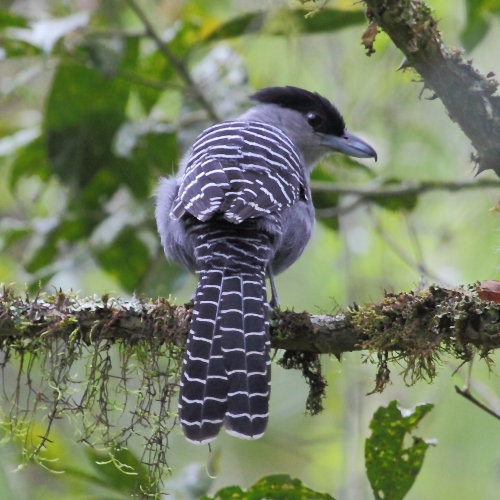
Santa Marta Antbird
Drymophila hellmayri
Order: Passeriformes / Family: Thamnophilidae

Wikimedia Commons
About the Santa Marta Antbird
The Santa Marta Antbird, scientifically known as Drymophila hellmayri, is an exceptional avian inhabitant of the Sierra Nevada de Santa Marta, a unique mountain range in northern Colombia. Its presence in this isolated region contributes significantly to the area's rich biodiversity. As a member of the Thamnophilidae family, this bird showcases a fascinating ecological adaptation to its environment. The Santa Marta Antbird occupies mid-elevation and montane forests, where it plays a crucial role in controlling insect populations. This bird's ecological niche involves foraging on the forest floor, primarily targeting ants and other small invertebrates. By doing so, it helps maintain the delicate balance of its forest habitat. Its significance extends beyond its ecological role, as it also serves as an indicator species for the health of its ecosystem. Seasonal behaviors of the Santa Marta Antbird include changes in vocalization patterns, which peak during the breeding season as males establish territories and attract mates. This antbird's reliance on intact forest habitats makes it vulnerable to deforestation, emphasizing its conservation importance. Observing the Santa Marta Antbird in its natural habitat reveals the intricate interactions within its ecosystem, highlighting the need for continued protection of the Sierra Nevada de Santa Marta's unique avian diversity.
The Santa Marta Antbird belongs to the family Thamnophilidae, within the order Passeriformes. These birds typically live average 4-5 years, with some living up to 7 years..
How to Identify a Santa Marta Antbird
The Santa Marta Antbird is a small bird measuring about 15 cm in length. Its striking black-and-white plumage is a key identifying feature, with males exhibiting a predominantly black body contrasted by white wing bars and throat. Females differ slightly, with a more grayish hue on the upper parts and buffy underparts. Juveniles resemble the females but with a more muted color palette. The Santa Marta Antbird's slender body and short tail aid in quick, agile movements through dense underbrush. Its perching posture is often horizontal, making it adept at navigating through tangled branches. While its plumage is distinct, birders may confuse it with similar species such as the Rufous-capped Antshrike. However, the Santa Marta Antbird lacks the rufous tones and exhibits more pronounced wing bars. In flight, this bird is swift but not often seen, as it typically stays within the lower forest strata. Identifying the Santa Marta Antbird requires careful observation of its behavior and habitat preference, as it shuns open areas.
Having trouble telling birds apart? Upload a photo to our bird identification tool for an instant species match.
Santa Marta Antbird Habitat and Range
Preferred Habitat
The Santa Marta Antbird thrives in the humid montane forests of the Sierra Nevada de Santa Marta. It predominantly inhabits elevations ranging from 600 to 2,500 meters. These forests offer dense vegetation and a myriad of insects, providing the ideal environment for foraging. The antbird favors areas with thick understory and fallen logs, where it can effectively hunt for ants and other small prey. There is no significant seasonal habitat shift, as the bird remains within these forests year-round. Despite its preference for remote montane regions, the Santa Marta Antbird is absent from urban settings, highlighting its reliance on pristine forest conditions.
Geographic Range
The range of the Santa Marta Antbird is restricted to the Sierra Nevada de Santa Marta, a mountain range isolated from the Andes and located in northern Colombia. This endemic species does not undertake long migrations, instead residing year-round within its montane forest range. The bird's population density is highest in areas with intact forest cover, particularly between 1,000 and 1,800 meters above sea level. Unlike some other antbird species, the Santa Marta Antbird's distribution is limited, emphasizing the importance of protecting its unique habitat.
Want to know which birds visit your area? Browse our backyard birds by location guides for region-specific species lists.
What Does the Santa Marta Antbird Eat?
The diet of the Santa Marta Antbird mainly consists of ants and other small invertebrates, which it forages from the forest floor. This bird employs a methodical foraging technique, meticulously searching through leaf litter and probing under logs for hidden prey. During the wet season, when insect activity peaks, the Santa Marta Antbird may diversify its diet to include small beetles and spiders. It primarily feeds in the early morning and late afternoon, reducing activity during the hottest part of the day. The antbird's prey size tends to be small, typically less than 1 cm, allowing it to efficiently consume large quantities.
Santa Marta Antbird Behavior and Social Structure
The Santa Marta Antbird exhibits a solitary lifestyle, with individuals or pairs maintaining defined territories. Males engage in frequent vocal displays to assert dominance and communicate with potential mates. During the breeding season, courtship involves elaborate displays, including wing-flicking and soft calls. This antbird shows strong territorial behavior, aggressively defending its range from intruding conspecifics. Unlike some species that form mixed-species flocks, the Santa Marta Antbird largely forages alone or in pairs. Its response to predators involves stealth and concealment, utilizing dense underbrush to evade detection. The bird's daily activity follows a pattern of active foraging in the morning and late afternoon, with periods of rest during midday heat.
Santa Marta Antbird Nesting and Reproduction
Santa Marta Antbirds construct cup-shaped nests using twigs, leaves, and plant fibers. They prefer nesting sites hidden in dense undergrowth or low shrubs, usually no more than 2 meters above ground. The clutch size typically consists of two to three eggs, which both parents incubate for approximately 14-16 days. After hatching, both male and female participate in feeding and caring for the chicks, which fledge about 14 days post-hatching. The Santa Marta Antbird may raise one to two broods per year, depending on environmental conditions and food availability.
Santa Marta Antbird Sounds and Vocalizations
The primary song of the Santa Marta Antbird is a series of sharp, staccato notes delivered at a steady rhythm, reminiscent of a high-pitched typewriter. Its calls include short, sharp chips used for communication between mates and as alarm signals. During the dawn chorus, the antbird's song can be heard echoing through the forest, marking its territory. Compared to the melodious songs of many songbirds, the Santa Marta Antbird's vocalizations are more functional, focusing on territoriality and mate attraction.
Interesting Facts About the Santa Marta Antbird
- 1The Santa Marta Antbird is endemic to Colombia, found only in the Sierra Nevada de Santa Marta, highlighting its unique evolutionary lineage.
- 2Despite its name, the Santa Marta Antbird's diet extends beyond ants to include a variety of small invertebrates.
- 3The bird's black-and-white plumage provides effective camouflage among the shadows and light patterns of the forest floor.
- 4Santa Marta Antbirds are known for their territorial songs, which can carry over long distances in the mountainous terrain.
- 5The species was named in honor of Carl Hellmayr, a prominent ornithologist who contributed significantly to the study of South American birds.
- 6The bird's restricted range makes it particularly vulnerable to habitat disturbance, underscoring its conservation importance.
- 7Santa Marta Antbirds rarely venture into open areas, preferring the cover of dense foliage for protection and foraging.
Santa Marta Antbird Conservation Status
The Santa Marta Antbird is currently listed as Near Threatened by the IUCN. Its population is experiencing a declining trend due to habitat loss from deforestation and agricultural expansion. Conservation efforts focus on preserving the forested areas of the Sierra Nevada de Santa Marta to ensure the survival of this and other endemic species. Protection of the region's biodiversity is crucial, as the Santa Marta Antbird serves as an indicator of ecosystem health. Historical population declines emphasize the need for continued monitoring and habitat conservation.