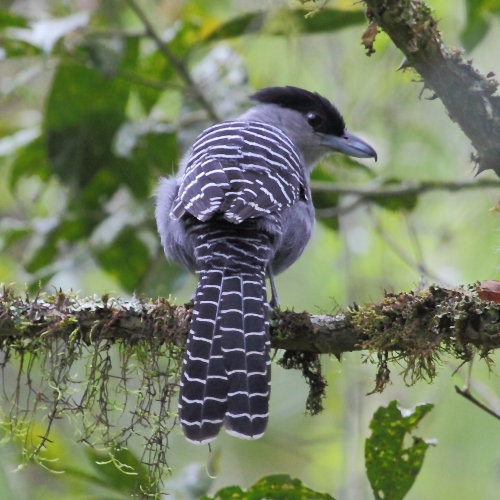
Scaled Antbird
Drymophila squamata
Order: Passeriformes / Family: Thamnophilidae

Wikimedia Commons
About the Scaled Antbird
The Scaled Antbird (Drymophila squamata) is a captivating species belonging to the Thamnophilidae family, renowned for its distinctive scale-like pattern across its plumage. This bird is predominantly found in the dense, humid forests of eastern Brazil, stretching from Bahia to Rio de Janeiro. As an understory specialist, the Scaled Antbird plays a critical role in the ecosystem by participating in the complex web of predator-prey interactions that sustain forest biodiversity. It frequently joins mixed-species foraging flocks, contributing to the dynamic energy flow within its habitat.
In these regions, the Scaled Antbird often inhabits lowland and foothill forests, preferring altitudes ranging from sea level up to 1,200 meters. Its presence in these forests is vital, as it helps control insect populations, thus maintaining ecological balance. As a year-round resident, the Scaled Antbird does not engage in significant migratory behavior, choosing instead to remain within its established territories throughout the seasons.
During the breeding season, which aligns with the wet season from October to March, the Scaled Antbird exhibits increased territoriality and vocal activity. These behaviors are crucial for defending nesting sites and ensuring successful reproduction. The bird's ecological significance extends beyond its immediate environment, as it serves as an indicator species for the health of its habitat. The Scaled Antbird's presence can signal well-preserved forest areas rich in biodiversity, making it a focal point for conservation efforts in Brazil's Atlantic Forest biome.
The Scaled Antbird belongs to the family Thamnophilidae, within the order Passeriformes. These birds typically live average 4-6 years with a max recorded of 8 years..
How to Identify a Scaled Antbird
Identifying the Scaled Antbird involves observing its characteristic plumage, which features a striking black and white pattern reminiscent of scales. Adult males typically display a more pronounced contrast with dark black feathers edged in white, while females exhibit a more subdued, brownish tone with similar scaling. Juveniles can be distinguished by their overall duller appearance and less defined scale pattern, which becomes more distinct as they mature.
The Scaled Antbird's size is relatively small, typically measuring between 12 to 14 centimeters in length with a wingspan that complements its agile movements through dense foliage. Its perching posture is often upright, allowing it to scan for prey on the forest floor. In flight, this bird presents a compact silhouette, as its short wings and tail are adapted for maneuvering through the understory.
While its unique plumage sets it apart, potential confusion may arise with similar species such as the Rufous-backed Antvireo or the Ferruginous Antbird. However, the Scaled Antbird's distinctive scaling pattern and habitat preference usually aid in accurate identification for experienced birders.
Having trouble telling birds apart? Upload a photo to our bird identification tool for an instant species match.
Scaled Antbird Habitat and Range
Preferred Habitat
The Scaled Antbird thrives in the tropical and subtropical forests of eastern Brazil, particularly within the Atlantic Forest biome. This habitat type is characterized by dense, humid vegetation with a rich understory, providing ample cover and foraging opportunities. The bird's preference for lowland and foothill forests means it is frequently found at elevations ranging from sea level to about 1,200 meters.
Within these forests, the Scaled Antbird favors areas with dense understory vegetation, where it can forage for insects and remain hidden from predators. It is less commonly found in urban areas, as it relies on relatively undisturbed habitats for survival. Seasonal shifts in habitat are minimal, as the bird remains a year-round resident, maintaining territories within its preferred forest environment.
Geographic Range
The Scaled Antbird's range is confined to the eastern regions of South America, with a strong presence in Brazil's Atlantic Forest. Its breeding range stretches from the state of Bahia southward to Rio de Janeiro, where it occupies both lowland and foothill forests. Unlike many other bird species, the Scaled Antbird does not engage in long-distance migration, instead opting to maintain its territories throughout the year.
Population density hotspots are often localized in areas of well-preserved forest, where the dense understory provides optimal conditions for foraging and nesting. This sedentary lifestyle makes the Scaled Antbird particularly susceptible to habitat degradation, emphasizing the need for targeted conservation efforts within its limited range.
Want to know which birds visit your area? Browse our backyard birds by location guides for region-specific species lists.
What Does the Scaled Antbird Eat?
The Scaled Antbird's diet primarily consists of insects and other small arthropods, which it skillfully hunts in the dense understory of its forest habitat. This bird employs a foraging technique known as 'gleaning,' where it picks prey off leaves and branches with precision. Its diet includes ants, beetles, spiders, and caterpillars, making it an important component in regulating insect populations.
Seasonal variations in diet are subtle, as the Scaled Antbird remains within the same habitat year-round and continues to exploit similar food resources. Its feeding schedule is predominantly diurnal, with peak activity occurring during the early morning and late afternoon hours when insect activity is highest.
Foraging often occurs in mixed-species flocks, which enhances the efficiency of prey capture and reduces the risk of predation. These flocks provide the Scaled Antbird with increased opportunities to locate food, as the collective movement disturbs insects and other prey items.
Scaled Antbird Behavior and Social Structure
The Scaled Antbird exhibits a social structure that revolves around pair bonds, which form the nucleus of its territorial behavior. These pairs maintain and defend small territories within their preferred forest habitats. Territorial defense often includes vocalizations, which serve both as a deterrent to intruders and as a means of communication between mates.
Courtship displays in the Scaled Antbird involve both vocal and physical elements. Males typically engage in song flights and perform distinctive calls to attract females and reinforce pair bonds. Once paired, the birds exhibit cooperative behaviors, including joint territory defense and coordinated foraging.
Flocking patterns include participation in mixed-species foraging flocks, a behavior that offers mutual benefits such as increased foraging efficiency and predator avoidance. The Scaled Antbird's response to predators involves a series of alarm calls and rapid movements through the underbrush, using its cryptic plumage to evade detection.
Daily activity patterns are diurnal, with peak activity during cooler parts of the day. This bird spends much of its time in the dense understory, rarely venturing into open areas or high canopy levels.
Scaled Antbird Nesting and Reproduction
Nesting for the Scaled Antbird occurs primarily during the wet season from October to March, coinciding with the abundance of food resources necessary for raising young. The nest is typically a cup-shaped structure constructed from twigs, leaves, and other plant materials, often lined with softer fibers for insulation.
Preferred nesting sites are within dense understory vegetation, where the nest remains concealed from predators. Clutch size generally ranges from two to three eggs, which both parents incubate over a period of 14 to 16 days. Following hatching, the chicks remain in the nest for approximately two weeks before fledging.
Parental roles are largely shared, with both male and female participating in feeding and protecting the young. The Scaled Antbird may produce one or two broods per year, depending on environmental conditions and resource availability. This breeding strategy ensures maximum offspring survival in the variable conditions of the tropical forest.
Scaled Antbird Sounds and Vocalizations
The primary song of the Scaled Antbird is a series of clear, melodious whistles that rise and fall in pitch. This distinctive song serves both as a territorial marker and a means of attracting a mate during the breeding season. The quality of the song has a sweet, flute-like tone that carries well through the dense forest understory.
Call notes are typically sharp and quick, often used in communication between mates or as alarm signals when predators are nearby. The Scaled Antbird's alarm calls are rapid, staccato sounds that alert nearby birds to potential danger. During the dawn chorus, its song blends with other bird species, creating a rich tapestry of sound that defines the early morning ambiance in the forest.
The overall vocal repertoire of the Scaled Antbird is crucial for maintaining social bonds and coordinating activities within its territory. Its vocalizations, while distinct, harmonize with the chorus of forest sounds, contributing to the acoustic landscape of its habitat.
Interesting Facts About the Scaled Antbird
- 1The Scaled Antbird is part of the Thamnophilidae family, which includes over 200 species known for their ant-following behavior.
- 2Unlike some antbirds, the Scaled Antbird does not primarily follow army ant swarms, preferring to forage independently in dense understory.
- 3Scaled Antbirds have a unique vocalization pattern that can help birders distinguish them from other similar forest-dwelling species.
- 4The scale-like feather pattern of the Scaled Antbird provides excellent camouflage in the dappled light of the forest understory.
- 5The Atlantic Forest, home to the Scaled Antbird, is a biodiversity hotspot, hosting over 20,000 plant species and 950 bird species.
- 6Despite its limited range, the Scaled Antbird is adaptable to both primary and secondary forests, which aids its survival.
- 7The Scaled Antbird's song contributes to the rich soundscape of the Atlantic Forest, a crucial aspect of its ecological environment.
Scaled Antbird Conservation Status
The Scaled Antbird currently holds a conservation status of Least Concern according to the IUCN, but its populations face pressures from habitat loss due to deforestation and fragmentation in the Atlantic Forest. While the population trend appears stable, ongoing habitat destruction poses a significant threat to its long-term survival. Conservation efforts focus on preserving critical forest habitats and promoting sustainable land-use practices. Protected areas within Brazil play a crucial role in safeguarding the Scaled Antbird's habitat, ensuring that viable populations can persist. Historical population changes reflect broader trends in forest health, with declines linked to increased agricultural and urban development. Efforts to mitigate these threats include reforestation projects and the establishment of ecological corridors that connect fragmented habitats. These initiatives are vital for maintaining genetic diversity and allowing for natural dispersal of the Scaled Antbird across its range.