
Short-tailed Parrotbill
Neosuthora davidiana
Order: Passeriformes / Family: Sylviidae

Wikimedia Commons
About the Short-tailed Parrotbill
The Short-tailed Parrotbill, scientifically known as Neosuthora davidiana, is a fascinating member of the Sylviidae family. This small bird inhabits the dense bamboo thickets and undergrowth of subtropical and tropical forests in parts of Asia. Its presence is notably recorded in regions such as southern China, Vietnam, and Laos. These birds prefer the humid, lush environments where their cryptic plumage provides excellent camouflage among the dense foliage. The Short-tailed Parrotbill plays a crucial role in the ecosystem as both a seed disperser and an insect predator, contributing to the control of insect populations and aiding in plant propagation. During the breeding season, which typically spans from April to June, these birds become more vocal and territorial. They exhibit increased activity early in the morning and late in the afternoon. While generally resident, some populations may engage in altitudinal movements based on seasonal changes in food availability. The Short-tailed Parrotbill also serves as an indicator species for the health of its forest habitat. Its preference for dense bamboo and secondary growth highlights the importance of these ecosystems for biodiversity. As habitat destruction continues to threaten these areas, the conservation of the Short-tailed Parrotbill becomes increasingly significant. Its adaptability to secondary forest growth also suggests resilience, yet ongoing habitat loss could impact its population over time.
The Short-tailed Parrotbill belongs to the family Sylviidae, within the order Passeriformes. These birds typically live average 3 years, max recorded 5 years.
How to Identify a Short-tailed Parrotbill
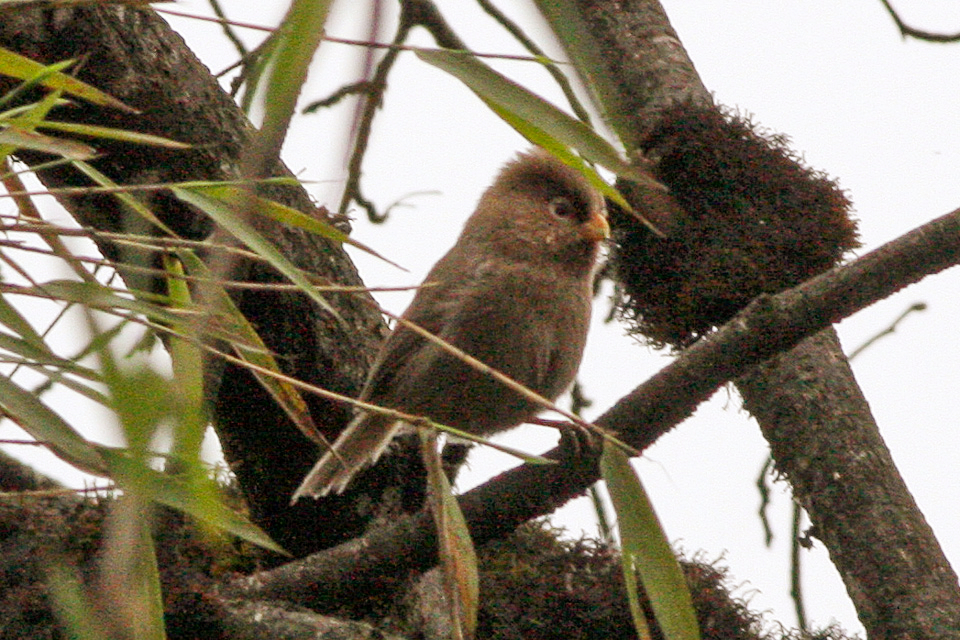
The Short-tailed Parrotbill is a small bird, measuring approximately 11 cm in length. Its most distinguishing feature is its notably short tail, which sets it apart from similar species. The adult plumage is a mixture of earthy browns and greens, providing effective camouflage in its forested habitat. The head is rounded with a distinctive buff throat and a small, sharp bill adapted for feeding on insects and seeds. Juveniles resemble adults but may have slightly duller plumage. Males and females are similar in appearance, making it difficult to distinguish between the sexes in the field. In comparison to other parrotbills, the Short-tailed Parrotbill has a more compact body and shorter tail, aiding its agility in dense underbrush. Its flight is direct and swift, with rapid wing beats that allow it to maneuver easily through the bamboo thickets it calls home. While perched, it often assumes a vertical posture, clinging to stalks of bamboo or other vegetation, which further aids in its concealment.
Having trouble telling birds apart? Upload a photo to our bird identification tool for an instant species match.
Short-tailed Parrotbill Habitat and Range
Preferred Habitat
The Short-tailed Parrotbill thrives in dense bamboo forests, subtropical and tropical moist lowland forests, and sometimes in montane regions. It is typically found at elevations ranging from 200 to 1,500 meters, though it may venture higher in some areas. These birds prefer areas with abundant undergrowth, providing both food and protection from predators. While predominantly a forest dweller, the Short-tailed Parrotbill can occasionally be found in secondary growth areas and abandoned agricultural lands where bamboo and other dense vegetation flourish. Unlike some avian species, it rarely ventures into urban environments, maintaining its preference for natural, densely vegetated areas.
Geographic Range
The Short-tailed Parrotbill is predominantly found in Southeast Asia, with its range extending across southern China, Vietnam, Laos, and parts of Thailand. It does not engage in long-distance migration, instead exhibiting localized movements based on food availability. In southern China, it is commonly observed in the provinces of Yunnan and Guangxi. In Vietnam, its presence is noted in regions such as the Annamese Lowlands and Central Highlands. While its population density is not evenly distributed, certain areas with abundant bamboo growth host higher concentrations of these birds. The lack of major migratory behavior means that populations remain relatively stable within their preferred habitats, although localized movements may occur in response to seasonal changes in resource distribution.
Want to know which birds visit your area? Browse our backyard birds by location guides for region-specific species lists.
What Does the Short-tailed Parrotbill Eat?
The diet of the Short-tailed Parrotbill consists primarily of insects and their larvae, with a secondary intake of seeds and small fruits. This bird employs a foraging technique known as 'gleaning,' where it picks food items off leaves and branches with its small, pointed bill. It often feeds in mixed-species flocks, a behavior that may increase foraging efficiency and reduce the risk of predation. During the breeding season, the demand for protein-rich insects increases, supporting the growth of chicks. In contrast, during the non-breeding season, seeds and fruits become more prominent in the diet. The Short-tailed Parrotbill's feeding schedule is largely diurnal, with peak activity occurring in the cooler hours of early morning and late afternoon, aligning with the periods when insects are most active.
Short-tailed Parrotbill Behavior and Social Structure
The Short-tailed Parrotbill exhibits a social structure that includes both monogamous pairs during the breeding season and small family groups or flocks during other times of the year. Territorial behavior is pronounced during breeding, with pairs actively defending their nesting sites from intruders. Courtship displays are subtle, involving mutual preening and soft calls. Outside of the breeding season, these birds often join mixed-species flocks, which can provide safety in numbers and enhance foraging success. The Short-tailed Parrotbill displays a notable ability to move swiftly through dense vegetation, using its short tail to navigate tight spaces. This agility helps it evade predators such as snakes and birds of prey. Daily activity patterns show a preference for foraging during cooler parts of the day, reducing exposure to midday heat.
Short-tailed Parrotbill Nesting and Reproduction
The nesting habits of the Short-tailed Parrotbill involve the construction of cup-shaped nests, typically situated in dense bamboo or low shrubs. These nests are crafted from grasses, leaves, and other plant materials, often lined with finer fibers for comfort. Nesting sites are carefully chosen to be concealed from potential predators. A typical clutch consists of 3 to 5 eggs, which are incubated by both parents for a period of about 12 to 14 days. After hatching, the altricial chicks remain in the nest for approximately 10 to 12 days before fledging. Both parents share responsibilities in feeding the chicks and maintaining the nest. The Short-tailed Parrotbill usually raises one brood per year, although conditions may allow for a second brood.
Short-tailed Parrotbill Sounds and Vocalizations
The vocalizations of the Short-tailed Parrotbill are characterized by soft, melodious whistles and sharp, repetitive calls. Its primary song comprises a series of clear, sweet notes that are often delivered in rapid succession. These songs serve as both territorial signals and mating calls during the breeding season. Alarm calls are more abrupt and harsh, designed to alert other flock members of potential threats. While not known for a prominent dawn chorus, these birds are more vocally active during the early morning hours, taking advantage of the calm and quiet of the forest to communicate effectively.
Interesting Facts About the Short-tailed Parrotbill
- 1The Short-tailed Parrotbill's short tail is an adaptation that helps it navigate the dense bamboo thickets it inhabits.
- 2This bird is known for joining mixed-species flocks, which can include up to 15 different bird species.
- 3The Short-tailed Parrotbill's diet shifts with the seasons, showing a reliance on insects during breeding periods.
- 4Its nesting locations are carefully chosen to remain hidden, often in dense bamboo stands that provide excellent cover.
- 5While it is primarily a resident species, some populations exhibit altitudinal movements in response to food availability.
Short-tailed Parrotbill Conservation Status
The Short-tailed Parrotbill is currently listed as a species of Least Concern by the IUCN, with stable population trends. However, habitat destruction due to logging, agricultural expansion, and urbanization poses a significant threat to its preferred environments. Conservation efforts focus on protecting and restoring bamboo forests and other crucial habitats. Historical population changes are not well documented, but ongoing habitat loss could impact future populations. Protective measures include the establishment of reserves and the promotion of sustainable land-use practices.
Other Sylviidae Species



Birds Similar to the Short-tailed Parrotbill
These species are often confused with the Short-tailed Parrotbill due to similar appearance or overlapping range.
