
Sickle-billed Vanga
Falculea palliata
Order: Passeriformes / Family: Vangidae

Wikimedia Commons
About the Sickle-billed Vanga
The Sickle-billed Vanga, Falculea palliata, is a striking bird endemic to Madagascar, specifically found in the island's northwestern dry deciduous forests. This species belongs to the family Vangidae and is notable for its distinctive sickle-shaped bill, which is an adaptation perfectly suited to its foraging habits. The bird plays a crucial role in its ecosystem by helping control insect populations and thus maintaining the health of its forest habitat. The Sickle-billed Vanga is primarily found in lowland and mid-elevation areas, often between 0 to 800 meters, although it occasionally ventures higher. Its presence is most pronounced in protected areas such as the Ankarafantsika National Park, a biodiversity hotspot that offers a sanctuary for numerous endemic species.
Significance of the Sickle-billed Vanga extends beyond its ecological roles. It serves as an indicator species for the health of Madagascar's unique ecosystems, which face threats from deforestation and habitat fragmentation. The bird's reliance on intact forest habitats highlights the urgent need for conservation efforts focusing on habitat preservation, making it a focal point for both local and international conservation groups. Furthermore, the bird's striking appearance and unique behaviors make it a subject of interest for birdwatchers and researchers alike.
Seasonally, the Sickle-billed Vanga exhibits some shifts in behavior, particularly during the breeding season when it becomes more vocal and visible. During this time, one might observe these birds engaging in courtship displays and nest-building activities. The onset of the rainy season often triggers these behavioral changes, as the abundance of food and favorable conditions support breeding. Outside the breeding season, Sickle-billed Vangas are more secretive, blending into the dense foliage. Their role in seed dispersal, although secondary to their insectivorous diet, contributes to the regeneration of their forest habitat, further underscoring their ecological importance.
The Sickle-billed Vanga belongs to the family Vangidae, within the order Passeriformes. These birds typically live average 7-9 years with a max recorded of 12 years.
How to Identify a Sickle-billed Vanga
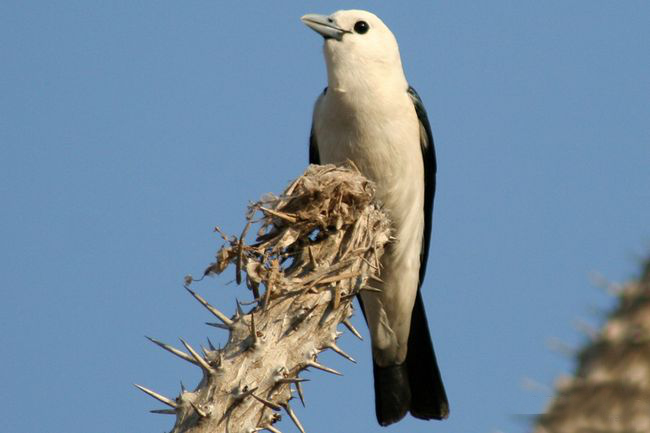
The Sickle-billed Vanga is easily recognized by its conspicuous, elongated bill, which curves downward in a sickle shape. Adult plumage is predominantly white on the breast and belly, contrasting with a black cap and back. The wings are a mix of black and white, adding to its striking appearance. Juveniles resemble adults but may exhibit duller plumage and a less pronounced bill curvature. Both males and females appear similar, making gender identification challenging without observing behavior or vocalizations.
In terms of size, the Sickle-billed Vanga measures approximately 30 to 34 cm in length, with the bill accounting for a significant portion of this measurement. Its wingspan ranges from 45 to 50 cm, providing a robust frame for its active foraging lifestyle. The bird is often confused with the Hook-billed Vanga, another member of the Vangidae family, but the latter has a shorter, less curved bill.
In flight, the Sickle-billed Vanga presents a distinctive silhouette, with its long bill and streamlined body. Perched, it maintains an alert stance, often tilting its head to examine its surroundings. Its perching posture, combined with its unique bill, makes it unmistakable once spotted, especially against the backdrop of Madagascar's verdant forests.
Having trouble telling birds apart? Upload a photo to our bird identification tool for an instant species match.
Sickle-billed Vanga Habitat and Range
Preferred Habitat
The Sickle-billed Vanga thrives in Madagascar's dry deciduous forests, preferring areas with dense canopy cover. These forests provide the ideal environment for its foraging activities, as the bird primarily feeds on insects found in tree bark and foliage. It is typically found at elevations ranging from sea level to about 800 meters, although it can occasionally be seen at higher altitudes. During the dry season, the Sickle-billed Vanga may venture into slightly more open areas in search of food, but it generally avoids urbanized regions.
Many of its preferred habitats are located within Madagascar's protected areas, such as the Ankarafantsika and Kirindy forests. These regions offer a stable environment where the Vanga can thrive, free from the pressures of habitat destruction that plague much of the island. While the bird is primarily associated with forested areas, it can adapt to secondary growth and degraded habitats, provided there is sufficient cover and food availability.
Seasonal habitat shifts are minimal for the Sickle-billed Vanga, as its habitat requirements remain relatively constant throughout the year. However, during the breeding season, pairs may become more territorial and confine themselves to specific trees or sections of the forest where they build their nests.
Geographic Range
The Sickle-billed Vanga is endemic to Madagascar, with its range primarily concentrated in the island's northwestern regions. It is most commonly found in the dry deciduous forests that characterize this part of Madagascar, including well-known areas like the Ankarafantsika National Park. The bird's range does not extend beyond Madagascar, making it a truly unique species to this biodiversity-rich island.
While the Sickle-billed Vanga does not engage in long-distance migration like some other bird species, it may practice short-distance movements within its range to exploit seasonal food resources or seek out optimal breeding sites. These movements are generally influenced by local environmental conditions, such as the availability of insects and nesting materials. Population density is highest in protected areas where suitable habitat is preserved, though it can be found in lower densities in surrounding areas.
The species' restricted range makes it particularly vulnerable to habitat loss, and conservation efforts focus on safeguarding the forests that are critical to its survival. Despite its limited distribution, the Sickle-billed Vanga remains relatively widespread within its range, though specific population estimates are challenging due to its secretive nature.
Want to know which birds visit your area? Browse our backyard birds by location guides for region-specific species lists.
What Does the Sickle-billed Vanga Eat?
The diet of the Sickle-billed Vanga primarily consists of insects, which it skillfully extracts from tree bark and foliage using its specialized sickle-shaped bill. This bill is particularly adept at probing into crevices and under loose bark, allowing the bird to access insects that other species might overlook. Common prey items include beetles, caterpillars, and spiders, which provide essential nutrition throughout the year.
During the wet season, when insect populations flourish, the Sickle-billed Vanga may expand its diet to include small fruits and seeds, though these remain secondary to its insectivorous habits. This dietary flexibility allows the bird to take advantage of fluctuating food availability, ensuring a stable food supply even as environmental conditions change.
The Sickle-billed Vanga typically forages alone or in pairs, often in the mid to upper canopy where insect density is highest. It employs a methodical foraging technique, moving slowly and deliberately along branches while scanning for prey. This deliberate approach maximizes its foraging efficiency and allows it to occupy a specific ecological niche within its forest habitat.
Sickle-billed Vanga Behavior and Social Structure
The Sickle-billed Vanga is generally a solitary or paired bird, exhibiting territorial behavior, especially during the breeding season. Pairs establish territories in forested areas where they defend their nesting sites vigorously against intruders. During courtship, males perform displays that include singing and bill displays to attract females, reinforcing pair bonds through mutual preening and feeding.
Outside the breeding season, the Sickle-billed Vanga may join mixed-species flocks, a behavior thought to enhance foraging efficiency and predator detection. In these flocks, the Vanga participates harmoniously with other species, benefiting from the collective vigilance of the group. Despite this association, the Sickle-billed Vanga maintains a certain level of independence, often venturing slightly away from the main group while foraging.
In response to predators, the Sickle-billed Vanga relies on its agility and knowledge of its forest environment. It often employs evasive maneuvers, darting through dense foliage to escape potential threats. During daily activities, the bird is most active during the early morning and late afternoon, avoiding the midday heat that characterizes its habitat.
Sickle-billed Vanga Nesting and Reproduction
Sickle-billed Vangas build their nests in the forks of trees, often choosing locations that provide ample cover and protection from predators. The nest itself is a cup-shaped structure constructed from twigs, leaves, and other plant materials, bound together with spider silk for added stability. This strategic nesting choice reflects the bird's need for concealment and safety.
The typical clutch size for the Sickle-billed Vanga ranges from two to three eggs, which are incubated by both parents over a period of approximately 15 to 18 days. During this time, the parents take turns incubating the eggs and foraging for food, showcasing a high level of parental cooperation and commitment to raising their young.
Fledging occurs about 18 to 21 days after hatching, at which point the young birds leave the nest but continue to receive care and feeding from their parents for several weeks. The Sickle-billed Vanga generally raises one brood per year, though in optimal conditions, a second brood may be attempted. This reproductive strategy highlights the bird's adaptation to the seasonal availability of resources, ensuring the highest possible survival rates for its offspring.
Sickle-billed Vanga Sounds and Vocalizations
The Sickle-billed Vanga's song is a series of melodious whistles and trills, characterized by a rising and falling rhythm that carries through the forest. These vocalizations are particularly prominent during the breeding season when males sing to establish territories and attract mates. Their songs are clear and flute-like, often compared to the calls of other Vangidae species but with a distinct tonal quality.
In addition to their primary song, Sickle-billed Vangas produce a variety of call notes used for communication between pairs or within family groups. These calls are shorter and more abrupt than their songs, serving as contact calls or alerts to potential threats. When alarmed, the Vanga emits sharp, repetitive calls that signal danger to nearby birds.
During the dawn chorus, the Sickle-billed Vanga's song can be heard intermingling with those of other forest inhabitants, creating a rich acoustic tapestry that defines the morning soundscape in Madagascar's forests. This vocal activity not only serves to reinforce pair bonds but also plays a crucial role in maintaining social structures within their habitat.
Interesting Facts About the Sickle-billed Vanga
- 1The Sickle-billed Vanga's bill can measure up to 8 cm, nearly a third of its total body length.
- 2Despite being called a vanga, it shares more evolutionary traits with the corvid family, including intelligence.
- 3This species has inspired studies in biomimicry due to its efficient prey extraction techniques using its curved bill.
- 4Sickle-billed Vangas are known to use tools, such as sticks, to extract insects from tree bark, showcasing advanced problem-solving skills.
- 5Their nests are often reused by other bird species once abandoned, highlighting their importance in the ecosystem.
- 6The Sickle-billed Vanga is one of the few birds endemic to Madagascar that does not migrate, remaining in its range year-round.
- 7Observations suggest that Sickle-billed Vangas can recognize individual human observers, adjusting their behavior if they feel threatened.
Sickle-billed Vanga Conservation Status
The Sickle-billed Vanga is currently listed as Least Concern by the IUCN, yet its population is subject to pressures from habitat loss and degradation. Deforestation for agriculture and logging represents the primary threat to its survival, as these activities reduce the availability of suitable forest habitat. Despite these challenges, the species remains relatively stable in protected areas where conservation efforts focus on habitat preservation. Population trends indicate a slow decline outside protected regions, underscoring the importance of ongoing conservation measures. Initiatives aimed at sustainable land management and reforestation in Madagascar provide some hope for the future of the Sickle-billed Vanga. Historical population changes have been linked to the island's deforestation rates, highlighting the connection between habitat health and species viability. Conservation groups, both local and international, continue to advocate for expanded protected areas and stricter enforcement of existing environmental laws. These efforts are crucial to ensuring that the Sickle-billed Vanga, along with the myriad other species that share its habitat, can continue to thrive in Madagascar's unique ecosystems.
Other Vangidae Species


Birds Similar to the Sickle-billed Vanga
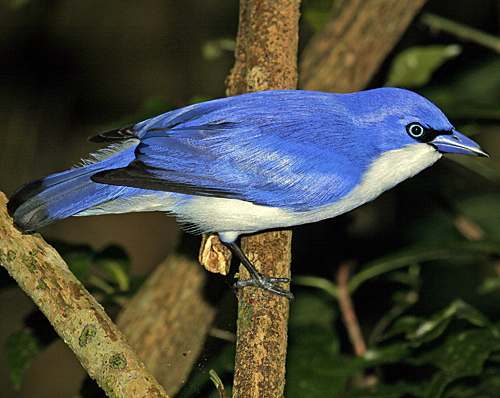
These species are often confused with the Sickle-billed Vanga due to similar appearance or overlapping range.
