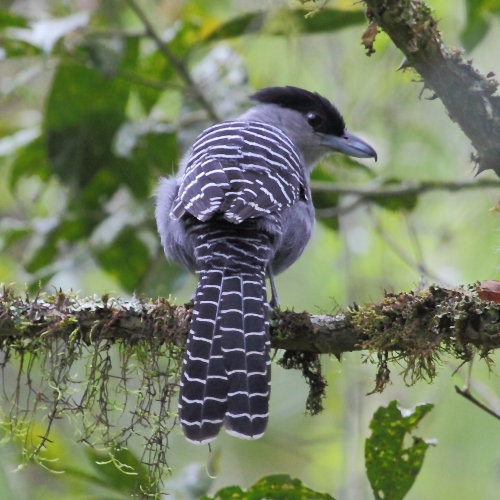
Silvery-flanked Antwren
Myrmotherula luctuosa
Order: Passeriformes / Family: Thamnophilidae

Wikimedia Commons
About the Silvery-flanked Antwren
The Silvery-flanked Antwren (Myrmotherula luctuosa) is a small but captivating bird belonging to the Thamnophilidae family. This species is primarily found in the dense tropical forests of South America, particularly within the Amazon Basin that spans countries such as Brazil, Peru, Colombia, and Venezuela. The Silvery-flanked Antwren plays a significant role in the ecosystem as both predator and prey. Its diet largely consists of small insects, which it skillfully hunts in the lower strata of the forest, thus contributing to the control of insect populations.
This antwren is an integral part of the diverse avian community within its habitat, known for its dynamic interactions with other bird species in mixed-species flocks. These flocks enhance foraging efficiency and offer protection from predators, showcasing the antwren's social adaptability. The bird's presence in the biodiverse Amazon underscores the importance of preserving these habitats, as they host a myriad of species that rely on each other for survival.
During the breeding season, the Silvery-flanked Antwren exhibits fascinating behaviors, including intricate courtship displays that involve fluffed plumage and soft calls. This period marks a time of increased territoriality as pairs establish breeding grounds to raise their young. As with many forest-dwelling birds, the Silvery-flanked Antwren faces challenges from habitat destruction and fragmentation, which threaten its long-term survival. Conservation efforts focusing on preserving continuous tracts of forest are vital to maintaining the population stability of this and other similarly affected species.
The Silvery-flanked Antwren belongs to the family Thamnophilidae, within the order Passeriformes. These birds typically live average 3-4 years, with a maximum recorded of 5 years..
How to Identify a Silvery-flanked Antwren
The Silvery-flanked Antwren measures approximately 9 to 10 cm in length, making it a small bird. This species exhibits sexual dimorphism, with males and females displaying distinct plumage characteristics. Males boast a striking appearance with black plumage contrasted by silvery-white flanks, which are particularly noticeable when the bird is in motion. The back and wings are a deep black, while the throat and chest show a slight grayish tint. Females, on the other hand, feature more subdued coloration. They possess brownish-gray plumage with less pronounced flank markings, aiding in camouflage within the dense foliage.
Juvenile Silvery-flanked Antwrens resemble females but display even duller plumage with more brown tones. This camouflage is crucial for their survival in the early stages of life. In flight, the Silvery-flanked Antwren's short, rounded wings and quick, agile movements make it a challenge to spot, often blending seamlessly into its forest environment. When perched, the bird maintains a slightly upright posture, often flicking its tail as it scans for prey.
Confusion with similar species is possible, particularly with other members of the Myrmotherula genus. However, the combination of the male's distinctive silvery flanks and the female's unique brownish-gray coloration helps differentiate the Silvery-flanked Antwren from its relatives. Careful observation of these field marks, along with their vocalizations, assists in correct identification.
Having trouble telling birds apart? Upload a photo to our bird identification tool for an instant species match.
Silvery-flanked Antwren Habitat and Range
Preferred Habitat
The Silvery-flanked Antwren thrives in the dense, humid tropical forests of South America. It is commonly found in the understory and midstory layers of these forests, which offer abundant cover and foraging opportunities. This bird is most prevalent in the Amazon Basin, an area known for its rich biodiversity and complex ecosystems. The bird prefers primary and secondary forests but can also be found in well-preserved forest fragments, provided there is sufficient canopy cover and a dense understory.
Typically found at low elevations, the Silvery-flanked Antwren rarely ventures into higher altitudes, remaining below 500 meters. This preference for lower elevations aligns with its habitat selection, as these areas offer the dense foliage and insect prey it requires. Unlike some avian species, the Silvery-flanked Antwren does not exhibit significant seasonal habitat shifts, remaining in its preferred forested areas year-round.
Urban environments and heavily disturbed habitats are generally unsuitable for this species, as it relies on the complex structure and resources of intact forests. As such, the Silvery-flanked Antwren serves as an important indicator of forest health and integrity.
Geographic Range
The Silvery-flanked Antwren is endemic to South America, with its range primarily concentrated within the expansive Amazon Basin. This includes significant portions of northern Brazil, southeastern Colombia, eastern Peru, and southern Venezuela. Within these countries, the Silvery-flanked Antwren is mostly found in lowland tropical rainforests, where the combination of heat and humidity supports a diverse array of insect prey.
The bird does not undertake long-distance migrations, remaining within its tropical forest range throughout the year. Its distribution is somewhat patchy, reflecting the fragmentation of suitable habitats within its range. However, where suitable habitats remain, the Silvery-flanked Antwren can be locally abundant, particularly in areas with minimal human disturbance.
Population density hotspots are often found in protected areas and forest reserves where conservation measures help maintain habitat quality. Such areas are crucial for the species' survival, as they provide refuges from deforestation and other anthropogenic pressures that threaten its habitat.
Want to know which birds visit your area? Browse our backyard birds by location guides for region-specific species lists.
What Does the Silvery-flanked Antwren Eat?
The diet of the Silvery-flanked Antwren primarily consists of small insects and other arthropods. Ants, beetles, and spiders form a significant part of their diet, reflecting the bird's adaptation to foraging in the dense undergrowth of tropical forests. This antwren employs a gleaning technique, meticulously picking insects from leaves and branches with its sharp bill.
Foraging typically occurs in the lower strata of the forest, where the Silvery-flanked Antwren moves quickly and deliberately through the foliage. The bird's small size and agile movements allow it to access crevices and areas dense with insect activity. The feeding schedule of the Silvery-flanked Antwren aligns with the availability of its prey, generally peaking during the early morning and late afternoon when insect activity is highest.
Seasonal variations in diet may occur as the availability of specific insect species changes throughout the year. During the rainy season, when insect populations are abundant, the Silvery-flanked Antwren may exhibit increased foraging activity and a broader diet to maximize energy intake for breeding and raising young.
Silvery-flanked Antwren Behavior and Social Structure
The Silvery-flanked Antwren exhibits a range of behaviors typical of small forest-dwelling birds. It is a social species, often seen participating in mixed-species flocks. These flocks provide numerous advantages, including increased foraging success and protection from predators. Within these flocks, the Silvery-flanked Antwren is an active participant, foraging alongside other insectivorous birds and maintaining a cooperative dynamic.
Territorial behavior intensifies during the breeding season, with pairs establishing and defending nesting territories. Courtship displays are a notable aspect of their behavior, involving visual displays such as fluffed plumage and soft, rhythmic calls to attract mates. Once a pair forms, they remain closely bonded throughout the breeding cycle, working collaboratively to rear their young.
Daily activity patterns of the Silvery-flanked Antwren closely follow the rhythms of the forest. The bird is most active during daylight hours, with peak activity occurring in the early morning and late afternoon. During these times, the antwren engages in foraging, social interactions, and territorial displays, while seeking cover during the heat of midday.
Silvery-flanked Antwren Nesting and Reproduction
The nesting habits of the Silvery-flanked Antwren are closely tied to the dense vegetation of their forest habitat. Nests are typically positioned in the midstory or understory, where they are well-concealed by foliage. The nests are cup-shaped and constructed from a combination of plant fibers, leaves, and spider silk, which provide both stability and camouflage.
Clutch size for the Silvery-flanked Antwren generally ranges from two to three eggs. These eggs are small and pale, blending well with the nest surroundings. Both parents share responsibilities, with the incubation period lasting approximately 14 to 16 days. During this time, one parent remains on the nest while the other forages for food.
After hatching, the chicks are altricial, requiring considerable care and feeding from both parents. The fledging period lasts about 10 to 12 days, during which the chicks develop rapidly. The Silvery-flanked Antwren typically raises one to two broods per year, depending on environmental conditions and food availability.
Silvery-flanked Antwren Sounds and Vocalizations
The vocalizations of the Silvery-flanked Antwren are an integral aspect of its behavior and identification. Its primary song is a series of sharp, melodic notes delivered in rapid succession. The rhythm is brisk, with each note clear and distinct, often described as a 'whizzing' sound reminiscent of a finely tuned wind instrument.
In addition to its song, the antwren produces a variety of call notes used for communication within mixed-species flocks and with its mate. Alarm calls are sharper and more abrupt, serving as a warning to nearby birds of potential threats. During the dawn chorus, the bird's song is particularly prominent, contributing to the vibrant soundscape of the forest.
These vocalizations are critical for maintaining social bonds and defending territory, making them a key aspect of the Silvery-flanked Antwren's ecological niche.
Interesting Facts About the Silvery-flanked Antwren
- 1The Silvery-flanked Antwren weighs around 8 to 10 grams, making it one of the lighter members of its genus.
- 2Despite its small size, the Silvery-flanked Antwren's territory can span several hectares, showcasing its active foraging range.
- 3This antwren is often seen in mixed-species flocks with other insectivores, benefiting from shared foraging efforts.
- 4The species' distinctive silvery flanks are most visible when it flits through the forest understory.
- 5The Silvery-flanked Antwren's song can be heard up to 50 meters away, a testament to its clear, piercing call.
- 6Silvery-flanked Antwrens can consume more than a hundred insects daily, playing a crucial role in insect population control.
- 7In dense forest habitats, the Silvery-flanked Antwren relies heavily on its vocalizations for communication with conspecifics.
Silvery-flanked Antwren Conservation Status
The Silvery-flanked Antwren is currently listed as Least Concern by the IUCN, although its population is believed to be decreasing due to ongoing habitat loss. Deforestation for agriculture, logging, and infrastructure development poses significant threats to the species' forest habitat. Conservation efforts focus on preserving large tracts of intact forest and establishing protected areas within the Amazon Basin. These efforts are crucial for maintaining the ecological balance and biodiversity of the region. Organizations working in South America often collaborate with local communities to promote sustainable land-use practices, which can mitigate some of the pressures on the Silvery-flanked Antwren's habitat. Historical data indicate that the species was more widespread before extensive human activity began altering its environment. Continued conservation initiatives are necessary to ensure the long-term survival of the Silvery-flanked Antwren and the myriad of other species that share its habitat.