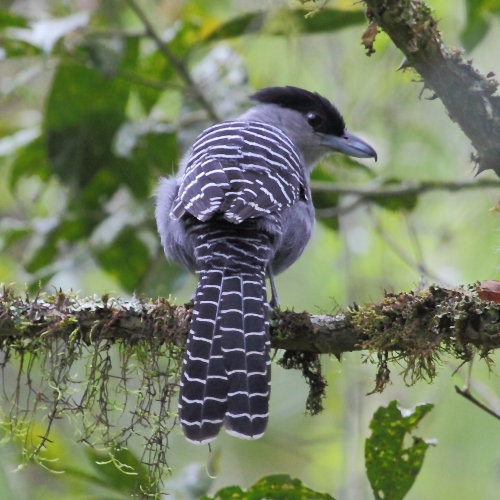
Sincora Antwren
Formicivora grantsaui
Order: Passeriformes / Family: Thamnophilidae

Wikimedia Commons
About the Sincora Antwren
The Sincora Antwren, scientifically known as Formicivora grantsaui, is a small passerine bird found primarily in Brazil's Chapada Diamantina region. This bird inhabits the high-altitude grasslands of the Espinhaço Range, a unique biome characterized by its rocky outcrops and endemic flora. The Sincora Antwren plays a critical role in the local ecosystem, contributing to the control of insect populations. As an insectivore, it primarily feeds on ants and other small invertebrates, facilitating nutrient cycling within its habitat. The species is adapted to the specific environmental conditions of these highland regions, which range from 800 to 1,200 meters in elevation. The Sincora Antwren's presence is vital for the maintenance of ecological balance in these areas, where its specialized feeding behavior influences the composition and abundance of insect communities. During the breeding season, which occurs from September to February, the Sincora Antwren exhibits increased territorial behavior and vocal activity. This period aligns with the region's wetter months, when food resources are abundant, supporting the energetic demands of raising offspring. The Sincora Antwren's adaptation to its niche environment underscores its ecological significance and the importance of conserving its natural habitat. Its restricted range and specialized habitat requirements make it vulnerable to environmental changes, particularly those induced by human activities such as agriculture and deforestation. Conservation efforts are crucial to ensure the survival of this unique species and the protection of the biodiverse ecosystems it inhabits.
The Sincora Antwren belongs to the family Thamnophilidae, within the order Passeriformes. These birds typically live generally lives 3-5 years, with some individuals reaching up to 7 years..
How to Identify a Sincora Antwren
The Sincora Antwren is a small bird, measuring approximately 11 centimeters in length. Adult males display a striking contrast of black and white plumage, with a prominent white stripe running above the eye, which aids in identification. The underparts are predominantly white, with black wings that feature two white wing bars. Females are similar in size but can be distinguished by their brownish hue on the upperparts, replacing the black seen in males, and slightly duller overall coloration. Juveniles resemble females but have a more subdued pattern, lacking the full intensity of adult plumage. When observed in the field, the Sincora Antwren can be confused with other antwren species within its range, such as the Black-capped Antwren. However, the Sincora Antwren's unique habitat preferences and the distinct white eyebrow stripe are key differentiators. In flight, its short, rounded wings and long tail are indicative of its species, though it is more commonly seen flitting between low shrubs and perching conspicuously on exposed branches. Its typical perching posture, upright with a slightly cocked tail, also aids in identification.
Having trouble telling birds apart? Upload a photo to our bird identification tool for an instant species match.
Sincora Antwren Habitat and Range
Preferred Habitat
The Sincora Antwren inhabits the high-altitude campos rupestres, or rocky grasslands, found in Brazil's Espinhaço Range, particularly prevalent in Chapada Diamantina. These areas are characterized by their sparse vegetation, rocky outcrops, and a mix of grasses and shrubs. The elevation range of 800 to 1,200 meters provides a cooler and more stable microclimate compared to the surrounding lowlands. This antwren shows a preference for areas with dense patches of shrubs, where it forages for insects. Seasonal shifts in habitat use are minimal, as the species is non-migratory and relies on the consistent ecological conditions provided by the high-altitude grasslands. Occasional sightings near human-influenced areas are rare, as the Sincora Antwren primarily avoids urban environments, preferring the undisturbed natural habitats of its native range.
Geographic Range
The Sincora Antwren is endemic to Brazil, with its range restricted to the Espinhaço Range in eastern Brazil, specifically within the Chapada Diamantina National Park. This region, located in the state of Bahia, is known for its unique geological formations and high biodiversity. The species does not exhibit migratory behavior, maintaining a resident status year-round within this confined range. Population densities are higher in areas with optimal habitat conditions, particularly those with abundant shrub cover and minimal human disturbance. Outside this core range, sightings are exceedingly rare, underscoring the species' limited distribution and the importance of focused conservation efforts in preserving its habitat.
Want to know which birds visit your area? Browse our backyard birds by location guides for region-specific species lists.
What Does the Sincora Antwren Eat?
The Sincora Antwren primarily feeds on a diet of ants and other small invertebrates, utilizing its sharp beak to glean prey from foliage and the ground. Its foraging technique involves actively hopping among shrubs and low vegetation, probing into crevices and turning over leaves to uncover hidden prey. During the wetter months, its diet may expand to include a broader range of insects, such as beetles and caterpillars, which become more abundant. The Sincora Antwren's feeding schedule is diurnal, with peak foraging activity occurring in the early morning and late afternoon, coinciding with periods of cooler temperatures and increased prey activity. The bird's specialized feeding habits play a crucial role in controlling insect populations within its habitat, highlighting its ecological importance.
Sincora Antwren Behavior and Social Structure
The Sincora Antwren exhibits a primarily solitary or paired social structure, with pairs often maintaining territories during the breeding season. Territorial behavior includes vocal displays and chasing intruders from their established areas. Courtship displays involve males performing fluttering flights and presenting food to females, reinforcing pair bonds. Outside the breeding season, the Sincora Antwren remains relatively inconspicuous, blending into its environment. The species does not typically form large flocks, but may occasionally associate with mixed-species foraging groups, particularly during the non-breeding season. In response to predators, the Sincora Antwren emits sharp alarm calls and employs evasive maneuvers to escape, often seeking refuge in dense vegetation. Its daily activity patterns are influenced by the diurnal cycle, with periods of intense activity during the cooler parts of the day.
Sincora Antwren Nesting and Reproduction
The nesting habits of the Sincora Antwren involve constructing cup-shaped nests from fine grasses and fibers, usually placed low in shrubs or among grass tussocks. Nests are well-concealed, offering protection from predators and environmental elements. Clutch size typically consists of two to three eggs, with both parents sharing incubation duties over a period of approximately 14 days. After hatching, the fledging period lasts about 12-14 days, during which both parents participate in feeding and caring for the young. The Sincora Antwren may produce two broods per year, depending on food availability and environmental conditions, maximizing reproductive success during the favorable breeding season.
Sincora Antwren Sounds and Vocalizations
The Sincora Antwren's primary song is a series of clear, melodious notes delivered in quick succession. The rhythm is fast-paced, with each note ascending in pitch, producing a cheerful and distinctive melody. Call notes are short and sharp, often used in communication between mates or to signal alarm. During the dawn chorus, the Sincora Antwren's song is prominent, often one of the first to be heard in its habitat. The alarm calls are harsher and more abrupt, serving as an effective deterrent against potential threats. These vocalizations play a pivotal role in maintaining territory and facilitating social interactions within the species.
Interesting Facts About the Sincora Antwren
- 1The Sincora Antwren was only officially described in 2007, showcasing the ongoing discoveries in ornithology.
- 2Despite its limited range, the Sincora Antwren's habitat in Chapada Diamantina is a hotspot for biodiversity.
- 3The Sincora Antwren is named in honor of the late zoologist Helmut Sick, who contributed significantly to Brazilian ornithology.
- 4The bird's striking plumage helps it blend into the contrasting light and shadows of its rocky grassland environment.
- 5Unlike many other antwren species, the Sincora Antwren does not form large flocks, preferring solitary or paired life.
Sincora Antwren Conservation Status
The Sincora Antwren is currently classified as Near Threatened on the IUCN Red List, with a population trend indicating a slight decline. The primary threats to its survival are habitat loss and degradation due to agricultural expansion, mining, and deforestation. Conservation efforts focus on protecting the unique high-altitude grasslands where the Sincora Antwren resides, with initiatives aimed at preserving natural habitats and curbing destructive land-use practices. Historical population changes have been driven by increasing human activity in the region, highlighting the need for ongoing monitoring and habitat protection to ensure the future of this vulnerable species.