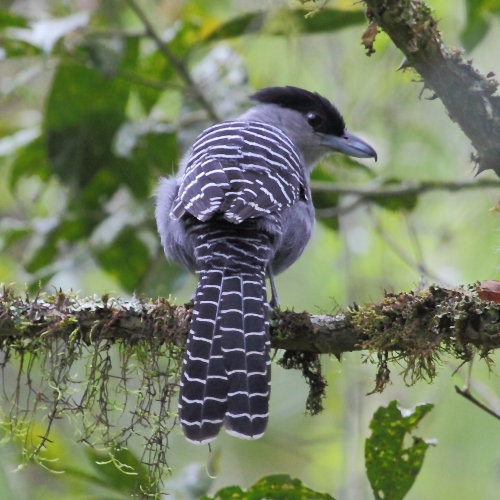
Slaty Antwren
Myrmotherula schisticolor
Order: Passeriformes / Family: Thamnophilidae

Wikimedia Commons
About the Slaty Antwren
The Slaty Antwren (Myrmotherula schisticolor) is a small songbird native to the Neotropics, particularly flourishing in the humid forests of Central and South America. This bird, belonging to the family Thamnophilidae, plays a crucial ecological role by participating in mixed-species foraging flocks, which enhances resource exploitation and predator avoidance. The Slaty Antwren helps maintain insect populations in check, thus contributing to forest health. It is predominantly found in countries such as Costa Rica, Panama, and portions of Colombia and Ecuador. These birds are experts at navigating the dense thickets and tangles of lowland and foothill forests, thriving in elevations ranging from sea level to about 1,500 meters. Seasonal migrations are not characteristic of the Slaty Antwren, although minor altitudinal movements may occur in response to food availability. The ecological significance of the Slaty Antwren extends beyond its role in insect control, as it also serves as a bioindicator of forest integrity. Its presence typically correlates with undisturbed habitats, providing insights into the health of forest ecosystems. While primarily a resident bird, it often adjusts its territory size and location based on seasonal resource abundance, demonstrating a remarkable adaptability to varying environmental conditions.
The Slaty Antwren belongs to the family Thamnophilidae, within the order Passeriformes. These birds typically live average 4-6 years, with a maximum recorded of 8 years..
How to Identify a Slaty Antwren
The adult male Slaty Antwren is most easily recognized by its striking slate-gray plumage, a characteristic that sets it apart from many other antbirds. It has a darker cap and a contrastingly lighter gray throat and chest, giving it a distinct appearance in the dim forest light. Females differ significantly, sporting a more subdued olive-brown color on their upperparts with a lighter yellowish-buff underpart, which can sometimes lead to confusion with other small antbird species. Juvenile Slaty Antwrens resemble the females but with more indistinct and muted coloration. Unlike many other forest birds, this species lacks pronounced sexual dimorphism in terms of size, with both males and females measuring about 10 centimeters in length. When observing in the field, watch for their distinctive low and agile flight pattern, as they tend to fly in short, purposeful bursts through the understory. Perched, the Slaty Antwren often maintains a slightly upright stance, which aids in quick take-offs when foraging or evading predators. While their plumage ensures they remain inconspicuous among the foliage, their constant flitting motion often betrays their presence.
Having trouble telling birds apart? Upload a photo to our bird identification tool for an instant species match.
Slaty Antwren Habitat and Range
Preferred Habitat
The Slaty Antwren primarily inhabits the dense, humid understory of primary and secondary forests. These environments provide ample cover and an abundance of their insect prey. Commonly found between sea level and elevations up to 1,500 meters, they exhibit a preference for the lower strata of the forest. In regions such as the Chocó biogeographical zone and the foothills of the Andes, their preference for dense thickets and tangled vegetation becomes particularly evident. While the Slaty Antwren is a forest specialist, it occasionally ventures into forest edges and disturbed areas if sufficient cover exists. Unlike some other antbirds, it rarely enters urban environments, instead showing a strong fidelity to its forested habitats. Seasonal shifts in habitat preference are minimal, as the bird remains largely sedentary throughout the year, occasionally moving vertically within forested areas in response to resource availability.
Geographic Range
The Slaty Antwren's range extends throughout much of Central and South America, predominantly found in countries like Costa Rica, Panama, Colombia, and Ecuador. Although the bird's range is relatively broad, it is not uniformly distributed and is largely concentrated in areas with suitable dense forest cover. This antwren does not engage in long-distance migrations but may exhibit some altitudinal movement within its range. In Costa Rica, the Slaty Antwren is more commonly found in the Caribbean slope's humid forests and is less frequent on the drier Pacific slope. In Colombia and Ecuador, its presence is notable in the Chocó region, an area renowned for its high biodiversity and endemism. Population densities are generally higher in regions with extensive, contiguous forest, as fragmentation can adversely affect their numbers. While not considered migratory, some local populations might adjust their range slightly in response to changes in habitat quality or availability of food resources.
Want to know which birds visit your area? Browse our backyard birds by location guides for region-specific species lists.
What Does the Slaty Antwren Eat?
The diet of the Slaty Antwren predominantly consists of insects and other arthropods, making it an integral part of the forest's insectivorous community. It primarily targets ants, beetles, and spiders, which it forages for by gleaning from leaves and branches in the understory. Seasonal variations in diet are mostly influenced by the availability of prey, with some shifts observed during periods of abundant insect hatches. The Slaty Antwren employs a methodical foraging technique, often joining mixed-species flocks to increase foraging efficiency and reduce the risk of predation. These flocks allow the bird to cover a larger area and access different layers of the forest in search of prey. Despite its small size, the Slaty Antwren can capture relatively large insects, sometimes targeting prey nearly half its size. Its feeding schedule is primarily diurnal, with peak activity during the morning and late afternoon hours when insects are most active.
Slaty Antwren Behavior and Social Structure
The Slaty Antwren is a social bird that exhibits a variety of interesting behaviors, particularly in its interactions with other species. It frequently participates in mixed-species foraging flocks, a strategy that offers both increased protection from predators and enhanced foraging opportunities. Within these flocks, the Slaty Antwren maintains a cooperative, yet competitive, dynamic, often chasing after insects flushed out by the activity of its companions. This species demonstrates territorial behavior, with both males and females actively defending their feeding and nesting areas against intruders. Courtship displays are subtle and involve mutual feeding and synchronized movements between pairs. Flocking patterns change seasonally, with larger groups forming during the non-breeding season. In response to predators, the Slaty Antwren exhibits a range of behaviors, from quiet retreat into dense foliage to emitting alarm calls that alert nearby birds. Its daily activity patterns are largely influenced by the availability of food and the level of light within the understory, with peak activity occurring during the cooler parts of the day.
Slaty Antwren Nesting and Reproduction
The Slaty Antwren constructs its nest low in the forest understory, often placing it in dense shrubs or small trees to ensure concealment from predators. The nest is a delicate cup structure, woven from fine plant fibers, leaves, and spider silk, providing both camouflage and structural integrity. Clutch size typically ranges from two to three eggs, which are incubated by both parents. The incubation period lasts approximately 14 to 16 days, with both male and female sharing responsibilities. After hatching, the chicks remain in the nest for about 10 to 14 days before fledging. Parental roles are shared, with both parents involved in feeding and protecting the young. The Slaty Antwren may produce one to two broods per year, depending on environmental conditions and food availability. Nesting success is closely tied to habitat quality, with higher success rates in more undisturbed areas.
Slaty Antwren Sounds and Vocalizations
The primary song of the Slaty Antwren is a clear, high-pitched series of notes that descends in pitch and accelerates, creating a distinctive, musical quality that can be heard throughout its forest habitat. These songs serve both to establish territory and to facilitate mate attraction. In addition to its song, the Slaty Antwren uses a variety of call notes, including a sharp, metallic 'chip' sound that functions as an alarm call. During the dawn chorus, its song is often one of the first to be heard, contributing to the complex tapestry of sounds within the tropical forest. The alarm calls are typically emitted in response to perceived threats, alerting both conspecifics and other species within mixed flocks.
Interesting Facts About the Slaty Antwren
- 1The Slaty Antwren is often a participant in mixed-species flocks, which can include up to 10 different bird species.
- 2Despite its small size, the Slaty Antwren can capture prey nearly half its body length, showcasing its remarkable hunting skills.
- 3The Slaty Antwren has adapted to its dark forest environment, with slate-gray plumage providing excellent camouflage.
- 4This species is a year-round resident, showing little need for long-distance migration, unlike many other Neotropical birds.
- 5The Slaty Antwren's presence in a forest often indicates high biodiversity and minimal human disturbance.
- 6It uses spider silk and plant fibers to weave its delicate cup-shaped nests, highlighting its resourceful nesting habits.
- 7Fledging occurs quickly, with chicks leaving the nest within 10 to 14 days after hatching, ensuring rapid development.
Slaty Antwren Conservation Status
The Slaty Antwren is classified as Least Concern by the International Union for Conservation of Nature (IUCN), with its population considered stable. However, habitat destruction due to deforestation poses a significant threat to its long-term survival. Conservation efforts focus on protecting and restoring forest habitats, particularly in biodiversity hotspots like the Chocó region. Historical population changes have been influenced by land-use changes, with declines noted in areas heavily impacted by logging and agriculture. Continued monitoring of population trends and habitat conditions is essential to ensure the preservation of this species.