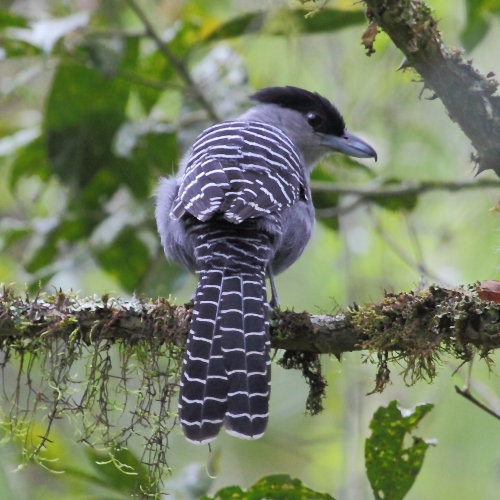
Sooretama Slaty-Antshrike
Thamnophilus ambiguus
Order: Passeriformes / Family: Thamnophilidae

Wikimedia Commons
About the Sooretama Slaty-Antshrike
The Sooretama Slaty-Antshrike, known scientifically as Thamnophilus ambiguus, is an intriguing bird species native to the Atlantic Forest region of Brazil. This bird is particularly significant due to its highly specialized habitat requirements and its role as an indicator species for forest health. Its slaty-gray plumage allows it to blend seamlessly into the dense understory of tropical forests, offering it protection from predators and aiding in its hunting of insects and other small invertebrates. The Sooretama Slaty-Antshrike primarily inhabits the lowland rainforests of southeastern Brazil, where it contributes to the ecological balance by controlling insect populations.
These antshrikes are predominantly found in the states of Espírito Santo and Rio de Janeiro, with their range extending into parts of southern Bahia. The bird thrives in humid, dense forests, where it displays fascinating behaviors, particularly during the breeding season. The Sooretama Slaty-Antshrike plays a vital ecological role as part of the insectivorous bird community, helping to maintain the health of forest ecosystems by preying on insects that may otherwise overpopulate and damage vegetation.
Seasonally, the Sooretama Slaty-Antshrike exhibits changes in behavior, particularly during the breeding season when males become more vocal and territorial. This period is crucial for the establishment of breeding territories and successful mating. Outside of the breeding season, these birds may be less vocal and primarily focused on foraging. The Sooretama Slaty-Antshrike's continued presence in its native habitat is essential for the preservation of biodiversity in the Atlantic Forest, a region known for its high levels of endemism and biodiversity. The conservation of this species is tightly linked to the protection and sustainable management of its forest habitat.
The Sooretama Slaty-Antshrike belongs to the family Thamnophilidae, within the order Passeriformes. These birds typically live average 5-6 years, with a maximum recorded of 8 years..
How to Identify a Sooretama Slaty-Antshrike
The Sooretama Slaty-Antshrike is recognized by its predominantly slaty-gray plumage, which is consistent across both sexes, although males tend to exhibit slightly darker tones compared to females. One key identification feature is the bird's strikingly contrasting white wing bars, which stand out against its gray body. The bird's size is relatively small, averaging around 16 centimeters in length, which makes it a medium-sized member of the Thamnophilidae family.
Juvenile Sooretama Slaty-Antshrikes can be differentiated from adults by their slightly duller plumage and less pronounced wing bars. As they mature, their plumage becomes more defined and their vocalizations more robust, aligning with those of adult birds. The bird's flight silhouette is compact, with rounded wings that are typical of birds adapted to maneuvering through dense forest underbrush. When perching, the Sooretama Slaty-Antshrike often adopts an upright posture, occasionally flicking its tail as a behavioral trait.
This species may be confused with other antshrikes or antbirds in its range, such as the Spot-backed Antshrike, but careful observation of plumage color, wing patterns, and vocalizations can aid in accurate identification. The Sooretama Slaty-Antshrike's distinctive vocal calls, a series of clear whistles and trills, are often the first clue to its presence in dense foliage.
Having trouble telling birds apart? Upload a photo to our bird identification tool for an instant species match.
Sooretama Slaty-Antshrike Habitat and Range
Preferred Habitat
The Sooretama Slaty-Antshrike primarily inhabits the humid lowland rainforests of southeastern Brazil, specifically within the Atlantic Forest biome. This region is characterized by dense vegetation and high humidity levels, providing an ideal environment for this species. Within the forest, the bird favors the understory and mid-story layers, where it can find abundant food resources and suitable nesting sites.
The bird's elevation range generally spans from sea level up to approximately 1,000 meters. It shows strong preferences for undisturbed forest habitats, although it can occasionally be found in secondary growth areas, provided they offer sufficient cover and food availability. Seasonal habitat shifts are minimal, as this species is largely sedentary, relying on the consistent availability of resources within its home range.
The Sooretama Slaty-Antshrike does not typically venture into urban environments, preferring the secluded and resource-rich confines of its forest home. Conservation efforts to protect its habitat focus on preventing deforestation and promoting sustainable land use practices in the Atlantic Forest region.
Geographic Range
The Sooretama Slaty-Antshrike is endemic to Brazil, with its range primarily confined to the southeastern part of the country. Its breeding and year-round range includes the states of Espírito Santo and Rio de Janeiro, extending into southern Bahia. Within this region, the bird is closely associated with the Atlantic Forest, a globally recognized biodiversity hotspot.
The bird does not engage in long-distance migrations, maintaining a relatively stable presence within its range throughout the year. Instead, it exhibits localized movements in response to food availability and breeding requirements. Population density hotspots are typically found in areas of well-preserved forest, where the ecological integrity supports a diverse insect community for foraging.
Due to its restricted range and specific habitat requirements, the Sooretama Slaty-Antshrike is considered vulnerable to habitat loss. Conservation efforts in Brazil are critical to maintaining suitable conditions for this species, and protecting its native forests is a priority for ensuring its continued survival.
Want to know which birds visit your area? Browse our backyard birds by location guides for region-specific species lists.
What Does the Sooretama Slaty-Antshrike Eat?
The Sooretama Slaty-Antshrike primarily feeds on a diet of insects and other small invertebrates, which it skillfully captures in the dense underbrush of its forest habitat. Its diet consists mainly of ants, beetles, spiders, and caterpillars, although it may occasionally consume small vertebrates such as lizards.
Foraging behavior typically involves gleaning prey from foliage or capturing insects in flight. The bird employs a methodical approach, moving through the forest understory with calculated hops and short flights to inspect leaves and branches. During the breeding season, its diet may shift slightly to accommodate the increased energy demands of nesting and raising chicks.
The Sooretama Slaty-Antshrike's feeding schedule aligns with the diurnal activity patterns of its prey, with peak foraging occurring during the early morning and late afternoon hours. This schedule allows the bird to capitalize on the higher activity levels of insects during these times, ensuring a steady supply of food.
Sooretama Slaty-Antshrike Behavior and Social Structure
The Sooretama Slaty-Antshrike exhibits a range of behaviors that reflect its adaptation to life in the dense tropical forests. It is generally seen singly or in pairs, particularly during the breeding season when pairs become more territorial. Males engage in vocal displays to establish and defend their territories, using a repertoire of whistles and trills to communicate with potential rivals and mates.
Courtship behaviors include vocal duets between males and females, as well as mutual preening. These interactions strengthen pair bonds and facilitate successful breeding. Outside the breeding season, the bird may join mixed-species foraging flocks, benefiting from the increased vigilance and foraging efficiency offered by the group.
The Sooretama Slaty-Antshrike's response to predators involves a combination of camouflage and retreat into dense vegetation. Its slaty-gray plumage provides effective concealment, while its agile movements allow it to navigate through thick foliage to avoid detection. Daily activity patterns are primarily diurnal, with the bird being most active during the early morning and late afternoon hours.
Sooretama Slaty-Antshrike Nesting and Reproduction
The Sooretama Slaty-Antshrike constructs its nest in the dense lower strata of the forest, often choosing a site that offers protection from predators and the elements. The nest is typically a small cup-shaped structure, woven from twigs, leaves, and plant fibers, and lined with softer materials for insulation and comfort.
Preferred nesting locations include low branches or shrubs, which provide concealment within the understory. Clutch size generally consists of two to three eggs, with both parents sharing incubation duties. The incubation period lasts approximately 14 to 16 days, during which time the parents alternate between incubating the eggs and foraging for food.
After hatching, the nestlings remain in the nest for about 12 to 15 days before fledging. Parental care continues after fledging, with both parents involved in feeding and protecting the young until they become independent. The Sooretama Slaty-Antshrike typically raises one to two broods per year, depending on environmental conditions and food availability.
Sooretama Slaty-Antshrike Sounds and Vocalizations
The Sooretama Slaty-Antshrike is known for its distinctive vocalizations, which play a crucial role in communication and territory establishment. Its primary song consists of a series of clear, melodious whistles that rise and fall in pitch, often described as a "whee-whee-whee" pattern. These whistles are delivered in a steady rhythm, with each phrase lasting several seconds.
Call notes include a variety of sharp, chipping sounds used for contact between mates or signaling alarm. Alarm calls are more rapid and high-pitched, alerting other birds to potential threats. During the dawn chorus, the Sooretama Slaty-Antshrike contributes its whistles to the symphony of forest sounds, establishing its presence and reinforcing territorial boundaries.
In comparison to other birds, its vocalizations are less complex but carry well through dense foliage, ensuring effective communication over short distances. The clarity and consistency of its calls make it a recognizable presence in the Atlantic Forest.
Interesting Facts About the Sooretama Slaty-Antshrike
- 1The Sooretama Slaty-Antshrike is part of a group of birds called antbirds, which are named for their diet that heavily features ants.
- 2Despite its name, the Sooretama Slaty-Antshrike's diet includes a variety of insects, not just ants, showcasing its adaptability.
- 3The Sooretama Slaty-Antshrike's vocal duets between mates serve both as a bonding mechanism and a territorial defense strategy.
- 4This bird is a valuable indicator species for the health of the Atlantic Forest, reflecting changes in ecosystem integrity.
- 5The Sooretama Slaty-Antshrike's presence is often detected by its distinctive whistle before it is seen, due to its secretive nature.
- 6The bird's slaty-gray coloration provides effective camouflage against the backdrop of the dense forest understory.
- 7The Sooretama Slaty-Antshrike's conservation status benefits from Brazil's efforts to protect the Atlantic Forest, a critical biodiversity hotspot.
Sooretama Slaty-Antshrike Conservation Status
The Sooretama Slaty-Antshrike is currently classified as Least Concern by the IUCN, though its population trends warrant careful monitoring due to ongoing habitat loss. The primary threat to this species is deforestation driven by agricultural expansion, logging, and urban development in the Atlantic Forest region. Conservation efforts focus on preserving and restoring forest habitats, which are crucial for maintaining the ecological balance necessary for the survival of this and other forest-dependent species. Protected areas and private reserves play a significant role in safeguarding the Sooretama Slaty-Antshrike's habitat. Historically, the population has experienced fluctuations corresponding with habitat changes, but current initiatives aim to stabilize and potentially increase numbers through habitat protection and sustainable land management practices. Continued research and monitoring are essential to assess the effectiveness of these conservation efforts and to adjust strategies as needed.