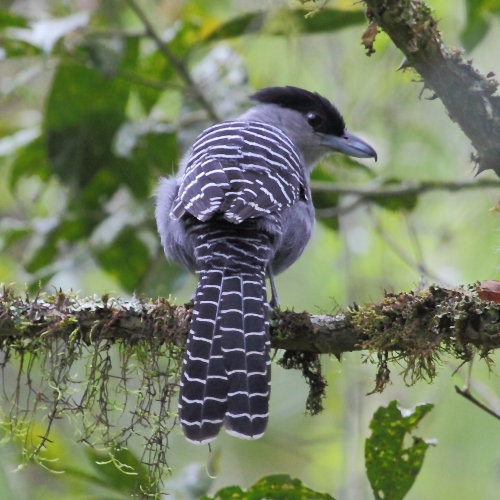
Southern Chestnut-tailed Antbird
Myrmeciza hemimelaena
Order: Passeriformes / Family: Thamnophilidae

Wikimedia Commons
About the Southern Chestnut-tailed Antbird
The Southern Chestnut-tailed Antbird (Myrmeciza hemimelaena) is a remarkable species that inhabits the dense and humid lowland forests of the Amazon Basin. Found primarily in countries like Peru, Brazil, and Bolivia, this bird plays a crucial role in the forest ecosystems. As part of the Thamnophilidae family, Southern Chestnut-tailed Antbirds are known for their insectivorous diets and their role in controlling insect populations. They typically dwell in the understory layer of forests, where their movements and feeding habits have a significant impact on insect communities.
This antbird species is a vital component of the Amazonian forest, serving as both a predator and prey. By consuming a variety of insects, including ants and beetles, they help to maintain a balance in the ecosystem. Their presence also benefits the health of the forest by facilitating nutrient cycling. During the breeding season, which usually occurs in the wet months, Southern Chestnut-tailed Antbirds become more vocal and territorial, making them easier to observe.
In terms of ecological significance, the Southern Chestnut-tailed Antbird is an indicator of forest health. Its reliance on pristine forest habitats means that population declines can signal environmental disturbances. Conservationists often use the presence or absence of such species to assess the impacts of deforestation and habitat degradation. The bird's ability to adapt to subtle changes within its environment also provides insights into the resilience of tropical ecosystems. However, climate change and habitat destruction continue to threaten their existence, making conservation efforts more important than ever.
The Southern Chestnut-tailed Antbird belongs to the family Thamnophilidae, within the order Passeriformes. These birds typically live average 5-7 years, with a maximum recorded of 10 years..
How to Identify a Southern Chestnut-tailed Antbird
Adult Southern Chestnut-tailed Antbirds are medium-sized with a distinctive chestnut-colored tail, which sets them apart from other antbirds. Males display a darker plumage with a slate-gray head and upperparts, contrasting with the rich chestnut of their tails. Females are similar in size but tend to have lighter gray on their heads and more rufous coloration on their underparts and tail. Juveniles resemble females but with even paler tones, especially on their chest and belly.
One of the key identification features of the Southern Chestnut-tailed Antbird is its behavior. It often forages close to the ground, hopping through the leaf litter in search of prey. The bird's posture is typically upright when perched, with its tail slightly cocked. In flight, the bird's silhouette is compact, with broad wings, and its chestnut tail is noticeable even mid-flight.
Confusion with similar species, such as the Northern Chestnut-tailed Antbird, can occur. However, the Southern Chestnut-tailed Antbird is generally found further south, and its vocalizations differ slightly. Observers should also note the bird's habitat preferences, as it favors dense, lowland forests where it is less likely to be confused with other antbird species.
Having trouble telling birds apart? Upload a photo to our bird identification tool for an instant species match.
Southern Chestnut-tailed Antbird Habitat and Range
Preferred Habitat
Southern Chestnut-tailed Antbirds thrive in the dense understory of lowland tropical forests. They are predominantly found in the Amazon Basin, with a preference for humid, evergreen forests that offer abundant leaf litter and thick vegetation. These birds are most commonly encountered at elevations ranging from 100 to 700 meters above sea level, though they can occasionally be found at higher altitudes in suitable habitats.
Their habitat preference is closely tied to the presence of a rich insect fauna, which is vital for their diet. While primarily forest dwellers, Southern Chestnut-tailed Antbirds are rarely seen in open or urban areas. They do not exhibit significant seasonal habitat shifts, instead remaining in their forested habitats year-round. In regions where deforestation is prevalent, these birds are among the first to disappear, underscoring their dependence on intact forest environments.
Geographic Range
The Southern Chestnut-tailed Antbird inhabits the expansive Amazon Basin, with its range spanning several South American countries. It is found in eastern Peru, northern Bolivia, and western Brazil. The species is non-migratory, residing in these areas throughout the year, although it may exhibit minor local movements in response to environmental conditions.
Within its range, the bird is most commonly associated with the undisturbed lowland forests that characterize the heart of the Amazon. Population density is highest in regions where the forest canopy and understory remain intact, such as the Manu Biosphere Reserve in Peru and the Madidi National Park in Bolivia. These areas serve as crucial refuges for the species, providing the necessary habitat conditions for survival.
Though the Southern Chestnut-tailed Antbird is considered widespread within its range, habitat destruction poses a significant threat to its populations. Logging, agriculture, and infrastructure development are contributing to forest fragmentation, which may lead to isolated populations and increase the risk of local extinctions.
Want to know which birds visit your area? Browse our backyard birds by location guides for region-specific species lists.
What Does the Southern Chestnut-tailed Antbird Eat?
The Southern Chestnut-tailed Antbird feeds predominantly on insects, making it an important insectivore within its ecosystem. Its primary food sources include ants, beetles, and spiders, which it catches by foraging through the leaf litter and dense underbrush. The bird employs a methodical foraging technique, hopping along the forest floor and using its sharp bill to probe beneath leaves and debris.
During the wet season, when insect populations are at their peak, Southern Chestnut-tailed Antbirds have access to a more abundant food supply. They adapt their foraging behavior to exploit this abundance, sometimes following army ant swarms to capture insects that are flushed out by the ants' movements.
While primarily insectivorous, these antbirds may occasionally consume small invertebrates or fruits, although such instances are rare. Their feeding schedule is diurnal, with most activity occurring in the early morning and late afternoon when temperatures are cooler and prey is more active.
Southern Chestnut-tailed Antbird Behavior and Social Structure
Southern Chestnut-tailed Antbirds exhibit a complex social structure, often forming monogamous pairs that remain together throughout the year. They are territorial birds, with pairs defending their space against intruders through vocalizations and displays. The birds communicate with a series of calls and songs, primarily to establish territory boundaries and strengthen pair bonds.
Courtship displays involve the male presenting food items to the female, followed by mutual preening and singing. These behaviors reinforce the pair bond and are integral to successful breeding. During the breeding season, which coincides with the wet season, the birds become more vocal, advertising their presence and readiness to breed.
Southern Chestnut-tailed Antbirds are generally solitary or found in pairs, rarely forming large flocks. Their response to predators involves a combination of stealth and vocal alarms, alerting mates or neighbors to potential threats. Daily activity patterns are closely tied to foraging, with peak activity during cooler parts of the day.
Southern Chestnut-tailed Antbird Nesting and Reproduction
The nesting habits of the Southern Chestnut-tailed Antbird involve constructing small cup-shaped nests made from twigs, leaves, and moss. These nests are typically located low to the ground, often less than a meter above the forest floor, concealed within dense vegetation to protect against predators.
Females lay a clutch of 2 to 3 eggs, which both parents incubate for a period of 14 to 16 days. The eggs are usually pale with darker speckles, providing camouflage within the nest. After hatching, the chicks remain in the nest for another 12 to 15 days before fledging.
Both male and female antbirds share parental duties, including feeding and protecting the young. The number of broods per year is typically limited to one, as the demands of raising and defending chicks in the dense forest environment are considerable.
Southern Chestnut-tailed Antbird Sounds and Vocalizations
The Southern Chestnut-tailed Antbird's primary song is a series of rapid, melodious notes that rise and fall in pitch, often described as a 'tinkling' sound. This song is most frequently heard during the early morning and late afternoon, serving as a territorial call and a means of communication between pairs.
Their call notes are short, sharp clicks or 'chips' used to communicate with mates or signal alarm. When threatened by predators, the bird emits a harsh, rapid series of calls, alerting others to potential danger.
In the dawn chorus, the Southern Chestnut-tailed Antbird's song blends with the cacophony of the forest, adding to the rich tapestry of sounds that characterize the Amazon. The bird's vocalizations are crucial for maintaining territory and social bonds within its dense habitat.
Interesting Facts About the Southern Chestnut-tailed Antbird
- 1The Southern Chestnut-tailed Antbird's tail is not just vibrant but also functional, providing balance as it hops through dense vegetation.
- 2This antbird species is known for following army ants, capturing insects that flee from the swarm, a behavior known as 'ant-following'.
- 3Unlike many birds, the Southern Chestnut-tailed Antbird does not migrate, spending its entire life within the Amazon's rich forests.
- 4The species' territorial songs are used not only to ward off rivals but also to communicate and strengthen pair bonds.
- 5Southern Chestnut-tailed Antbirds are adept at navigating the complex understory of the Amazon, rarely ascending to the canopy.
- 6Both male and female antbirds are involved in nest building, incubation, and feeding the young, showcasing their strong parental cooperation.
- 7Despite their reliance on dense forests, these antbirds are surprisingly adaptable, adjusting their foraging techniques to seasonal insect availability.
Southern Chestnut-tailed Antbird Conservation Status
The Southern Chestnut-tailed Antbird is currently listed as 'Least Concern' by the IUCN, although its populations are declining due to habitat loss. Deforestation driven by logging, agriculture, and infrastructure projects poses the most significant threat to this species, leading to fragmentation and degradation of its habitat. Conservation efforts are focused on preserving large tracts of primary forest within the Amazon Basin, which are critical for the survival of this and many other species. Protected areas such as national parks and reserves play a vital role in providing safe havens for the bird. Historically, the Southern Chestnut-tailed Antbird has maintained stable populations in its native range. However, ongoing threats necessitate continued monitoring and habitat preservation to ensure its long-term survival. Promoting sustainable land use practices and raising awareness about the importance of tropical forests are essential to conserving this species.