
Spot-crowned Barbet
Capito maculicoronatus
Order: Piciformes / Family: Capitonidae

Wikimedia Commons
About the Spot-crowned Barbet
The Spot-crowned Barbet, scientifically known as Capito maculicoronatus, is a captivating resident of the Neotropical forests of Central America. Renowned for its vibrant plumage and distinctive spotted crown, this bird plays a significant role in its ecosystem as both a consumer of fruits and an agent of seed dispersal. The Spot-crowned Barbet is primarily found in humid lowland and foothill forests, ranging from southeastern Nicaragua through Costa Rica and into western Panama.
This barbet inhabits elevations from sea level up to about 1500 meters, favoring areas with dense canopy cover where it can forage effectively. It thrives in both primary forests and well-developed secondary forests, often venturing into forest edges and gardens that adjoin natural habitats. Its presence in these ecological niches highlights its adaptability to varying forest conditions.
Ecologically, the Spot-crowned Barbet contributes to forest dynamics through its frugivorous diet. By consuming a wide array of fruits, it aids in seed dispersal, ensuring the propagation of numerous plant species. During the breeding season, which typically occurs from March to May, these barbets intensify their foraging efforts, taking advantage of the seasonal abundance of fruits. Outside the breeding season, their diet becomes more diversified as they incorporate insects and small vertebrates, adapting to the fluctuating availability of their primary food resources.
The Spot-crowned Barbet belongs to the family Capitonidae, within the order Piciformes. These birds typically live average 7-9 years, with some living up to 12 years in the wild..
How to Identify a Spot-crowned Barbet
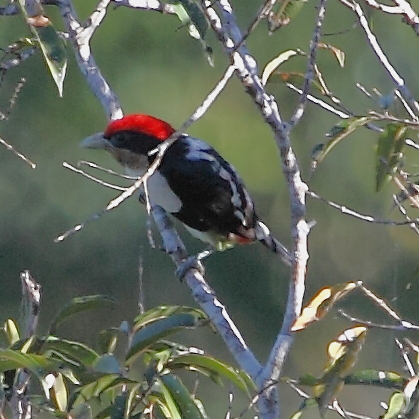
The Spot-crowned Barbet has a striking appearance that makes it relatively easy to identify in its native habitat. Adults exhibit a distinctive black crown with white spots, a trait that provides the bird its common name. The upperparts are primarily yellow with black streaks, while the underparts are a vibrant yellow with varying amounts of red on the breast and flanks. The wings and tail are dark, contrasting with the bright body plumage.
Juvenile Spot-crowned Barbets generally have duller plumage compared to adults, with less pronounced spotting on the crown and more muted colors on the body. These differences can make young birds more challenging to identify until they molt into adult plumage.
There is little sexual dimorphism in this species, meaning that males and females look quite similar, although males may display slightly brighter plumage. In the field, the Spot-crowned Barbet can be confused with similar species like the Red-headed Barbet. However, the unique crown pattern of the Spot-crowned Barbet is a reliable distinguishing feature. When perched, its robust body and short tail are characteristic, making it stand out among other tropical forest inhabitants.
Having trouble telling birds apart? Upload a photo to our bird identification tool for an instant species match.
Spot-crowned Barbet Habitat and Range
Preferred Habitat
The Spot-crowned Barbet predominantly inhabits humid tropical forests, thriving in both primary and mature secondary forests. It is frequently found in lowland and foothill forests, particularly those with a well-developed canopy and dense understory. The species is adaptable, also occupying forest edges and gardens adjacent to its natural habitat, which facilitates encounters with humans.
This barbet typically resides at elevations from sea level up to 1500 meters. It shows some preference for lower elevations during the breeding season, likely due to the abundance of fruiting trees and shrubs. In non-breeding seasons, it may venture to slightly higher elevations or more open areas, reflecting its versatility in habitat selection.
Despite its adaptability, the Spot-crowned Barbet is predominantly a forest dweller, rarely venturing into urban or suburban areas unless suitable forest patches are present. This preference underscores the importance of conserving forest habitats to maintain healthy populations of this species.
Geographic Range
The Spot-crowned Barbet has a range that encompasses several Central American countries, with its distribution primarily concentrated from southeastern Nicaragua through Costa Rica to western Panama. In Costa Rica, it is commonly observed in the lowland forests of the Caribbean slope and the Pacific slope's wetter areas.
This species is a non-migratory resident, meaning it does not undertake long-distance migrations but may exhibit some altitudinal movements in response to seasonal changes in food availability. The barbet remains within its established territories throughout the year, relying on the consistent presence of fruiting trees within its range.
Population density tends to be higher in regions where suitable habitat is contiguous and undisturbed, such as protected national parks and reserves. These areas provide the necessary resources and environmental stability to support robust populations of the Spot-crowned Barbet.
Want to know which birds visit your area? Browse our backyard birds by location guides for region-specific species lists.
What Does the Spot-crowned Barbet Eat?
The Spot-crowned Barbet's diet primarily consists of a variety of fruits, making it an important frugivore in its ecosystem. It favors figs, berries, and other fleshy fruits, playing a crucial role in seed dispersal for many plant species. During the breeding season, the abundance of fruits aligns with the barbet's increased nutritional demands.
In addition to fruits, the Spot-crowned Barbet supplements its diet with insects and small vertebrates, especially when fruit availability declines. This dietary flexibility allows it to thrive in different forest conditions and seasons. The bird employs a gleaning foraging technique, carefully picking fruits and prey from foliage and branches.
Feeding typically occurs during the early morning and late afternoon, taking advantage of cooler temperatures and reduced competition with other frugivores. This schedule allows the Spot-crowned Barbet to maximize its intake of ripe fruits and maintain its energy levels throughout the day.
Want to attract Spot-crowned Barbets to your yard? See our recommended feeders and seed types for the best results.
Spot-crowned Barbet Behavior and Social Structure
The Spot-crowned Barbet exhibits a social and often territorial behavior, frequently observed in pairs or small family groups. These birds maintain territories that they defend vigorously against conspecifics, especially during the breeding season. Territorial displays often involve vocalizations and physical posturing to deter intruders.
Courtship displays include mutual preening and food-sharing, strengthening the pair bond. During the breeding season, pairs become highly vocal, with both partners participating in territorial songs and calls. Outside the breeding season, the Spot-crowned Barbet may join mixed-species foraging flocks to exploit food resources more efficiently.
In terms of daily activity, the Spot-crowned Barbet is primarily diurnal, with peak activity periods in the morning and late afternoon. It remains relatively inactive during the hottest part of the day, resting or engaging in maintenance behaviors like preening. When confronted by potential predators, the bird employs evasive flight and seeks cover in dense foliage.
Spot-crowned Barbet Nesting and Reproduction
The Spot-crowned Barbet exhibits a unique nesting behavior, often excavating nest cavities in dead trees or using abandoned woodpecker holes. The selection of nest sites is influenced by the availability of suitable trees within their territory. These cavities provide protection from predators and environmental elements.
A typical clutch consists of 2 to 3 eggs, which both parents incubate over a period of approximately 14 days. During incubation, one parent remains in the nest while the other forages and defends the territory. After hatching, both parents actively participate in feeding the chicks, which fledge approximately 25 to 30 days after hatching.
The Spot-crowned Barbet generally raises one brood per year, although favorable conditions may occasionally allow for a second brood. The cooperative nature of both parents enhances the survival rate of the offspring, ensuring the continuation of their lineage.
Spot-crowned Barbet Sounds and Vocalizations
The Spot-crowned Barbet's vocal repertoire includes a primary song characterized by a series of rapid, melodious notes, often described as a rhythmic 'tuk-tuk-tuk.' This song serves as a territorial and courtship display, resonating through the forest.
In addition to its song, the barbet emits a variety of call notes, including sharp 'peep' and 'churr' sounds used for communication between mates and for signaling alarm. When threatened, the Spot-crowned Barbet's alarm call becomes more urgent and louder, alerting others to potential danger.
At dawn, the Spot-crowned Barbet participates in the dawn chorus, its song blending with those of other forest birds to create a vibrant symphony that marks the beginning of a new day. This vocal activity is most pronounced during the breeding season, emphasizing the bird's territorial presence.
Interesting Facts About the Spot-crowned Barbet
- 1The Spot-crowned Barbet's striking appearance and unique song make it a favorite among birdwatchers visiting Central America.
- 2This bird is an excellent seed disperser, helping regenerate tropical forests by spreading seeds over wide areas.
- 3Spot-crowned Barbets are known to use their strong beaks to excavate nesting cavities in softer wood, showcasing their impressive adaptability.
- 4Despite being predominantly frugivorous, the Spot-crowned Barbet occasionally hunts for insects and small lizards, demonstrating dietary flexibility.
- 5During courtship, Spot-crowned Barbets engage in mutual preening and food-sharing, strengthening pair bonds and ensuring reproductive success.
- 6The Spot-crowned Barbet's vocalizations are a key component of the dawn chorus, contributing to the rich soundscape of tropical forests.
- 7Due to its bright colors and distinctive crown, the Spot-crowned Barbet serves as an indicator species for healthy forest ecosystems.
Spot-crowned Barbet Conservation Status
The Spot-crowned Barbet is currently listed as Least Concern by the International Union for Conservation of Nature (IUCN), with stable population trends. However, habitat loss due to deforestation poses a significant threat to its long-term viability. Conservation efforts focus on preserving and restoring the barbet's natural habitats, particularly in regions where deforestation is rampant. Protected areas and national parks within its range play a crucial role in safeguarding its populations by maintaining the ecological integrity of forest ecosystems. Historical data indicate that while the Spot-crowned Barbet has experienced some population declines due to human activities, its adaptability to secondary forests has helped mitigate these impacts. Continued conservation initiatives are essential to ensure the species remains a thriving component of its ecosystem.
Attracting Spot-crowned Barbets to Your Feeder
The Spot-crowned Barbet is a regular visitor to backyard bird feeders across its range. At the Eye On The Fly feeding station, we observe Spot-crowned Barbets regularly and capture footage with our feeder cameras.
Other Capitonidae Species


Birds Similar to the Spot-crowned Barbet
These species are often confused with the Spot-crowned Barbet due to similar appearance or overlapping range.