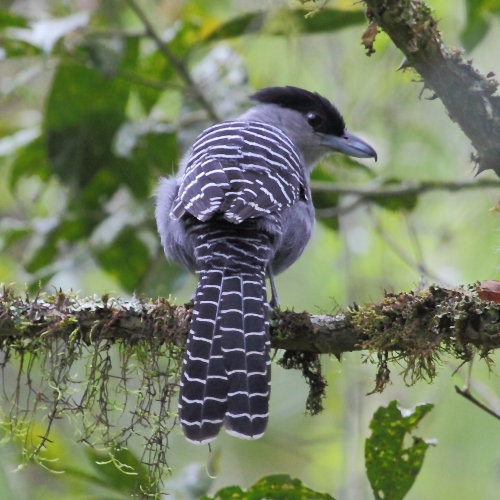
Spot-winged Antshrike
Pygiptila stellaris
Order: Passeriformes / Family: Thamnophilidae

Wikimedia Commons
About the Spot-winged Antshrike
The Spot-winged Antshrike, scientifically known as Pygiptila stellaris, is a fascinating member of the Thamnophilidae family, widely recognized for its intricate plumage and ecological significance. This medium-sized bird is found predominantly in the humid tropical and subtropical forests of South America, where it plays a critical role in maintaining the balance of these ecosystems. The Spot-winged Antshrike inhabits regions spanning from the Amazon Basin to the eastern slopes of the Andes, thriving in dense understory vegetation where it can effectively forage for insects. Its presence is often an indicator of healthy forest ecosystems, as it relies heavily on the intricate network of flora and fauna that comprise these rich habitats.
The Spot-winged Antshrike's ecological role extends beyond mere insect control. By preying on a variety of invertebrates, the bird helps regulate insect populations, contributing to the overall health of the forest. Its foraging habits also aid in the dispersal of seeds, as it moves through the understory, inadvertently transferring seeds from one location to another. The bird's role as both a predator and a seed disperser highlights its importance in maintaining the delicate balance of tropical forest ecosystems.
Seasonally, the Spot-winged Antshrike's behavior exhibits slight variations. During the breeding season, which generally occurs in the wettest months of the year, the bird becomes more territorial and vocal. This period is marked by increased activity as males establish and defend territories, while pairs engage in cooperative nest-building and rearing of young. Outside the breeding season, the Spot-winged Antshrike may join mixed-species foraging flocks, benefiting from the collective vigilance and foraging efficiency of these groups. This seasonal behavioral shift underscores the bird's adaptability and its ability to thrive in the dynamic environments of South America's forests.
The Spot-winged Antshrike belongs to the family Thamnophilidae, within the order Passeriformes. These birds typically live average 4-6 years, with a maximum recorded of 8 years..
How to Identify a Spot-winged Antshrike
Identifying the Spot-winged Antshrike involves observing several key field marks. Adults of the species display a striking plumage, characterized by dark gray to black feathers with distinct white spots on their wings, which give the bird its common name. The male Spot-winged Antshrike typically exhibits a more intense coloration, with a glossy black head and upperparts contrasted by the prominent white wing spots. Females, on the other hand, have a slightly duller plumage with a more subdued grayish tone and a less pronounced contrast between the wing spots and the surrounding feathers.
Juveniles of the species can be distinguished from adults by their overall browner plumage and less well-defined wing spots. As they mature, their feathers gradually darken, and the characteristic wing pattern becomes more prominent. The Spot-winged Antshrike can also be confused with other antbird species, such as the White-shouldered Antshrike, but the latter lacks the distinct spotting on the wings.
In flight, the Spot-winged Antshrike exhibits a compact silhouette with short, rounded wings and a relatively short tail. When perched, it often assumes a horizontal posture, moving stealthily through the undergrowth as it searches for prey. These combinations of field marks and behaviors are crucial for accurate identification, particularly in the dense habitats where the bird is typically found.
Having trouble telling birds apart? Upload a photo to our bird identification tool for an instant species match.
Spot-winged Antshrike Habitat and Range
Preferred Habitat
The Spot-winged Antshrike predominantly inhabits lowland tropical forests, thriving in areas with dense understory vegetation. These birds are particularly common in the Amazon Basin, which provides the perfect combination of humidity, temperature, and vegetation density for their needs. They are also found in the eastern foothills of the Andes, where the elevation ranges from sea level up to about 1000 meters.
Within these forests, the Spot-winged Antshrike prefers habitats that feature thick tangles of vines and shrubs, which offer ample cover and foraging opportunities. The bird’s presence is largely absent in more open forest types or areas significantly altered by human activity, indicating a preference for pristine, undisturbed environments. Seasonal shifts in habitat use are minimal, as the Spot-winged Antshrike is a year-round resident of its chosen territories.
While primarily a resident of rural and forested areas, the Spot-winged Antshrike may occasionally venture into the edges of human settlements that border dense forests. However, it is rarely observed in heavily urbanized areas, due to its reliance on intact forest ecosystems.
Geographic Range
The Spot-winged Antshrike has a relatively wide range across the tropical regions of South America. Its breeding and year-round range primarily cover the Amazon Basin, including parts of Brazil, Peru, Ecuador, Colombia, and Venezuela. The bird is most abundant in the vast stretches of the Brazilian Amazon, where suitable habitats abound.
In addition to its presence in the Amazon, the Spot-winged Antshrike is found in the eastern Andean foothills, extending its range into Bolivia and the northern regions of Argentina. This extension provides the species with access to diverse microhabitats created by the varying elevations and climates along the Andean slopes.
While the Spot-winged Antshrike does not engage in long-distance migration, its range can fluctuate slightly with environmental changes, such as deforestation or habitat degradation. Conservation efforts in these regions are crucial to maintaining the habitat integrity necessary for the bird's survival.
Want to know which birds visit your area? Browse our backyard birds by location guides for region-specific species lists.
What Does the Spot-winged Antshrike Eat?
The Spot-winged Antshrike primarily feeds on a variety of invertebrates, with insects making up the bulk of its diet. Common prey items include ants, beetles, spiders, and caterpillars, which the bird skillfully extracts from the dense vegetation of the forest understory. This antshrike employs a methodical foraging technique, characterized by slow, deliberate movements as it investigates leaves and branches for hidden prey.
Seasonal variations in diet are minimal, as the bird's tropical habitat provides a consistent supply of insects year-round. However, during the wetter months, when insect populations peak, the Spot-winged Antshrike may exploit temporary increases in prey availability, adjusting its foraging patterns accordingly.
The bird typically forages alone or in pairs, but during non-breeding seasons, it may join mixed-species flocks. These flocks allow the Spot-winged Antshrike to benefit from the collective intelligence and vigilance of different bird species, enhancing its foraging efficiency. Despite its specialized insectivorous diet, the bird occasionally consumes small fruits or seeds, particularly during periods of insect scarcity.
Spot-winged Antshrike Behavior and Social Structure
The Spot-winged Antshrike exhibits intriguing behavioral patterns that reflect its social structure and ecological interactions. Typically, these birds are monogamous, forming long-term pair bonds that persist across breeding seasons. Territorial behavior is prominent during the breeding season, with males aggressively defending their territories through vocal displays and physical confrontations.
Courtship displays involve a variety of vocalizations and visual signals, with the male often showcasing its wing spots and performing subtle movements to attract a mate. Once paired, both partners participate in nest-building and parental duties, demonstrating a high degree of cooperation.
Throughout the year, the Spot-winged Antshrike is predominantly solitary or forms small family groups. However, outside the breeding season, it may join mixed-species flocks, a behavior that enhances foraging success and provides safety in numbers. In response to predators, the bird relies on its cryptic plumage and the dense forest cover to remain inconspicuous, often freezing in place or retreating into the undergrowth.
The daily activity of the Spot-winged Antshrike generally begins at dawn and continues until dusk. During these hours, the bird actively forages, vocalizes, and defends its territory, with periodic breaks for resting in shaded areas. This diurnal rhythm aligns with the availability of its insect prey, which is most abundant during daylight hours.
Spot-winged Antshrike Nesting and Reproduction
Nesting for the Spot-winged Antshrike involves constructing a compact, cup-shaped nest, typically situated low in the understory vegetation. The nest is meticulously crafted using twigs, leaves, and plant fibers, camouflaging it against the forest backdrop. This strategic placement helps protect the nest from predators and environmental elements.
Clutch size for the Spot-winged Antshrike generally consists of two to three eggs, which are incubated by both parents. The incubation period lasts approximately 14 to 16 days, during which the parents alternate between incubating the eggs and foraging for food. Once hatched, the chicks are altricial, meaning they are born relatively undeveloped and require significant parental care.
The fledging period, when the young birds develop the necessary strength and skills for flight, occurs around 12 to 15 days after hatching. Throughout this time, both parents continue to feed and protect the chicks, teaching them essential survival skills. The number of broods per year typically depends on environmental conditions, with favorable seasons potentially allowing for multiple broods.
Spot-winged Antshrike Sounds and Vocalizations
The Spot-winged Antshrike is known for its distinctive vocalizations, which play a crucial role in communication and territorial defense. The primary song of the species consists of a series of short, melodious notes that rise and fall in pitch, creating a rhythmic and resonant pattern that can carry through the dense forest.
Call notes are typically sharp and somewhat metallic, serving as contact calls between mates or warning signals in response to potential threats. Alarm calls are more abrupt and urgent, effectively alerting other birds to the presence of predators. During the dawn chorus, the Spot-winged Antshrike's song contributes to the symphony of sounds that define the awakening forest, allowing it to establish its presence among the cacophony of other avian species.
Comparatively, the bird's song is less complex than that of many passerines, focusing on clarity and repetition rather than elaborate melodies. This simplicity ensures that its calls are easily recognizable by conspecifics, reinforcing social bonds and territorial boundaries.
Interesting Facts About the Spot-winged Antshrike
- 1The Spot-winged Antshrike's scientific name, Pygiptila stellaris, reflects its 'starry' wing spots, which are key to its identification.
- 2Unlike many other antbirds, the Spot-winged Antshrike often joins mixed-species flocks, benefiting from collective foraging.
- 3The species' distinctive wing spots serve both as a visual cue for mates and a form of camouflage among the dappled forest light.
- 4Spot-winged Antshrikes are primarily found in the Amazon Basin, which harbors one of the highest levels of biodiversity on Earth.
- 5Despite being a forest bird, the Spot-winged Antshrike can occasionally adapt to secondary growth and disturbed habitats.
- 6Their methodical foraging behavior contrasts with the more frenetic feeding styles of some other insectivorous birds.
- 7The Spot-winged Antshrike's vocalizations are essential for maintaining territory boundaries in the dense forests.
Spot-winged Antshrike Conservation Status
The Spot-winged Antshrike is currently listed as Least Concern by the International Union for Conservation of Nature (IUCN), with a stable population trend. Despite this classification, the species faces several challenges, primarily due to habitat destruction and fragmentation resulting from deforestation and agricultural expansion in the Amazon Basin and other parts of its range. Conservation efforts in regions where the Spot-winged Antshrike is found focus on preserving its natural habitat and mitigating the impacts of human activity. Initiatives include establishing protected areas and promoting sustainable land-use practices. Historical population changes have been minimal, as the bird has maintained a relatively stable presence in its extensive range. However, ongoing monitoring is essential to ensure that any future threats are promptly addressed, safeguarding the species and its vital ecological role within tropical forest ecosystems. By maintaining the integrity of these forests, conservationists aim to preserve not only the Spot-winged Antshrike but also the myriad of species that share its habitat.