
Streak-capped Antwren
Terenura maculata
Order: Passeriformes / Family: Thamnophilidae

Wikimedia Commons
About the Streak-capped Antwren
The Streak-capped Antwren (Terenura maculata) is a small passerine bird of the Thamnophilidae family, known for its active and agile behavior in the dense undergrowth of its native habitats. This species inhabits the humid subtropical and tropical forests of South America, with a distribution that includes countries such as Brazil, Bolivia, and Argentina. The bird plays a significant ecological role as an insectivore, helping to control insect populations within its environment. Streak-capped Antwrens are often observed in mixed-species flocks, which provides them with increased protection from predators and heightened foraging efficiency. This behavior underscores their importance as part of the intricate web of tropical forest biodiversity. The Streak-capped Antwren exhibits seasonal behaviors that align with the rainy season of its habitat. During the wetter months, increased insect activity provides ample food resources, promoting breeding activities. The bird's adaptability to different forest types, from primary forest to secondary growth, highlights its resilience, yet its reliance on forested environments makes it vulnerable to deforestation. The Streak-capped Antwren's presence is a marker of healthy forest ecosystems, and its decline could signal broader ecological issues. Conservation efforts must prioritize habitat protection to ensure the survival of this and other forest-dependent species. Given the ongoing threats of habitat loss due to agriculture and logging, the Streak-capped Antwren's future depends on sustainable management practices.This species, though not currently listed as endangered, faces pressures that could change its status if habitat degradation continues. The bird's ecological niche and interactions within its environment make it a valuable subject for avian studies, contributing to a broader understanding of tropical forest dynamics.
The Streak-capped Antwren belongs to the family Thamnophilidae, within the order Passeriformes. These birds typically live average 4 years, with a maximum recorded of 6 years..
How to Identify a Streak-capped Antwren
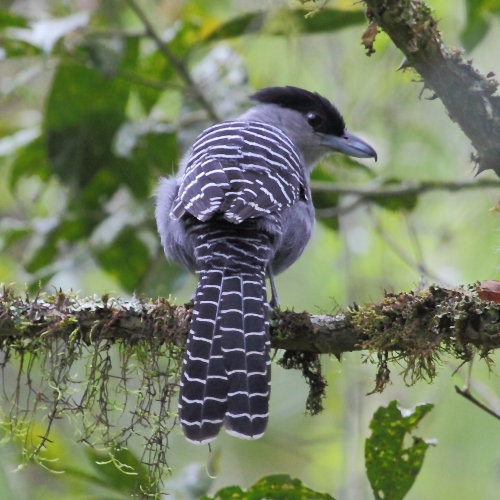
The Streak-capped Antwren is a small bird, measuring about 10 centimeters in length. Its most distinctive feature is the streaked crown, composed of fine black lines on a white or pale gray background, giving it a striped appearance from above. The back and wings are primarily olive-brown, providing effective camouflage among the foliage. Its underparts are lighter, with a pale gray or white tone, contributing to its inconspicuous nature. Males and females appear similar, though males may exhibit slightly more pronounced streaking on the crown. Juveniles are not markedly different from adults, but their plumage can appear duller, lacking the crispness of mature feathers. The Streak-capped Antwren can be confused with similar species, such as the Rufous-tailed Antwren, but differences in crown patterning and habitat preference aid in correct identification. In flight, the Streak-capped Antwren exhibits a direct, swift movement, typical of many forest-dwelling antbirds. When perching, it often adopts a horizontal posture, keeping close to branches and vines.
Having trouble telling birds apart? Upload a photo to our bird identification tool for an instant species match.
Streak-capped Antwren Habitat and Range
Preferred Habitat
The Streak-capped Antwren thrives in humid subtropical and tropical forests, with a preference for dense understory vegetation. It inhabits primary forests, secondary growth, and occasionally edges near water bodies. While primarily found at elevations ranging from sea level to 1,500 meters, it is most commonly observed in lowland and foothill forests. During the dry season, the Streak-capped Antwren may shift slightly towards areas with more lush vegetation, following food availability. Urban presence is minimal, as this species requires the cover and resources of forested environments to thrive. Its adaptability to secondary growth forest highlights its potential resilience, though continuous habitat destruction poses significant threats.
Geographic Range
The Streak-capped Antwren is native to South America, with its range primarily within Brazil, Bolivia, and Argentina. It occupies a relatively stable area, largely confined to the Atlantic Forest biome, one of the most biodiverse yet threatened regions in the world. This bird does not undertake significant migrations, although slight altitudinal movements may occur in response to seasonal changes in food availability. Within its range, population densities are highest in well-preserved forested areas, though densities can vary widely depending on local habitat conditions. The Streak-capped Antwren's distribution is closely tied to forest cover, making it a reliable indicator of habitat quality in its native regions.
Want to know which birds visit your area? Browse our backyard birds by location guides for region-specific species lists.
What Does the Streak-capped Antwren Eat?
The diet of the Streak-capped Antwren consists predominantly of insects and other small arthropods. It employs a methodical foraging technique, gleaning prey from the undersides of leaves and twigs. This bird captures a variety of prey including ants, spiders, and caterpillars. Seasonal diet changes are minimal, although the abundance of certain prey types may fluctuate with the seasons. The Streak-capped Antwren feeds throughout the day, often joining mixed-species foraging flocks, which enhances its feeding efficiency and provides safety in numbers. By controlling insect populations, the Streak-capped Antwren plays a crucial role in maintaining the ecological balance within its habitat.
Streak-capped Antwren Behavior and Social Structure
The Streak-capped Antwren exhibits a social structure centered around pair bonds, often observed with a mate throughout the year. Its territorial behavior is restrained, as it frequently participates in mixed-species flocks, which offers mutual benefits such as increased vigilance and foraging success. During the breeding season, courtship displays include vocal duets between partners, strengthening pair bonds and coordinating reproductive efforts. Despite its small size, the Streak-capped Antwren is an active defender of its territory from intruders, using sharp calls to ward off potential threats. Daily activity patterns peak during the early morning and late afternoon, aligning with periods of heightened insect activity. Response to predators involves swift retreats into dense foliage, relying on the cover provided by the underbrush to evade capture.
Streak-capped Antwren Nesting and Reproduction
The Streak-capped Antwren constructs a compact, cup-shaped nest using fine plant materials, such as grass, leaves, and spider silk. These nests are usually situated low in the forest understory, often attached to a forked branch or vine. The typical clutch size consists of two eggs, which are incubated by both parents over approximately two weeks. After hatching, the nestlings remain in the nest for about 12 to 14 days before fledging. Parental duties are shared, with both parents involved in feeding and protecting the young. In favorable conditions, the Streak-capped Antwren may raise multiple broods within a single breeding season, although this is contingent on food availability and environmental stability.
Streak-capped Antwren Sounds and Vocalizations
The primary song of the Streak-capped Antwren is a rapid series of high-pitched notes, each note delivered with a clear, melodic quality. These songs serve both to advertise territory and to strengthen pair bonds. Call notes are sharp and piercing, used in communication within mixed-species flocks or to signal alarm. The alarm calls of the Streak-capped Antwren are more urgent, often involving a series of quick, repetitive notes. During the dawn chorus, its calls blend with those of other forest inhabitants, creating a rich tapestry of sound that marks the beginning of the daily activity period.
Interesting Facts About the Streak-capped Antwren
- 1The Streak-capped Antwren measures around 10 centimeters, making it one of the smaller members of the antbird family.
- 2Males and females of the Streak-capped Antwren are virtually indistinguishable, a rare trait in the avian world where sexual dimorphism is common.
- 3This bird often joins mixed-species flocks, which can include up to 20 different bird species, enhancing foraging success.
- 4The Streak-capped Antwren's nest, a delicate cup structure, is usually built just one to two meters above ground level.
- 5Despite its small size, the Streak-capped Antwren can be quite vocal, using its sharp calls to communicate within the dense forest underbrush.
- 6The bird's streaked crown not only aids in identification but also provides camouflage in the dappled light of the forest canopy.
- 7Unlike many birds, the Streak-capped Antwren maintains pair bonds year-round, showcasing a high degree of social stability.
Streak-capped Antwren Conservation Status
The Streak-capped Antwren is currently classified as Least Concern by the IUCN, but its population trend is decreasing due to ongoing habitat loss. Primary threats include deforestation for agriculture, logging, and urban development, which result in fragmentation of its forest habitats. Conservation efforts focus on preserving and restoring the Atlantic Forest biome, a critical habitat for this and many other species. Historical data suggest that the Streak-capped Antwren once inhabited a broader range, but human activities have confined it to increasingly isolated pockets. Sustainable forest management and the establishment of protected areas are crucial to the long-term survival of this species.
Other Thamnophilidae Species



Birds Similar to the Streak-capped Antwren
These species are often confused with the Streak-capped Antwren due to similar appearance or overlapping range.

