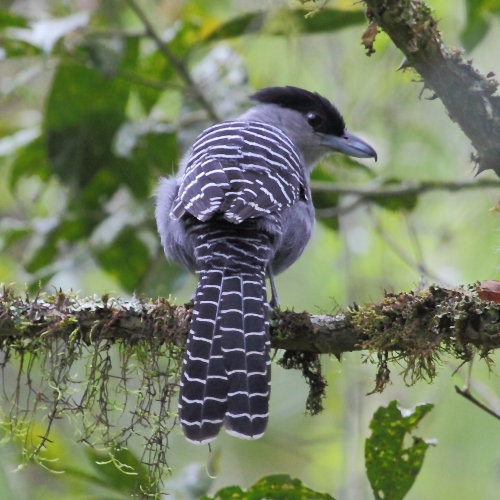
Streak-crowned Antvireo
Dysithamnus striaticeps
Order: Passeriformes / Family: Thamnophilidae

Wikimedia Commons
About the Streak-crowned Antvireo
The Streak-crowned Antvireo, or Dysithamnus striaticeps, is a small passerine bird belonging to the Thamnophilidae family. This bird is predominantly found in the humid lowland and montane forests of Central America, particularly from southern Mexico through Costa Rica and into western Panama. Its presence signifies a healthy forest ecosystem, as it plays a crucial role in insect population control and seed dispersal within these habitats.
This bird is often observed in the dense understory of primary and secondary forests, where it forages in mixed-species flocks. The Streak-crowned Antvireo is an insectivore, feeding primarily on a variety of arthropods. It employs a methodical foraging style, gleaning insects from leaves and branches, which helps maintain ecological balance in its habitat.
The ecological role of the Streak-crowned Antvireo is significant, as it participates in the complex food web of its forest environment. During the breeding season, often in the wet months, this bird becomes more solitary, focusing on nesting and raising its young. Outside the breeding season, it resumes its social foraging behavior, often accompanying other antbirds and insectivores in search of food. Observing the seasonal behaviors of the Streak-crowned Antvireo provides insights into the dynamics of tropical forest ecosystems and the interactions among various avian species.
The Streak-crowned Antvireo belongs to the family Thamnophilidae, within the order Passeriformes. These birds typically live average 4-7 years, with some individuals reaching up to 9 years..
How to Identify a Streak-crowned Antvireo
The Streak-crowned Antvireo is a small bird, measuring approximately 12 cm in length, with males and females exhibiting slight differences in plumage. Both sexes have a distinctive streaked crown, giving the species its name. The male typically has a more pronounced black streaking on its crown and upperparts, while the female may appear slightly duller with brownish tones.
Juveniles resemble the adults but usually show less defined streaking and a more subdued coloration overall. This species can be confused with similar antvireos, but the combination of its streaked crown, olive upperparts, and pale underparts helps in distinguishing it from others in its range.
In flight, the Streak-crowned Antvireo displays rapid, short bursts of flapping followed by brief glides. When perched, it often adopts a horizontal posture, moving deliberately as it scrutinizes its surroundings for prey.
Having trouble telling birds apart? Upload a photo to our bird identification tool for an instant species match.
Streak-crowned Antvireo Habitat and Range
Preferred Habitat
The Streak-crowned Antvireo inhabits humid lowland and montane forests, thriving in elevations ranging from sea level to about 2,000 meters. It favors dense understory environments, where it can find ample cover and food resources. Primary forests with mature trees and a well-developed understory are ideal habitats, but the bird can also persist in secondary forests and forest edges, provided the vegetation structure remains complex enough.
While predominantly a forest species, the Streak-crowned Antvireo occasionally ventures into adjacent shrublands and clearings with sufficient cover. It does not typically adapt well to urban settings, preferring the relative seclusion and continuity of forest habitats.
Geographic Range
The range of the Streak-crowned Antvireo extends from southern Mexico through Central America to western Panama. In Mexico, it is primarily found in the states of Chiapas and Oaxaca. The bird is relatively common in the cloud forests of Costa Rica and Panama, where it inhabits both the Pacific and Caribbean slopes.
The Streak-crowned Antvireo does not undertake long-distance migrations, but it may engage in altitudinal movements within its range, descending to lower elevations during cooler months. Population densities are highest in regions with extensive, uninterrupted tracts of mature forest, where the availability of food and nesting sites is greatest.
Want to know which birds visit your area? Browse our backyard birds by location guides for region-specific species lists.
What Does the Streak-crowned Antvireo Eat?
Primarily an insectivore, the Streak-crowned Antvireo feeds on a variety of arthropods, including beetles, spiders, and caterpillars. Its foraging technique involves meticulous gleaning from leaves, bark, and branches in the understory, a behavior that allows it to effectively capture prey hidden in foliage.
During times of food abundance, typically in the wet season, it may also consume small fruits and seeds, aiding in seed dispersal for certain plant species. This dietary shift underlines the bird's adaptability and its role in the forest ecosystem as both predator and disperser.
Streak-crowned Antvireo Behavior and Social Structure
The Streak-crowned Antvireo exhibits a range of behaviors that reflect its adaptation to a forest-dwelling lifestyle. It is generally seen alone or in pairs during the breeding season, becoming more sociable and joining mixed-species flocks during non-breeding periods. This social behavior facilitates more efficient foraging and provides increased vigilance against predators.
Territoriality is evident during the breeding season, with males defending their nesting areas through vocal displays and occasional physical confrontations. Courtship involves mutual preening and soft call exchanges between mates. The bird's response to predators includes a series of alarm calls and a tendency to freeze or remain motionless to avoid detection.
Daily activity patterns are characterized by periods of intense foraging in the early morning and late afternoon, with less activity during the hottest part of the day. This schedule maximizes foraging efficiency while minimizing exposure to midday heat.
Streak-crowned Antvireo Nesting and Reproduction
The nesting habits of the Streak-crowned Antvireo are closely tied to the vegetation structure of its forest habitat. It constructs a cup-shaped nest using materials such as leaves, twigs, and fibers, which are carefully woven and camouflaged within dense foliage. These nests are typically located at low heights, often less than two meters above the ground, in well-concealed spots.
A typical clutch consists of two to three eggs, with both parents sharing incubation duties that last approximately 14 days. After hatching, the young are fed and cared for by both adults, with fledging occurring around 12-15 days post-hatching. The species usually raises one brood per year, although favorable conditions may occasionally lead to a second.
Streak-crowned Antvireo Sounds and Vocalizations
The primary song of the Streak-crowned Antvireo is a series of sharp, high-pitched notes delivered in a rapid sequence, often described as a trilled 'tsee-tsee-tsee.' These songs serve both territorial and mate attraction purposes. In addition to its song, the bird emits various call notes, including soft 'chip' sounds used to maintain contact with its mate or other flock members.
Alarm calls are more intense and may include a rapid series of 'chit' sounds, signaling the presence of potential threats. During the dawn chorus, the Streak-crowned Antvireo's song can often be heard amidst the symphony of the forest, contributing to the rich acoustic environment of its habitat.
Interesting Facts About the Streak-crowned Antvireo
- 1The Streak-crowned Antvireo is often found in mixed-species flocks, which can include up to 30 different bird species.
- 2Unlike many other birds, both male and female Streak-crowned Antvireos contribute equally to incubating eggs and feeding chicks.
- 3Streak-crowned Antvireos can be quite elusive, often remaining hidden in dense foliage despite their close proximity.
- 4The species has adapted to elevations up to 2,000 meters, showcasing its versatility in varying forest environments.
- 5Its diet primarily consists of insects, but during the wet season, it will also consume small fruits, aiding in seed dispersal.
- 6The Streak-crowned Antvireo is an indicator species; its presence signals a well-preserved forest ecosystem.
- 7This bird's distinctive streaked crown allows for easy identification among the complex understory of its rainforest habitat.
Streak-crowned Antvireo Conservation Status
The International Union for Conservation of Nature (IUCN) currently lists the Streak-crowned Antvireo as a species of Least Concern, indicating that it is not immediately threatened with extinction. However, its population is suspected to be in decline due to habitat loss from deforestation and land conversion for agriculture and development. Conservation efforts aimed at preserving large tracts of continuous forest are crucial for maintaining healthy populations of this species. Protected areas and national parks in Central America serve as important refuges for the Streak-crowned Antvireo, helping to mitigate the impact of habitat fragmentation and degradation.