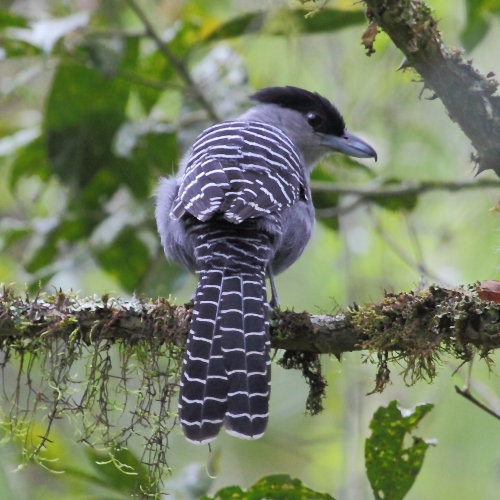
Streak-headed Antbird
Drymophila striaticeps
Order: Passeriformes / Family: Thamnophilidae

Wikimedia Commons
About the Streak-headed Antbird
The Streak-headed Antbird (Drymophila striaticeps) inhabits the dense undergrowth of montane forests in Central and South America, particularly in regions like Costa Rica and Panama. This bird is a member of the Thamnophilidae family, which comprises antbirds known for their insectivorous diet and preference for forested environments. The Streak-headed Antbird plays a significant ecological role as a predator of insects, contributing to the control of insect populations within its habitat. It often forages in mixed-species flocks, which enhances its feeding efficiency and decreases the likelihood of predation.
This species thrives in subtropical and tropical moist montane forests, where its streaked head and olive-brown plumage allow it to blend seamlessly into the leaf litter and forest floor. Such camouflage is essential for its survival, as it helps the bird avoid predators while it forages for insects among the underbrush. The Streak-headed Antbird is non-migratory, which means it remains in its preferred habitat year-round, taking advantage of the stable climate and abundant food supply that montane forests offer.
During the breeding season, the Streak-headed Antbird becomes more vocal, using its calls to establish territory and attract mates. This period is crucial for the continuation of its population, as it faces threats from habitat destruction due to deforestation and land conversion for agriculture. Conservation efforts in Central and South America focus on preserving the montane forest ecosystems that are vital not only for the Streak-headed Antbird but also for countless other species that share this habitat.
The Streak-headed Antbird belongs to the family Thamnophilidae, within the order Passeriformes. These birds typically live average 5-7 years with a max recorded of 9 years..
How to Identify a Streak-headed Antbird
Adult Streak-headed Antbirds are small songbirds characterized by their distinctive streaked head, lending the species its common name. The head features prominent white streaks against a dark background, providing a striking contrast that aids identification in the field. The rest of the plumage is primarily olive-brown, which assists in camouflage within the forest understory. Juveniles resemble adults but may exhibit less defined streaking on the head.
Males and females of the species display similar plumage, making visual sex differentiation challenging without close observation. However, behavioral cues during breeding season can assist in distinguishing between the sexes. In comparison to similar species, such as the Rufous-capped Antthrush, the Streak-headed Antbird is smaller and exhibits a more pronounced streak pattern on the head.
The flight silhouette of the Streak-headed Antbird is not commonly observed due to its preference for low, dense foliage. When perched, it maintains an upright posture, often flicking its wings and tail as a means of communication with conspecifics. This behavior is especially noticeable when the bird is agitated or in the presence of potential threats.
Having trouble telling birds apart? Upload a photo to our bird identification tool for an instant species match.
Streak-headed Antbird Habitat and Range
Preferred Habitat
The Streak-headed Antbird primarily inhabits subtropical and tropical moist montane forests, thriving in regions with dense understory growth. These forests provide the cover and food resources essential for its survival. In Costa Rica and Panama, the bird is commonly found at elevations ranging from 800 to 2500 meters, where the climate remains humid and relatively stable year-round.
Within these montane ecosystems, the Streak-headed Antbird favors areas with thick leaf litter and abundant insect life. Although it is primarily a forest-dwelling species, it may occasionally venture into adjacent secondary growth or disturbed areas if suitable cover is available. Unlike some bird species, it shows little preference for urban or suburban environments, as it relies heavily on the dense vegetation found in natural forest settings.
No significant seasonal habitat shifts are observed in the Streak-headed Antbird, as its habitat preferences align closely with the stable climatic conditions found in montane forests. Consequently, this species is considered a year-round resident in its range, benefiting from the consistent availability of food and shelter.
Geographic Range
The Streak-headed Antbird's range extends through parts of Central America, with a strong presence in countries such as Costa Rica and Panama. It occupies a relatively narrow altitudinal range, favoring the montane forests typical of these regions. Unlike many migratory birds, the Streak-headed Antbird is a sedentary species, meaning it does not undertake long-distance migrations.
In Costa Rica, the bird is found predominantly in the central and southern mountain ranges, where the forested terrain provides ideal living conditions. Similarly, in Panama, the species thrives in the highland areas, particularly within protected reserves such as La Amistad International Park, which straddles the border between Costa Rica and Panama.
The population density of the Streak-headed Antbird is highest in regions with extensive forest cover and minimal human disturbance. While the bird is not considered rare within its range, habitat fragmentation and deforestation pose ongoing threats to its population stability. Conservation efforts in these areas aim to maintain forest habitats and ensure the long-term survival of this and other forest-dependent species.
Want to know which birds visit your area? Browse our backyard birds by location guides for region-specific species lists.
What Does the Streak-headed Antbird Eat?
The diet of the Streak-headed Antbird centers primarily on insects, which it gleans from the forest floor and undergrowth. Its foraging behavior is characterized by a methodical search through leaf litter and vegetation, where it uses its bill to probe and pick prey items. This antbird's diet includes a variety of insect types, such as ants, beetles, and caterpillars, reflecting the abundance and diversity of insect life in its montane forest habitat.
Seasonal changes in diet are minimal due to the consistent availability of insects in its tropical environment. However, the Streak-headed Antbird may adjust its foraging strategy in response to fluctuations in insect populations, shifting focus to different prey types as necessary.
The bird typically forages in the early morning and late afternoon when insects are most active, although it may also feed opportunistically throughout the day. By foraging in mixed-species flocks, the Streak-headed Antbird benefits from increased efficiency in locating prey and reduced competition, as well as enhanced protection from predators.
Streak-headed Antbird Behavior and Social Structure
The Streak-headed Antbird exhibits a complex social structure, often participating in mixed-species flocks that provide benefits such as increased foraging efficiency and predator avoidance. Within these flocks, the antbird maintains a degree of territoriality, using vocalizations to assert its presence and ward off intruders.
During the breeding season, male Streak-headed Antbirds engage in courtship displays that involve vocalizations and physical posturing to attract mates. Once paired, the birds exhibit a strong bond, cooperating in nest building and chick rearing. The territorial behavior intensifies during this period, with both males and females actively defending their nesting area from potential threats.
The species displays a diurnal activity pattern, with peak activity during the cooler hours of the day. In response to predators, the Streak-headed Antbird employs a variety of strategies, including remaining motionless to utilize its camouflage or joining mixed-species flocks, which offer safety in numbers. Such behaviors highlight the adaptability and resourcefulness of this small songbird in its forest environment.
Streak-headed Antbird Nesting and Reproduction
The nesting habits of the Streak-headed Antbird involve constructing a cup-shaped nest placed strategically in dense vegetation or low shrubs. The nest is typically made from plant fibers, leaves, and twigs, providing a secure and camouflaged environment for the eggs and nestlings.
The female lays a clutch of two to three eggs, which undergo an incubation period of approximately 14 to 16 days. Both parents share incubation duties, ensuring the eggs remain at a stable temperature and are protected from predators. Once hatched, the chicks rely on parental care for food and protection, with both male and female contributing to feeding and tending to the young.
Fledging occurs after about 12 to 14 days, with the chicks leaving the nest but remaining under parental supervision as they learn to forage and navigate the forest. The Streak-headed Antbird typically raises one brood per year, although in optimal conditions, a second brood may be attempted. This breeding strategy reflects the balance between resource availability and predation risks in its montane forest habitat.
Streak-headed Antbird Sounds and Vocalizations
The primary song of the Streak-headed Antbird is a series of short, sharp notes delivered in rapid succession. This song serves as both a territorial marker and a means of attracting mates during the breeding season. The rhythm of the song is steady and deliberate, with a pitch that is generally high and clear.
In addition to its song, the Streak-headed Antbird produces a variety of call notes used for communication within flocks. These calls are often softer and less structured than the primary song but are essential for maintaining contact with other flock members.
Alarm calls are more abrupt and harsher, designed to alert conspecifics to the presence of potential threats. During the dawn chorus, the Streak-headed Antbird contributes its voice to the cacophony of the forest, signaling its presence and reinforcing its territorial boundaries. The vocalizations of this antbird are distinctive, yet they blend harmoniously into the complex soundscape of the montane forest environment.
Interesting Facts About the Streak-headed Antbird
- 1The Streak-headed Antbird often forages in mixed-species flocks, benefiting from increased efficiency and reduced predation risk.
- 2This bird is named for the distinct streaks on its head, which contrast sharply with its olive-brown body, making it a unique sight in the forest.
- 3Despite its small size, the Streak-headed Antbird plays a crucial role in controlling insect populations, acting as a natural pest manager.
- 4Unlike many bird species, the Streak-headed Antbird is non-migratory, remaining in its montane forest habitat year-round.
- 5The species primarily inhabits elevations between 800 and 2500 meters, where the climate provides consistent living conditions.
- 6Streak-headed Antbirds participate in a dawn chorus, adding their voices to the symphony of the montane forest each morning.
- 7Both male and female Streak-headed Antbirds share responsibilities in nest building, incubation, and chick rearing, demonstrating strong parental cooperation.
Streak-headed Antbird Conservation Status
The IUCN currently classifies the Streak-headed Antbird as a species of Least Concern, reflecting its relatively stable population numbers across its range. However, ongoing habitat destruction due to deforestation and land conversion poses significant threats to its long-term survival. Conservation efforts focus on preserving the montane forest habitats that are crucial for the Streak-headed Antbird and many other species. Protected areas in Costa Rica and Panama, such as La Amistad International Park, play a vital role in safeguarding these ecosystems. Despite its current status, the Streak-headed Antbird's population could face declines if habitat loss continues unchecked. Historical population changes are difficult to quantify, but maintaining habitat integrity is essential for ensuring the species' future stability. Conservationists advocate for sustainable land-use practices and the expansion of protected areas to mitigate the impact of human activities on this and other forest-dependent species.