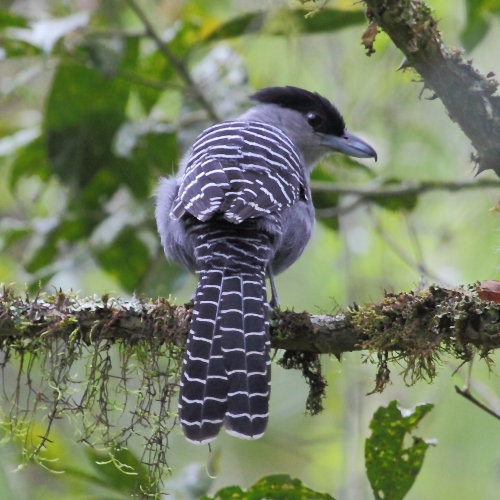
Stripe-chested Antwren
Myrmotherula longicauda
Order: Passeriformes / Family: Thamnophilidae

Wikimedia Commons
About the Stripe-chested Antwren
The Stripe-chested Antwren, scientifically known as Myrmotherula longicauda, is a small passerine bird that inhabits the dense understory of tropical lowland forests in South America. This species is particularly prevalent throughout the western Amazon Basin, including regions in Peru, Brazil, and Bolivia. The Stripe-chested Antwren plays a vital ecological role as an insectivore, contributing to the control of insect populations within its habitat. Its presence is often a reliable indicator of forest health, as it thrives in undisturbed, primary forests. During the breeding season, which coincides with the rainy months, males become vocal and territorial, defending their chosen patch of forest from rivals. The Stripe-chested Antwren is an essential part of the Thamnophilidae family, known for their specialization in ant-following behavior, although this particular species does not rely exclusively on this strategy. Instead, it forages independently or in mixed-species flocks, showcasing its adaptability within its ecological niche. The bird's striking plumage and distinctive vocalizations make it a favorite among birdwatchers and researchers alike, who seek to understand its role in the broader ecosystem of the Neotropical forests. As deforestation continues to threaten many parts of its range, understanding the Stripe-chested Antwren's habits and needs becomes increasingly crucial for conservation efforts. The bird's seasonal movements are minimal, as it remains largely sedentary, though slight altitudinal shifts may occur in response to food availability or habitat changes.
The Stripe-chested Antwren belongs to the family Thamnophilidae, within the order Passeriformes. These birds typically live average 3-4 years, with a maximum recorded of 5 years..
How to Identify a Stripe-chested Antwren
Adult Stripe-chested Antwrens are small, approximately 10 cm in length, with a distinctive black-and-white striped pattern across their chest, which is more pronounced in males. Females, while also striped, exhibit a slightly more subdued coloration, blending with the forest understory. Juveniles resemble adults but tend to have less well-defined stripes and a more muted plumage overall. In flight, the Stripe-chested Antwren displays a short, rounded wing shape, aiding its agility through dense vegetation. Perching usually occurs on thin branches, where its posture is upright, allowing for quick movements as it hunts insects. The bird's plumage can sometimes be confused with similar species like the Dot-winged Antwren, but the latter lacks the prominent chest striping and exhibits different wing markings. Careful observation of chest patterns and vocalizations can help distinguish these species in the field.
Having trouble telling birds apart? Upload a photo to our bird identification tool for an instant species match.
Stripe-chested Antwren Habitat and Range
Preferred Habitat
The Stripe-chested Antwren inhabits primary and secondary lowland tropical forests, favoring areas with dense understory and ample leaf litter. It is typically found at elevations up to 1,200 meters, although it mostly prefers lower altitudes. Within these forests, it occupies a niche that involves foraging close to the ground, often in tangles of vines and dense thickets. Seasonal habitat shifts are minimal, but the bird may move slightly to higher elevations or more secluded areas during non-breeding months. While it is not commonly found in urban areas, the Stripe-chested Antwren can occasionally be spotted in forest fragments near rural plantations, especially where secondary growth provides suitable cover and foraging opportunities.
Geographic Range
The Stripe-chested Antwren's range is primarily confined to the western Amazon Basin, with significant populations in the Amazonian regions of Peru, western Brazil, and northern Bolivia. Its distribution is relatively localized compared to some other antbird species, as it tends to avoid heavily disturbed or fragmented landscapes. The bird does not exhibit long-distance migrations, remaining largely resident within its preferred range. However, some local movements may occur, especially in response to changes in food availability or habitat conditions. Population densities are generally higher in undisturbed forests, where the complex understory provides abundant foraging opportunities and nesting sites.
Want to know which birds visit your area? Browse our backyard birds by location guides for region-specific species lists.
What Does the Stripe-chested Antwren Eat?
The Stripe-chested Antwren primarily feeds on a diet of small insects and arthropods, including beetles, ants, and spiders. Its foraging technique involves active gleaning from foliage and probing into crevices, demonstrating agility and precision. During the wet season, when insect abundance peaks, the antwren may expand its diet to include larger prey items, adapting its hunting strategy accordingly. The bird typically forages alone or in pairs, although it may join mixed-species flocks to exploit diverse insect populations more efficiently. Feeding occurs throughout the day, with peak activity during the morning and late afternoon when temperatures are cooler and prey is more active.
Stripe-chested Antwren Behavior and Social Structure
The Stripe-chested Antwren exhibits territorial behavior, particularly during the breeding season when males become more vocal and aggressive in defending their territory. Courtship displays involve both visual and vocal elements, with males showcasing their striped chests in a series of hops and wing flutters. Socially, this species is often seen in pairs but may join mixed-species flocks to enhance foraging success. When threatened by predators, the antwren relies on its cryptic plumage and swift movements through dense undergrowth to evade detection. Its daily activity pattern is typically diurnal, with periods of intense foraging interspersed with rest and preening.
Stripe-chested Antwren Nesting and Reproduction
Stripe-chested Antwrens construct cup-shaped nests using leaves, grasses, and spider silk, typically placing them in low shrubs or small trees, well-concealed within the understory. The clutch size generally consists of two eggs, with both parents sharing incubation duties over a period of approximately 14 days. After hatching, the nestlings are fed and cared for by both parents, who continue to provide food until the young fledge about 10 to 12 days post-hatching. The species usually raises one brood per year, timed to coincide with peak insect abundance during the rainy season, ensuring ample food supply for the growing chicks.
Stripe-chested Antwren Sounds and Vocalizations
The primary song of the Stripe-chested Antwren is a series of rapid, high-pitched notes that resemble a soft trill, often delivered from a concealed perch within the forest understory. This song serves as both a territorial declaration and a mate attraction call. Additionally, the bird emits call notes described as sharp 'tick' sounds, used to maintain contact between pairs or convey alarm. During the dawn chorus, its distinctive song can be heard echoing through the forest, adding to the rich soundscape of tropical birdlife. Compared to some other antwrens, its vocalizations are less varied but no less significant in communication.
Interesting Facts About the Stripe-chested Antwren
- 1The Stripe-chested Antwren measures about 10 cm, making it one of the smaller members of the Thamnophilidae family.
- 2Unlike some ants following antbirds, the Stripe-chested Antwren often forages independently or in small mixed-species flocks.
- 3This antwren's striped chest helps it blend into the dappled light and shadows of the forest understory, offering camouflage from predators.
- 4Myrmotherula longicauda can be distinguished from similar species by its distinctive, rapid song, which is often one of the first clues to its presence.
- 5The Stripe-chested Antwren plays a critical role in the ecosystem by controlling insect populations, thus maintaining a balanced food web.
- 6Despite its small size, this bird exhibits a strong territorial instinct, particularly during the breeding season when males sing frequently.
- 7The bird's preference for dense, humid forests makes it an excellent indicator species for the health of tropical ecosystems.
Stripe-chested Antwren Conservation Status
The Stripe-chested Antwren is currently listed as Least Concern by the IUCN, although its population is suspected to be declining due to habitat loss, primarily from deforestation and land conversion for agriculture. Conservation efforts focus on preserving large tracts of primary forest, which are critical for maintaining viable populations. Historically, this species has been relatively stable, but ongoing threats necessitate continued monitoring and habitat protection to ensure its long-term survival. Advocacy for sustainable land use practices in the Amazon Basin remains a priority for conservationists aiming to protect this and other forest-dependent species.