Todd's Antwren
Herpsilochmus stictocephalus
Order: Passeriformes / Family: Thamnophilidae

Wikimedia Commons
About the Todd's Antwren
Todd's Antwren, scientifically known as Herpsilochmus stictocephalus, is a small passerine bird found predominantly in the tropical forests of South America. This species belongs to the family Thamnophilidae, a group known for their adaptability to dense forest understories. Todd's Antwren plays a significant ecological role as an insectivore, helping to control insect populations in its native habitats. Its presence in the forest understory contributes to the complex food web and aids in maintaining the health of the ecosystem.
Unlike many other bird species, Todd's Antwren does not migrate, instead residing year-round in its habitat. It is primarily found in the Amazon Basin, with significant populations in countries like Brazil, Venezuela, and Colombia. These regions provide the dense forest canopy and diverse insect population that Todd's Antwren requires for survival. The bird's resilience to habitat changes has allowed it to maintain stable populations despite the deforestation challenges facing the Amazon.
Todd's Antwren is known for its vocal activity, particularly during the breeding season. Males often engage in vocal duets with females, a behavior that strengthens pair bonds and plays a crucial role in territory defense. Their song, a series of high-pitched notes, is a common sound in the rainforest, particularly during the early morning hours. The ecological importance of Todd's Antwren extends beyond its dietary habits, as its presence can be an indicator of forest health.
The species thrives in lowland tropical forests, particularly those with dense foliage and abundant insect life. Todd's Antwren often participates in mixed-species foraging flocks, a behavior that enhances foraging efficiency and provides protection from predators. Its adaptability and ecological role make Todd's Antwren a valuable species for studying rainforest ecosystems and their complex interdependencies.
The Todd's Antwren belongs to the family Thamnophilidae, within the order Passeriformes. These birds typically live average 5 years with a max recorded of 7 years..
How to Identify a Todd's Antwren
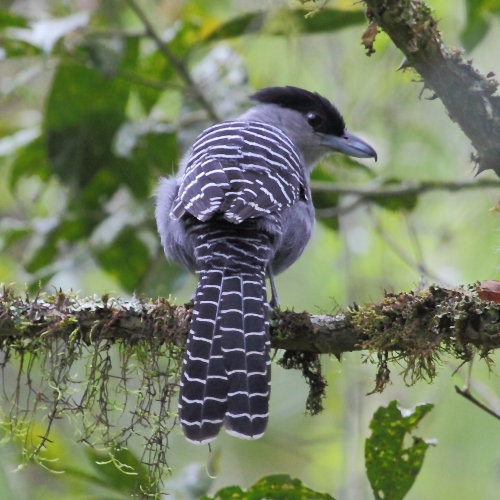
Todd's Antwren is a small bird, measuring about 11-12 cm in length. The adult male can be identified by its striking black-and-white head pattern, with black streaks on a white background on the crown and nape. The underparts are generally gray, while the wings are black with two white wing bars. Females, meanwhile, exhibit a slightly more subdued coloration with brownish tones replacing some of the black areas seen in males.
Juveniles resemble females but exhibit even duller plumage, lacking the crisp contrasts seen in adult males. This plumage variation aids in differentiating between age groups within the species. In flight, Todd's Antwren shows a rapid wingbeat and a characteristic fluttering flight pattern, making it distinguishable from other sympatric species.
Birders may confuse Todd's Antwren with other black-and-white antwrens, such as the White-flanked Antwren, but the distinct head pattern and habitat preferences often provide the necessary clues for accurate identification. Its perching posture, often horizontal with a slightly cocked tail, is another field mark that experienced birders use to identify this species.
Having trouble telling birds apart? Upload a photo to our bird identification tool for an instant species match.
Todd's Antwren Habitat and Range
Preferred Habitat
Todd's Antwren is predominantly found in lowland tropical forests, particularly within the Amazon Basin. It favors dense understory vegetation, often near water bodies, where it can forage effectively. The bird thrives at elevations up to 500 meters, rarely venturing into higher mountain forests.
Unlike some other antwrens, Todd's Antwren does not show significant seasonal habitat shifts. It remains in the same general area year-round, taking advantage of the consistent climate and food availability. While deforestation poses a threat, the species has shown adaptability by utilizing secondary growth forests when primary forests are unavailable.
In urban areas, Todd's Antwren is rarely spotted, as it prefers the undisturbed forest environment. However, in rural settings adjacent to forested areas, it can sometimes be observed, particularly in regions where forest edges meet agricultural lands.
Geographic Range
Todd's Antwren is primarily found in the northern part of South America, with its range extending across several countries. Its breeding range includes Brazil, Venezuela, Colombia, and parts of Guyana, Suriname, and French Guiana. The species does not undertake long-distance migrations, remaining within its breeding territories throughout the year.
Within these regions, the highest population densities occur in the Amazon rainforest, where the habitat provides optimal conditions for feeding and breeding. Significant populations have also been recorded in the Orinoco Basin in Venezuela and Colombia, highlighting the species' preference for humid lowland forests.
Due to its non-migratory nature, Todd's Antwren does not utilize specific migration corridors, unlike many other passerines. This sedentary behavior necessitates stable local environments for population maintenance, making habitat conservation critical for the species' survival.
Want to know which birds visit your area? Browse our backyard birds by location guides for region-specific species lists.
What Does the Todd's Antwren Eat?
Todd's Antwren primarily feeds on insects and other small arthropods, which it gleans from leaves and branches in the forest understory. Its diet includes ants, beetles, caterpillars, and spiders, making it an important pest control agent in its ecosystem.
Seasonal changes in insect abundance can influence its diet composition, with the bird exhibiting flexibility in prey selection based on availability. During the wet season, when insect populations peak, Todd's Antwren may focus on specific prey types that are more abundant.
The bird employs a foraging technique known as 'gleaning,' where it carefully picks insects from the foliage. It often participates in mixed-species flocks, which increases foraging efficiency and reduces the risk of predation. Todd's Antwren forages throughout the day, with peak activity observed during the cooler morning hours.
Todd's Antwren Behavior and Social Structure
Todd's Antwren exhibits a range of interesting behaviors, particularly in its social structure and territoriality. The bird is generally found in pairs or small family groups, maintaining territories within its dense forest habitat. Males play a significant role in territory defense, often using their distinctive song to ward off intruders and communicate with their mates.
Courtship displays in Todd's Antwren involve vocal duets, where males and females sing together, strengthening their pair bonds. This behavior is particularly prominent during the breeding season when establishing and maintaining territories is crucial.
The species is not highly social outside of the breeding pairs, but it does participate in mixed-species foraging flocks. This behavior provides safety in numbers from predators and enhances foraging success. Daily activity patterns include active foraging during the cooler morning and late afternoon hours, with a period of reduced activity during the heat of midday.
Todd's Antwren Nesting and Reproduction
Todd's Antwren constructs a small, cup-shaped nest made from fine plant materials, such as grasses and spider silk. The nest is typically situated low in the underbrush, often just 1-2 meters above the ground, providing concealment from predators.
The female lays a clutch of two to three eggs, which are incubated by both parents. The incubation period lasts about 14 days, during which the parents take turns keeping the eggs warm and safe. Once hatched, the chicks are altricial, meaning they are born relatively undeveloped and dependent on parental care.
Both male and female Todd's Antwrens participate in feeding and caring for the young. The fledging period lasts approximately 12-15 days, after which the chicks leave the nest, though they remain dependent on their parents for some time. The species typically raises one brood per year, with breeding synchronized with the peak of insect abundance to ensure food availability for the growing chicks.
Todd's Antwren Sounds and Vocalizations
The primary song of Todd's Antwren is a series of high-pitched, rapid notes that rise and fall in pitch, resembling a quiet trill. This song is often delivered during the early morning hours and serves as a territorial and mate-attraction signal.
Call notes include sharp 'chip' sounds used for communication between mates and to maintain contact during foraging. In response to threats, Todd's Antwren emits a short, harsh alarm call that alerts nearby birds to the presence of predators.
During the dawn chorus, the song of Todd's Antwren stands out with its distinct rhythm and quality, providing a backdrop to the symphony of the rainforest. Its vocalizations are reminiscent of other antwrens but are distinguishable by slight variations in pitch and cadence.
Interesting Facts About the Todd's Antwren
- 1Todd's Antwren can be seen in mixed-species foraging flocks, a strategy that increases foraging success and reduces predation risk.
- 2Despite its small size, Todd's Antwren plays a crucial role in pest control by feeding on insects like ants and beetles.
- 3The species is named after W. E. Clyde Todd, an American ornithologist known for his work on South American birds.
- 4Todd's Antwren exhibits a unique duet singing behavior, where pairs sing together to strengthen bonds and defend territories.
- 5The bird's distinctive black-and-white head pattern makes it relatively easy to identify in its forest habitat, even for novice birders.
- 6Todd's Antwren remains in its tropical habitat year-round, showcasing its adaptability to the stable climate of the Amazon Basin.
- 7While Todd's Antwren is non-migratory, changes in local insect populations can influence its foraging behavior seasonally.
Todd's Antwren Conservation Status
Todd's Antwren is currently classified as Least Concern by the IUCN, with stable population trends reported across its range. However, habitat destruction, particularly deforestation in the Amazon Basin, poses a significant threat to its long-term survival. The primary threats include logging, agriculture, and infrastructure development, leading to habitat fragmentation. Conservation efforts focus on preserving large tracts of continuous forest and implementing sustainable land-use practices. Historical population changes are not well-documented, but recent deforestation rates highlight the need for ongoing monitoring and habitat protection. Conservation organizations stress the importance of maintaining the ecological integrity of tropical forests to ensure the survival of Todd's Antwren and other forest-dependent species.