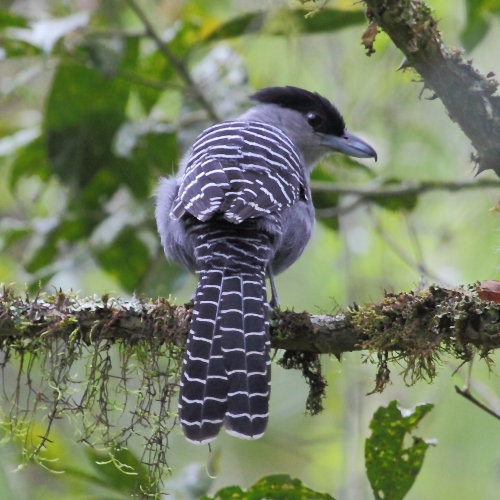
Tufted Antshrike
Mackenziaena severa
Order: Passeriformes / Family: Thamnophilidae

Wikimedia Commons
About the Tufted Antshrike
The Tufted Antshrike (Mackenziaena severa) stands out as a remarkable member of the antbird family, Thamnophilidae, primarily inhabiting the dense forests of South America. This bird is notable for its pronounced crest and bold black plumage that offer a striking contrast in its verdant environment. Found predominantly in the Atlantic Forest biome, it thrives in the subtropical and tropical moist lowland and montane forests across countries such as Brazil, Paraguay, and northeastern Argentina. The ecological role of the Tufted Antshrike is significant, as it serves as both a predator of insects and a prey species for larger birds of prey. Its primary habitat, the Atlantic Forest, is a biodiversity hotspot, underscoring the antshrike's importance as a bioindicator for the health of these ecosystems. The Tufted Antshrike is non-migratory, maintaining a year-round presence in its native range. However, breeding activities tend to peak in the wet season when insect populations, its primary food source, are most abundant. During this period, it becomes particularly vocal, using its distinctive calls to assert territories and attract mates. As a result of habitat destruction from logging and agricultural expansion, the Tufted Antshrike faces challenges to its population stability, although it currently maintains a status of Least Concern on the IUCN Red List. Despite these pressures, it remains a critical component of its ecosystem, contributing to insect population control and participating in the intricate web of forest biodiversity.
The Tufted Antshrike belongs to the family Thamnophilidae, within the order Passeriformes. These birds typically live average of 5 years with a maximum recorded of 8 years..
How to Identify a Tufted Antshrike
Identifying the Tufted Antshrike relies on its unique combination of field marks that make it a standout species. Adult males display striking black plumage with a prominent crest, giving them a regal appearance. The females, while similar in form, possess a slightly browner hue, allowing for sexual dimorphism recognition. Juveniles resemble females but often have more muted tones until they mature. The Tufted Antshrike's silhouette in flight is fairly compact, with rounded wings and a moderately long tail, aiding in its agile navigation through dense foliage. When perched, the antshrike's posture is upright, often showcasing its crest prominently, especially during displays of territoriality or courtship. Confusion with other antbirds is possible, but the prominent crest and overall size help distinguish it from similar species. Additionally, its habitat preferences can aid in identification, as it is less likely to be found in areas where other antshrikes, such as the more common Barred Antshrike, might frequent.
Having trouble telling birds apart? Upload a photo to our bird identification tool for an instant species match.
Tufted Antshrike Habitat and Range
Preferred Habitat
The Tufted Antshrike inhabits the lush and diverse environments of tropical and subtropical forests, particularly favoring the Atlantic Forest. This biome provides the dense understory and canopy cover essential for its foraging and nesting activities. Typically found at elevations ranging from sea level to about 1,200 meters, it thrives in both lowland and montane forests. Within these habitats, the Tufted Antshrike prefers areas with dense foliage, often near watercourses where insect activity is high. Unlike some bird species, it does not frequently venture into urban areas, as it relies heavily on the intact forest structure for its ecological needs. Seasonal shifts in habitat are minimal, given its non-migratory nature, but it may move to higher elevations during wetter months when food resources become more plentiful.
Geographic Range
The range of the Tufted Antshrike is confined to the Atlantic Forest region of South America, encompassing parts of southeastern Brazil, eastern Paraguay, and northeastern Argentina. Within these countries, it is most commonly found in the states of São Paulo, Rio de Janeiro, and Minas Gerais in Brazil, as well as the Misiones Province in Argentina. While its population density is highest in these core areas, the bird's presence is dispersed across suitable forest habitats within its range. Being a non-migratory species, the Tufted Antshrike does not undertake long-distance movements, instead maintaining territories year-round. This stability in range is both a benefit and a vulnerability, as habitat changes in these regions can have immediate impacts on its population.
Want to know which birds visit your area? Browse our backyard birds by location guides for region-specific species lists.
What Does the Tufted Antshrike Eat?
The diet of the Tufted Antshrike primarily consists of insects and other small arthropods, reflecting its role as an insectivore within its ecosystem. It actively forages in the understory and mid-levels of the forest, employing a methodical approach to uncover prey hiding beneath leaves or within the leaf litter. This antshrike is known to follow army ant swarms, taking advantage of the insects flushed out by the activity of the ants. Its prey includes beetles, spiders, and caterpillars, with size varying from small to medium depending on the availability. While insects form the bulk of its diet year-round, during the breeding season, the increased insect activity supports a more abundant and diverse dietary intake. Feeding generally occurs during daylight hours, peaking in the cooler morning and late afternoon periods.
Tufted Antshrike Behavior and Social Structure
The Tufted Antshrike exhibits a fascinating range of behaviors that underline its adaptability and ecological niche. It is predominantly a solitary bird outside of the breeding season, displaying strong territorial instincts. These territories are often marked by vocalizations and visual displays, particularly the raising of its crest. Courtship involves a combination of song and physical displays, with males showcasing their crest to attract a mate. Tufted Antshrikes are also known for their monogamous pair bonds, at least for the duration of a breeding season. Their response to predators can be quite aggressive, with alarm calls alerting mates and even neighboring birds to potential threats. Despite their solitary nature, they may join mixed-species flocks, particularly outside of the breeding season, as a strategy to enhance foraging efficiency and predator detection.
Tufted Antshrike Nesting and Reproduction
The nesting habits of the Tufted Antshrike are a marvel of avian architecture and parental care. Nests are typically cup-shaped, constructed with fine plant fibers, leaves, and sometimes embellished with spider silk to bind the materials. These nests are strategically placed low in dense shrubs or small trees, providing cover from predators and harsh weather. The typical clutch size consists of two eggs, which are incubated for approximately two weeks. Both parents play roles in incubation and feeding, showcasing a high degree of parental cooperation. After hatching, the fledglings remain in the nest for another two weeks before they are ready to venture out, though they often stay with their parents for some time to learn foraging skills. The Tufted Antshrike usually raises one brood per year, aligning the breeding season with periods of high insect availability.
Tufted Antshrike Sounds and Vocalizations
The vocalizations of the Tufted Antshrike are as distinctive as its appearance, featuring a series of sharp, repetitive notes that carry through the dense forest. The primary song consists of a rapid sequence of 'chip-chip-chip' sounds, delivered with increasing urgency and volume. These calls serve both territorial and mate-attraction purposes. In addition to its main song, the Tufted Antshrike uses a variety of call notes, including softer 'churr' sounds when in close contact with a mate or fledglings. Alarm calls are harsher and more abrupt, intended to alert others of potential threats. During the dawn chorus, its calls are a prominent feature, marking the beginning of daily activities and establishing its presence within the territory.
Interesting Facts About the Tufted Antshrike
- 1The Tufted Antshrike is named for its prominent crest, which it uses in displays of aggression and courtship.
- 2Unlike many birds, the Tufted Antshrike does not migrate, instead maintaining territories in the same forest regions year-round.
- 3Tufted Antshrikes often follow army ant swarms, taking advantage of insects flushed out by the ants' activity.
- 4The Atlantic Forest, home to the Tufted Antshrike, is one of the most diverse yet threatened ecosystems in the world.
- 5Despite their bold appearance, Tufted Antshrikes are often heard before they are seen, thanks to their distinctive calls.
- 6Tufted Antshrikes are known to join mixed-species flocks, enhancing their foraging success and predator awareness.
- 7Their nesting strategy involves both parents equally in incubation and feeding, showcasing notable parental cooperation.
Tufted Antshrike Conservation Status
As of the latest assessments, the Tufted Antshrike is listed as Least Concern by the IUCN. However, its population is experiencing pressures from habitat loss due to deforestation and agricultural encroachment in the Atlantic Forest. Conservation efforts focus on preserving its natural habitat through protected areas and reforestation projects. Historically, the population has remained relatively stable, but continued habitat degradation poses a long-term threat. Efforts by local and international conservation groups aim to mitigate these impacts by promoting sustainable land-use practices and enhancing the ecological value of remaining forest patches.