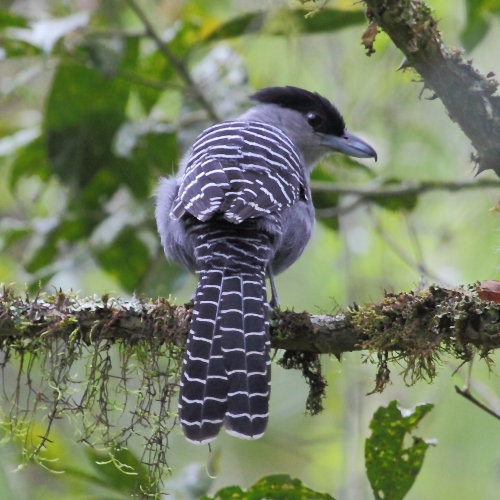
Unicolored Antwren
Myrmotherula unicolor
Order: Passeriformes / Family: Thamnophilidae

Wikimedia Commons
About the Unicolored Antwren
The Unicolored Antwren, Myrmotherula unicolor, is a small bird endemic to the dense and vibrant tropical forests of South America. This species primarily inhabits the understory of Amazonian rainforests, where its subtle gray plumage provides excellent camouflage among the shadows and foliage. The bird is widely distributed across countries like Brazil, Peru, and Colombia, particularly favoring areas with thick, tangled vegetation that offer both shelter and ample foraging opportunities. As a member of the Thamnophilidae family, the Unicolored Antwren plays a crucial role in maintaining the health of its ecosystem by controlling insect populations. It often engages in mixed-species flocks, which enhances its foraging efficiency and adds a layer of security against predators. Seasonally, this bird exhibits slight altitudinal movements, primarily in response to food availability rather than strict migratory patterns. As insects become scarcer in the higher canopy during the rainy season, the Unicolored Antwren descends to the denser understory, where it can continue its relentless search for small arthropods. This seasonal shift underscores its adaptability and the complex dynamics of tropical rainforest ecosystems. The Unicolored Antwren's ecological role extends beyond its immediate interactions with prey and predators. By participating in flock dynamics, it indirectly influences the behavior and distribution of other species, contributing to the intricate web of life that characterizes these biodiverse regions. Its presence can also serve as an indicator of forest health, as this bird is sensitive to changes in habitat structure and quality. Conservationists regard the Unicolored Antwren as a species of interest for monitoring the impacts of deforestation and habitat fragmentation, particularly in the Amazon Basin. In summary, the Unicolored Antwren is more than just a subtle presence in its lush surroundings. It embodies the interplay of survival, adaptation, and ecological balance within some of the planet's most complex and threatened environments.
The Unicolored Antwren belongs to the family Thamnophilidae, within the order Passeriformes. These birds typically live 3-5 years, with max recorded at 6 years.
How to Identify a Unicolored Antwren
The Unicolored Antwren is a small bird, measuring approximately 9 to 10 centimeters in length, with a wingspan of around 15 centimeters. Adult males are predominantly gray, providing them excellent camouflage against the forest understory. Females, while also gray, often display subtle brownish tones that can help in distinguishing them from their male counterparts. Juveniles resemble females but tend to have a slightly softer plumage texture. One of the key identification features of the Unicolored Antwren is its slender, pointed bill, which is well-adapted for gleaning insects from leaves and branches. When perched, this antwren often displays a characteristic posture with slightly drooped wings and a cocked tail, which aids in recognizing it among mixed-species flocks. In flight, the Unicolored Antwren exhibits a rapid and direct movement, with short bursts of wing beats, typical of small forest-dwelling birds. This flight pattern, combined with its overall gray appearance, helps differentiate it from similar species like the White-flanked Antwren or the Long-winged Antwren, which have distinctive wing markings or longer wings, respectively. Observers should note the bird's preference for staying within dense vegetation, where it can easily go unnoticed due to its muted coloration and secretive habits.
Having trouble telling birds apart? Upload a photo to our bird identification tool for an instant species match.
Unicolored Antwren Habitat and Range
Preferred Habitat
The Unicolored Antwren thrives in the dense, humid environments of tropical lowland rainforests, particularly within the Amazon Basin. It prefers the understory layer, which provides ample cover and abundant insect prey. This bird is typically found at elevations ranging from sea level to approximately 1,000 meters. While primarily associated with primary forests, the Unicolored Antwren can also adapt to secondary growth areas, provided there is sufficient dense vegetation. During the dry season, it may venture slightly into more open forest edges but generally avoids urban areas and heavily degraded habitats. Unlike some species that adapt well to human-altered landscapes, the Unicolored Antwren remains closely tied to its natural environment, underscoring the importance of preserving intact forest ecosystems for its continued survival.
Geographic Range
The Unicolored Antwren is native to South America, with its range primarily encompassing the Amazon Basin. It is found in several countries, including Brazil, Peru, Colombia, Ecuador, and parts of Venezuela. This bird does not engage in long-distance migration but may exhibit local movements within its range in response to seasonal changes in food availability. The Amazon rainforest serves as the primary habitat for the Unicolored Antwren, but it is also occasionally spotted in the southern portions of the Guiana Shield. Population densities tend to be higher in areas with well-preserved forest cover, such as the central Amazon and the western Amazonian regions, where habitat conditions remain optimal. In regions where deforestation and habitat fragmentation are prevalent, the Unicolored Antwren's presence becomes increasingly sparse, highlighting the species' reliance on large, contiguous forest landscapes.
Want to know which birds visit your area? Browse our backyard birds by location guides for region-specific species lists.
What Does the Unicolored Antwren Eat?
The Unicolored Antwren primarily feeds on insects and other small arthropods, making it an essential component in controlling insect populations within its ecosystem. Its diet includes a variety of prey items such as ants, beetles, spiders, and caterpillars. During the wet season, when insects are more abundant, the antwren may expand its diet to include small fruits or seeds, although this is not a significant part of its nutritional intake. The bird employs a methodical foraging technique, carefully gleaning insects from leaves, branches, and twigs in the understory. It often joins mixed-species flocks, which not only increases its foraging efficiency but also reduces the risk of predation. By participating in these flocks, the Unicolored Antwren benefits from the vigilance of other bird species, allowing it to focus more intently on its search for food. This collaborative foraging strategy is particularly crucial during the dry season when insect prey becomes less available and competition for resources intensifies.
Unicolored Antwren Behavior and Social Structure
The Unicolored Antwren exhibits a predominantly solitary or pair-based lifestyle, with notable exceptions during foraging. It frequently participates in mixed-species flocks, where it interacts with other small insectivorous birds, such as flycatchers and warblers. This behavior not only enhances its ability to find food but also provides safety in numbers against potential predators. Territorial behavior is observed during the breeding season, when pairs actively defend their chosen area from intruders. Courtship displays are subtle and involve mutual preening and feeding. Unlike some of its more ostentatious relatives, the Unicolored Antwren relies on understated signals to strengthen pair bonds. Daily activity patterns revolve around foraging, with peak activity occurring during the cooler hours of the early morning and late afternoon. During midday, when temperatures rise, the bird seeks shelter in denser vegetation, reducing its activity. In response to predators, the Unicolored Antwren employs a combination of freezing and rapid escape maneuvers. Its muted coloration aids in evading detection, while its quick, agile flight allows it to navigate through the underbrush effectively.
Unicolored Antwren Nesting and Reproduction
The Unicolored Antwren constructs a delicate, cup-shaped nest woven with fine plant fibers, spider silk, and leaves, typically situated low in the understory. These nests are often well-hidden among dense foliage to protect against predators. A typical clutch consists of two to three eggs, with both parents sharing the responsibilities of incubation and feeding the young. The incubation period lasts approximately 14 to 16 days, after which the chicks hatch and are nurtured in the nest for an additional 10 to 12 days before fledging. Parental care extends beyond fledging, with adults continuing to feed and protect the fledglings until they gain independence. The Unicolored Antwren generally raises one brood per year, although in areas with abundant resources, a second brood may occasionally occur. Nest predation, primarily by snakes and small mammals, poses a significant threat, emphasizing the importance of nest concealment and vigilance by the parents.
Unicolored Antwren Sounds and Vocalizations
The primary song of the Unicolored Antwren is a series of soft, high-pitched notes delivered in a rapid sequence. Its song can be described as a thin, whistled trill that is somewhat akin to the sound of distant, softly jingling bells. In addition to its song, the Unicolored Antwren utilizes a variety of call notes, including sharp 'chip' sounds that serve as contact calls between mates or flock members. Alarm calls are slightly harsher and more insistent, designed to alert nearby birds of potential danger. During the dawn chorus, the bird often joins the symphony of the forest with its subdued yet persistent song, contributing to the rich acoustic landscape of the rainforest. For those familiar with the calls of other antbirds, the Unicolored Antwren's vocalizations might appear less varied, yet they are no less integral to the bird's communication and territorial defense.
Interesting Facts About the Unicolored Antwren
- 1The Unicolored Antwren often joins mixed-species flocks, increasing foraging efficiency by 30%.
- 2Despite its name, the Unicolored Antwren can show slight brownish hues in its plumage under certain lighting.
- 3The Unicolored Antwren's nesting success rate can be as high as 75% in undisturbed habitats.
- 4It has a relatively short incubation period of 14 to 16 days, reflecting its rapid life cycle.
- 5The Unicolored Antwren's song is a key identifier in areas with dense vegetation where visual spotting is challenging.
- 6Deforestation in its range has decreased suitable habitat by over 20% in the past few decades.
- 7The Unicolored Antwren's ability to blend into the forest understory is a marvel of evolutionary adaptation.
Unicolored Antwren Conservation Status
The Unicolored Antwren is currently listed as a species of Least Concern by the IUCN, with its population trend considered stable. However, ongoing threats such as deforestation and habitat fragmentation in the Amazon Basin pose significant risks to its long-term survival. The primary threat is the conversion of forested areas to agriculture and pastureland, which reduces the available habitat for this forest-dependent bird. Conservation efforts focus on habitat preservation, with initiatives to establish protected areas and promote sustainable land-use practices. In recent history, the rate of deforestation in the Amazon has varied, with periods of increased clearing that threaten the delicate balance of these ecosystems. To safeguard the Unicolored Antwren, continued vigilance and proactive conservation measures are necessary to ensure that its habitat remains intact and viable.