
Van Dam's Vanga
Xenopirostris damii
Order: Passeriformes / Family: Vangidae

Wikimedia Commons
About the Van Dam's Vanga
Van Dam's Vanga (Xenopirostris damii) is an intriguing member of the Vangidae family, endemic to the northwestern parts of Madagascar. Known for its robust appearance and distinctive bill, this bird inhabits the dry deciduous forests that characterize much of the island's unique ecosystems. These forests, found in regions such as Ankarafantsika National Park and the vicinity of the Betsiboka River, provide the ideal environment for the Van Dam's Vanga, offering a combination of abundant insect prey and suitable nesting sites.
Significant not only for its charisma but also for its ecological role, Van Dam's Vanga contributes to controlling insect populations, particularly within its native habitat. The bird's presence indicates a healthy forest ecosystem, as its preferred environments are often under threat from deforestation and habitat degradation. The species plays a pivotal role in the intricate web of Madagascar's biodiversity, interacting with various plant and animal species.
Ecologically, the Van Dam's Vanga exhibits fascinating seasonal behaviors that align with Madagascar's climate patterns. Though primarily non-migratory, the bird may exhibit local movements within the forest in response to food availability, particularly during the dry season when resources become scarce. As a species residing in a biodiversity hotspot, Van Dam's Vanga serves as an important subject for conservation efforts, highlighting the need to preserve the island's unique and irreplaceable habitats.
The Van Dam's Vanga belongs to the family Vangidae, within the order Passeriformes. These birds typically live typically 6-10 years, with some individuals potentially living longer in undisturbed habitats..
How to Identify a Van Dam's Vanga
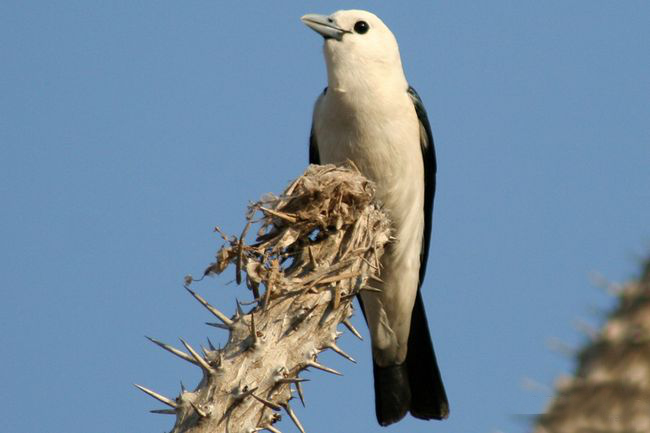
Identifying Van Dam's Vanga involves noting its robust build and distinctive hooked bill, which is particularly prominent. Adults exhibit a striking contrast between their dark gray upperparts and their lighter, often white, underparts. This plumage provides excellent camouflage against the light and shadow play of the forest canopy. Juveniles resemble adults but may possess slightly duller plumage.
Males and females show little sexual dimorphism, making it challenging to distinguish them in the field. However, close observation may reveal subtle differences in size, with males generally slightly larger. Similar species confusion might arise with other vangas, but the combination of the Van Dam's Vanga's unique bill and its specific habitat preferences aids in accurate identification.
In-flight, the Van Dam's Vanga's silhouette is characterized by its rounded wings and relatively short tail, which contribute to its agile maneuvering through dense foliage. When perched, the bird often adopts a horizontal posture, making it appear even more compact and robust.
Having trouble telling birds apart? Upload a photo to our bird identification tool for an instant species match.
Van Dam's Vanga Habitat and Range
Preferred Habitat
Van Dam's Vanga primarily inhabits dry deciduous forests, a habitat type that is rich in biodiversity yet threatened by human activity. These forests, prevalent in northwestern Madagascar, range in elevation from sea level to approximately 800 meters. Such regions include Ankarafantsika National Park, which provides not only food but also optimal nesting sites.
The bird shows a strong preference for mature, undisturbed forest areas where it can find ample insect prey and suitable conditions for breeding. Seasonal habitat shifts are minimal, though the vanga may move locally to exploit food resources. Unlike some bird species that adapt to urban environments, Van Dam's Vanga remains firmly rooted in its forest habitat, making it a key indicator of forest health.
Geographic Range
The Van Dam's Vanga's range is restricted to northwestern Madagascar, a region notable for its unique biodiversity. Breeding occurs within the boundaries of protected areas such as Ankarafantsika National Park, where forest conditions are ideal. The bird's range does not extend beyond Madagascar, marking it as endemic to the island.
Unlike migratory species that traverse vast distances, Van Dam's Vanga remains largely stationary, with its movements confined to local areas within its habitat in response to food availability. The bird is most densely populated in regions where forest conservation efforts are strongest, providing crucial insight into the impact of environmental degradation on endemic species.
Want to know which birds visit your area? Browse our backyard birds by location guides for region-specific species lists.
What Does the Van Dam's Vanga Eat?
Van Dam's Vanga primarily feeds on insects, which it deftly captures using its robust, hooked bill. This diet includes beetles, caterpillars, and other arthropods found within the forest litter and among tree bark. The bird employs a mix of foraging techniques, including gleaning from branches and probing into crevices, demonstrating its adaptability in securing prey.
Seasonal changes in diet occur as the availability of insects fluctuates, with the vanga occasionally consuming small vertebrates or fruits when insect populations decline. Foraging typically peaks in the early morning and late afternoon, aligning with periods of increased prey activity.
Van Dam's Vanga Behavior and Social Structure
Socially, Van Dam's Vanga is often observed in pairs or small family groups rather than large flocks. The bird exhibits territorial behavior, particularly during the breeding season, when pairs vigorously defend their nesting sites from intruders. Courtship displays involve a series of vocalizations and acrobatic flights, showcasing the bird's agility.
Despite its relatively solitary nature, the vanga does participate in mixed-species foraging flocks, particularly during the non-breeding season. These flocks provide increased foraging efficiency and protection from predators. Daily activity patterns show peaks during the cooler hours of the day, with periods of rest during the hottest midday hours.
Van Dam's Vanga Nesting and Reproduction
Van Dam's Vanga constructs its nest in the forks of trees, using materials such as twigs, leaves, and occasionally lichens. The nest is cup-shaped and well-camouflaged within the forest canopy. Preferred nesting locations are typically at moderate heights, offering protection from ground predators.
Clutch size generally consists of two to three eggs, which both parents incubate over a period of about 14 days. Once hatched, the chicks fledge approximately three weeks later. Parental roles are shared, with both males and females involved in feeding and protecting the young. The species typically raises one brood per year, with breeding closely tied to the availability of food resources.
Van Dam's Vanga Sounds and Vocalizations
The primary song of Van Dam's Vanga is a series of melodious whistles, often described as flute-like in quality. These notes vary in pitch and rhythm, contributing to the bird's vocal repertoire. Call notes are more abrupt and used in communication between mates or to signal alarm.
During the dawn chorus, the vanga's song is particularly prominent, adding to the symphony of forest sounds. Comparatively, its calls are less harsh than those of some sympatric species, making its vocalizations a key tool for identification in the field.
Interesting Facts About the Van Dam's Vanga
- 1Van Dam's Vanga is named after the Dutch ornithologist Cornelis van Dam, reflecting the bird's historical discovery.
- 2Despite its robust appearance, Van Dam's Vanga is agile, deftly navigating the forest in pursuit of insect prey.
- 3The bird's hooked bill, resembling that of a shrike, is highly specialized for its insectivorous diet.
- 4Van Dam's Vanga is one of the few species restricted to Madagascar's dry deciduous forests, highlighting its unique ecological niche.
- 5Studies show that Van Dam's Vanga contributes significantly to controlling insect populations within its habitat.
- 6The vanga plays an essential role in the forest ecosystem, participating in mixed-species foraging flocks outside the breeding season.
- 7Efforts to protect Van Dam's Vanga's habitat benefit numerous other species endemic to Madagascar, emphasizing its conservation importance.
Van Dam's Vanga Conservation Status
Van Dam's Vanga is currently listed as Near Threatened on the IUCN Red List, with its population trend showing a decline due to habitat loss and degradation. The primary threats include deforestation for agriculture, logging, and charcoal production, all of which reduce the available habitat for this forest-dependent species. Conservation efforts focus on habitat protection and restoration, particularly within protected areas such as Ankarafantsika National Park. Historical population changes have mirrored the island's fluctuating forest cover, underscoring the importance of sustainable land management practices to ensure the vanga's survival.
Other Vangidae Species


Birds Similar to the Van Dam's Vanga
These species are often confused with the Van Dam's Vanga due to similar appearance or overlapping range.

